Many English learners confuse so vs such because both words can add emphasis. They can make a sentence stronger, but they usually fit different sentence structures.
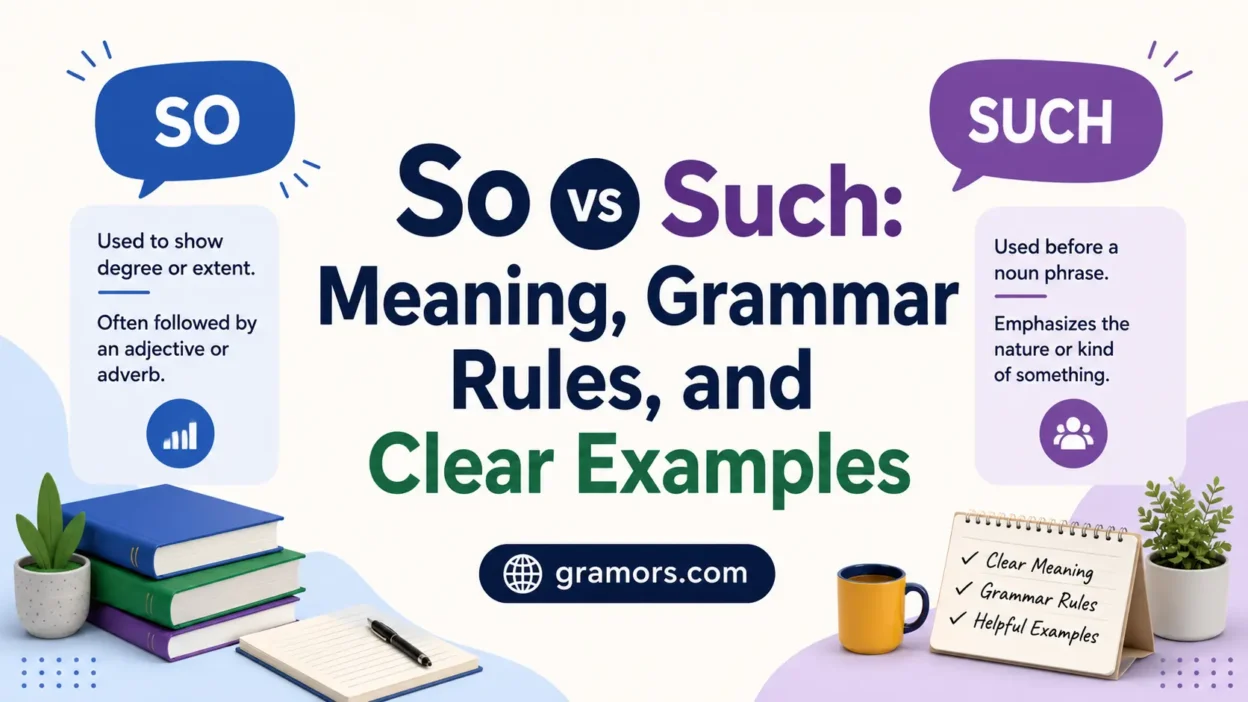
Use so before an adjective or adverb. Use such before a noun phrase.
Compare these examples:
“The room was so quiet.”
“It was such a quiet room.”
Both sentences describe a strong degree of quietness, but the grammar changes. This guide focuses on practical word choice, not every possible meaning of so or such.
Quick Answer
Use so before an adjective or adverb.
Examples: “so helpful,” “so quickly.”
Use such before a noun phrase.
Examples: “such a helpful guide,” “such useful advice.”
Use so with much, many, little, and few.
Example: “so many questions.”
Both so and such can show strong degree or result, but they need different structures.
Why People Confuse Them
People confuse so and such because both can intensify meaning. Both can also appear with that clauses.
Examples:
“She is so talented.”
“She is such a talented artist.”
The meaning is close, but the grammar is different. So comes before the adjective talented. Such comes before the noun phrase a talented artist.
Many sentences can be rewritten with either word, but the structure must change.
Example:
“The test was so hard that many students needed extra time.”
“It was such a hard test that many students needed extra time.”
Key Differences At A Glance
| Context | Best Choice | Why |
|---|---|---|
| Before an adjective | so | Use so to intensify a quality. |
| Before an adverb | so | Use so to intensify how an action happens. |
| Before a singular count noun phrase | such | Use such a/an + adjective + noun. |
| Before a plural noun phrase | such | Use such before plural noun groups. |
| Before an uncountable noun phrase | such | Use such before uncountable noun groups. |
| With much, many, little, few | so | Standard pattern is so much/many/little/few. |
| With result clauses | so or such | The choice depends on the structure before that. |
Meaning and Usage Difference
In this comparison, so works mainly as a degree adverb. It modifies qualities or actions.
Examples:
“The answer was so simple.”
“She drove so carefully.”
“We had so many questions.”
In these sentences, so strengthens an adjective, an adverb, or a quantity word.
Such works mainly before noun phrases. It modifies people, things, ideas, events, or noun groups.
Examples:
“It was such a simple answer.”
“She is such a careful driver.”
“They gave us such helpful advice.”
Here is the quick structure check:
• So + adjective: “so cold”
• So + adverb: “so carefully”
• Such + a/an + adjective + singular noun: “such a cold day”
• Such + adjective + plural noun: “such cold days”
• Such + adjective + uncountable noun: “such cold weather”
• So + much/many/little/few: “so much traffic”
Both words can also introduce a result with that.
Examples:
“The test was so hard that many students needed extra time.”
“It was such a hard test that many students needed extra time.”
Tone, Context, and Formality
Both so and such are standard and common in English. You can use them in casual speech, school writing, work messages, reviews, and formal writing.
So often sounds direct and conversational before adjectives and adverbs.
Example:
“That was so helpful.”
Such can sound slightly more polished or emphatic when it describes a full noun phrase.
Example:
“That was such a helpful explanation.”
This is not a strict formal rule. Both words can sound natural in many settings.
You may also see such in more formal patterns, such as:
“Such is life.”
“Such was the case.”
Those uses are correct, but they are not the main focus here.
Which One Should You Use?
Ask what comes right after the word.
If an adjective follows, use so.
Examples:
“so expensive”
“so useful”
“so cold”
If an adverb follows, use so.
Examples:
“so clearly”
“so quickly”
“so carefully”
If a noun phrase follows, use such.
Examples:
“such an expensive repair”
“such clear instructions”
“such a nice person”
If much, many, little, or few follows, use so.
Examples:
“so much work”
“so many repairs”
“so little time”
“so few options”
Also remember the article placement. Say such a nice day, not a such nice day.
When One Choice Sounds Wrong
Some patterns sound wrong in standard modern English.
Wrong: “It was so good movie.”
Correct: “It was such a good movie.”
Use such because a good movie is a noun phrase.
Wrong: “She speaks such clearly.”
Correct: “She speaks so clearly.”
Use so because clearly is an adverb.
Wrong: “There were such many people.”
Correct: “There were so many people.”
Use so with many.
Wrong: “He is a such nice person.”
Correct: “He is such a nice person.”
Put such before the article a or an.
Common Mistakes
Mistake: missing the article after such with a singular count noun.
Wrong: “It was such nice day.”
Correct: “It was such a nice day.”
Mistake: putting the article before such.
Wrong: “She is a such good teacher.”
Correct: “She is such a good teacher.”
Mistake: using so before an adjective plus noun.
Wrong: “He is so helpful person.”
Correct: “He is such a helpful person.”
Mistake: using such before an adverb.
Wrong: “She answered such fast.”
Correct: “She answered so fast.”
Mistake: using such with many, much, few, or little.
Wrong: “There were such many delays.”
Correct: “There were so many delays.”
Everyday Examples
“The meeting was so long.”
“That was such a long meeting.”
“You explained it so clearly.”
“That was such clear advice.”
“We had so much work today.”
“She is such a patient teacher.”
“The coffee was so hot.”
“It was such hot coffee that I had to wait.”
“This hotel is so clean.”
“This is such a clean hotel.”
“The flight was so expensive.”
“It was such an expensive flight.”
“You answered so quickly.”
“That was such a quick answer.”
“There were so few seats left.”
“We had such good seats at the game.”
Dictionary-Style Word Details
Verb
• So: Does not commonly function as a verb in standard modern English.
• Such: Does not commonly function as a verb in standard modern English.
For this comparison, treat both words as structure words, not action words.
Noun
• So: Not commonly used as a normal noun in this comparison. It can appear in fixed forms such as so-and-so, but that is not central here.
• Such: Can appear in dictionary treatment connected to expressions like as such, but in this comparison it usually works before or in place of a noun idea.
Synonyms
• So: Closest plain alternatives in intensifier use include very, really, extremely, and to that degree.
Example:
“The answer was so simple.”
“The answer was very simple.”
These do not replace every use of so.
• Such: Closest plain alternatives depend on structure. Possible rewrites include that kind of, that type of, so great, or very after changing the sentence.
Example:
“She is such a good speaker.”
“She is a very good speaker.”
No single synonym fits every use of such.
Example Sentences
• So:
“The answer was so simple.”
“She drove so carefully.”
“We had so many questions.”
“The room was so quiet that I could hear the clock.”
• Such:
“It was such a simple answer.”
“She is such a careful driver.”
“They gave us such helpful advice.”
“It was such a quiet room that I could hear the clock.”
Word History
• So: Major dictionaries trace so back to old English and Germanic roots. Today, its practical use in this comparison is as an intensifier before adjectives, adverbs, and certain quantity words.
• Such: Major dictionaries recognize long-standing standard uses of such for kind, type, degree, and similarity. In this guide, the useful point is simple: such usually works with noun phrases.
Phrases Containing
• So:
so much
so many
so far
if so
so what
so do I
so…that
so as to
• Such:
such as
as such
such a/an
such…that
no such thing
such is life
These phrases do not all follow the same rule, but they show how common both words are in everyday English.
FAQs
What is the difference between so and such?
Use so before an adjective or adverb. Use such before a noun phrase.
Example:
“The movie was so funny.”
“It was such a funny movie.”
Is it so good movie or such a good movie?
The correct standard phrase is such a good movie.
Wrong: “It was so good movie.”
Correct: “It was such a good movie.”
You can also say: “The movie was so good.”
Can I use so before a noun?
Usually not in this comparison. Use such before a noun phrase.
Wrong: “She is so kind person.”
Correct: “She is such a kind person.”
Can I use such before an adjective?
Use such before an adjective only when that adjective is part of a noun phrase.
Correct: “such a nice day.”
Not standard: “The day was such nice.”
Correct: “The day was so nice.”
Why do we say so many but not such many?
Because standard English uses so with many, much, few, and little.
Correct: “so many people.”
Avoid: “such many people.”
Are so…that and such…that both correct?
Yes, both are correct, but they use different structures.
Example:
“The lesson was so easy that everyone understood it.”
“It was such an easy lesson that everyone understood it.”
Conclusion
The main rule is easy: use so before an adjective or adverb, and use such before a noun phrase.
Also use so with much, many, little, and few.
Examples:
“so useful”
“such useful advice”
“so many useful tips”
When choosing between so vs such, check the word that comes next. That simple step will usually give you the right answer.