Many writers confuse such as vs like because both can appear before nouns and both can introduce examples. They are both standard, but they do not always do the same job.
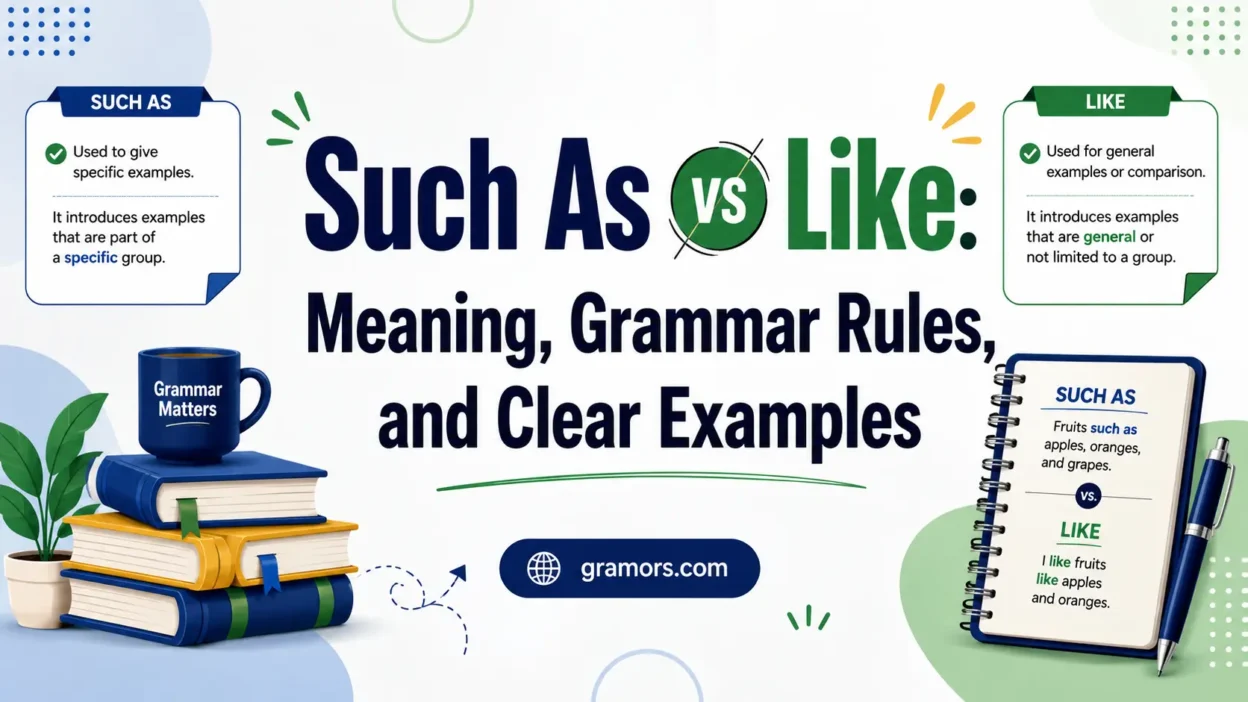
Such as usually introduces real examples that belong to a group. Like usually shows similarity or comparison, but it can also introduce examples in everyday use.
Compare these sentences:
“Topics such as grammar and spelling can help writers improve.”
“A site like Grammarly checks grammar and spelling.”
The first sentence lists included examples of topics. The second compares one site to another type of site.
Quick Answer
Use such as when you mean “for example” or “including.”
Example: “Foods such as rice and beans are affordable.”
Use like when you mean “similar to.”
Example: “The blanket has a texture like velvet.”
In casual English, like can also introduce examples. However, such as is clearer when precision matters.
Why People Confuse Them
People confuse such as and like because both can come before nouns or noun phrases.
Examples:
“Cities like Chicago have busy downtowns.”
“Cities such as Chicago have busy downtowns.”
Both sentences can be understood as giving an example. In casual writing and speech, like often works this way.
Still, the words are not always equal. Such as makes the example-list meaning clearer. Like can suggest comparison instead of inclusion.
For example, “a writer like Maya Angelou” may mean a writer similar to Maya Angelou. “Writers such as Maya Angelou” more clearly includes her as an example of the group.
Key Differences At A Glance
| Context | Best Choice | Why |
| Listing actual members of a group | such as | It clearly means “for example” or “including.” |
| Showing resemblance | like | It means “similar to.” |
| Casual example lists | like | Common in everyday speech and informal writing. |
| Formal or polished writing | such as | It sounds clearer and more exact for examples. |
| Similes and comparisons | like | It fits phrases such as “like an angel.” |
| After a comma in a nonessential example list | such as | The comma depends on whether the example list is extra information. |
Meaning and Usage Difference
Such as means for example or including examples of a category.
Examples:
“Outdoor hobbies, such as hiking and kayaking, can be affordable.”
“Many pets, such as cats and dogs, need regular care.”
“Documents such as passports and licenses are required.”
In these sentences, the items after such as are real examples included in the larger group.
Like often means similar to or in the manner of.
Examples:
“The clouds looked like cotton.”
“She runs like a pro.”
“This jacket feels like leather.”
In these sentences, like compares one thing to another.
However, like can also introduce examples in everyday English.
Example:
“Try a hobby like hiking or kayaking.”
That sentence is natural and common. If you want a more precise or polished version, write:
“Try a hobby such as hiking or kayaking.”
Compact comparison:
• Such as: clear included examples
• Like: similarity, comparison, or casual examples
• Such as: “tools such as spell checkers”
• Like: “a tool like a spell checker”
The meaning can change with context, so choose the word that matches your goal.
Tone, Context, and Formality
Such as sounds clearer, more formal, and more polished when you are listing examples.
Academic or business style:
“Digital tools such as shared calendars and project boards can improve team planning.”
School writing:
“Writers often use figures of speech such as similes and metaphors.”
Like sounds natural, conversational, and sometimes less exact.
Casual:
“I enjoy outdoor activities like hiking and kayaking.”
Texting:
“Bring something easy, like chips or soda.”
This is a style and clarity difference, not a strict grammar ban. Like is not automatically wrong before examples. Still, such as is usually better when exact inclusion matters.
Which One Should You Use?
Choose such as when the listed items are actual examples of a larger category.
Examples:
“Use apps such as Google Docs and Notion for writing notes.”
“Writers such as Toni Morrison and James Baldwin shaped American literature.”
“Fruits such as apples and oranges are easy to pack.”
Choose like when you are comparing one thing to another.
Examples:
“An app like Google Docs can help with shared writing.”
“She writes like a journalist.”
“The floor felt like ice.”
Choose such as in formal writing when either word could work and you want the example-list meaning to be clear.
Casual:
“Cities like Chicago and Boston have strong transit systems.”
More precise:
“Cities such as Chicago and Boston have strong transit systems.”
Context can change meaning. Like may compare. Such as usually includes.
When One Choice Sounds Wrong
Such as sounds wrong in pure comparison.
Wrong:
“The baby sleeps such as an angel.”
Correct:
“The baby sleeps like an angel.”
The sentence is a comparison, not a list of examples.
Like may sound imprecise when the writer means exact included examples.
Weak:
“Documents like passports and licenses are required.”
Clearer:
“Documents such as passports and licenses are required.”
The clearer version tells readers that passports and licenses are examples of required documents.
Do not mark every casual like example list as wrong. In everyday speech, “places like Target and Walmart” sounds normal. In formal writing, “places such as Target and Walmart” is often clearer.
Common Mistakes
Mistake: using like when exact inclusion matters.
Less precise:
“Medical records like test results and prescriptions should be saved.”
Clearer:
“Medical records such as test results and prescriptions should be saved.”
Mistake: using such as for a simile.
Wrong:
“He runs such as a pro.”
Correct:
“He runs like a pro.”
Mistake: adding a comma after such as for no reason.
Wrong:
“Bring snacks such as, apples and crackers.”
Correct:
“Bring snacks such as apples and crackers.”
Mistake: using as alone for examples.
Wrong:
“Bring fruits as apples and oranges.”
Correct:
“Bring fruits such as apples and oranges.”
Mistake: using commas without checking whether the example list is essential.
No comma when the examples are essential:
“Documents such as passports and licenses are accepted.”
Commas when the examples are extra information:
“Valid IDs, such as passports and licenses, are accepted.”
Everyday Examples
“Classes such as math and science require regular practice.”
“A class like biology can include lab work.”
“Work tools such as Slack and shared calendars help teams stay organized.”
“A tool like a shared calendar can prevent missed meetings.”
“Foods such as rice, eggs, and beans are easy to cook.”
“This sauce tastes like garlic.”
“Travel documents such as passports and visas should be checked early.”
“A hotel like this usually costs more downtown.”
“Sports such as basketball and soccer are popular at many schools.”
“He throws like a baseball player.”
“Stores such as Target and Costco sell household basics.”
“This blanket feels like wool.”
“Casual apps like TikTok change quickly.”
“Tech products such as laptops and tablets need regular updates.”
These examples show the practical difference. Such as lists examples. Like often compares, though it can introduce casual examples too.
Dictionary-Style Word Details
Verb
• Such as: Does not commonly function as a verb. It is a phrase built from such and as.
• Like: Fully applies as a verb. Like can mean to enjoy, prefer, approve of, or want.
Example:
“I like this idea.”
That verb use is separate from comparison like.
Noun
• Such as: Does not commonly function as a noun as a whole phrase. Such can appear in noun-like or pronoun uses, but such as is not normally taught as a noun.
• Like: Fully applies as a noun. Like can mean a preference, a similar person or thing, or an approval action.
Examples:
“My likes and dislikes changed.”
“She has never met his like.”
“The post got several likes.”
This article focuses on comparison and example-list use, not social-media meanings.
Synonyms
• Such as: Closest plain alternatives include for example, including, and for instance.
Example:
“Pets such as cats and dogs need care.”
“Pets, for example cats and dogs, need care.”
These alternatives may require punctuation or sentence changes.
• Like: For comparison, closest alternatives include similar to, resembling, and in the same way as.
Example:
“The fabric feels like silk.”
“The fabric feels similar to silk.”
For casual examples, such as may sometimes replace like.
Example:
“Try meals like soup or pasta.”
“Try meals such as soup or pasta.”
Example Sentences
• Such as:
“Many pets, such as cats and dogs, need regular care.”
“School subjects such as history and English involve a lot of reading.”
“Emergency items such as water and flashlights should be easy to reach.”
• Like:
“The blanket feels like wool.”
“She sings like a professional.”
“Try simple meals like soup or pasta.”
“A phone like this needs a strong case.”
The first two like examples show comparison. The third shows casual example-list use.
Word History
• Such as: This phrase comes from broader uses of such and as. In modern writing, the useful point is that such as introduces examples.
• Like: Like has many long-established uses, including verb, noun, comparison, and connector uses. For this guide, the key meaning is similarity, with a common everyday use for examples.
Word history is less important here than sentence meaning and clarity.
Phrases Containing
• Such as:
such as
as such
such as it is
such that
such a/an
These phrases do not all mean the same thing. For example, such as introduces examples, while as such means “in that role or sense.”
• Like:
look like
feel like
sound like
would like
like this
people like us
nothing like
These phrases show different uses of like. Some show comparison, while would like means “want.”
FAQs
What is the difference between such as and like?
Such as introduces real examples. Like usually shows similarity or comparison, but it can also introduce examples in casual English.
Example:
“Tools such as calendars and reminders help.”
“A tool like a calendar can help.”
Is like wrong before examples?
No. Like is common before examples in everyday English.
Example:
“Try snacks like fruit or crackers.”
For formal writing, such as is often clearer.
Is such as more formal than like?
Usually, yes. Such as sounds more polished when listing examples.
Example:
“Documents such as passports and licenses are accepted.”
Do I need a comma before such as?
Use commas when the example list is extra information.
Example:
“Valid IDs, such as passports and licenses, are accepted.”
Do not use commas when the examples are essential.
Example:
“Documents such as passports and licenses are accepted.”
Should I write such as or like in formal writing?
Use such as when you are listing examples in formal writing.
Example:
“Programs such as tutoring and mentoring can support students.”
Use like when you are making a comparison.
Example:
“A program like this needs clear goals.”
Can like mean such as?
Yes, in everyday use, like can introduce examples.
Example:
“Bring supplies like pens and notebooks.”
A more formal version is:
“Bring supplies such as pens and notebooks.”
Is such as always better than like?
No. Such as is better for clear example lists, but like is better for comparison.
Correct:
“She sings like a pro.”
Not:
“She sings such as a pro.”
Conclusion
Use such as for clear included examples. Use like for similarity, comparison, and casual examples.
Final pair:
“Tools such as grammar checkers and dictionaries can help writers.”
“A tool like a grammar checker can help writers.”
For such as vs like, let context guide the choice. If you mean “including,” choose such as. If you mean “similar to,” choose like.