Other and another can both describe something additional, different, or alternative. However, they do not fit the same noun structures.
Compare:
“Could I have another cup?”
“Do you have other sizes?”
“We need other information.”
The correct choice depends on whether the noun is singular, plural, countable, uncountable, specific, or understood from context. This guide explains the distinction through practical other vs another examples in modern American English.
Quick Answer
Use another for one additional or different nonspecific singular countable item.
Use other before plural countable nouns and uncountable nouns. Before a singular countable noun, other normally needs another determiner.
- another idea
- other ideas
- other advice
- the other idea
- my other bag
Another can also introduce a numbered amount: “another three weeks.”
Why People Confuse Them
Both terms contain other, and both can communicate an additional or different choice.
“I need another.”
“I need other ones.”
“Is there another option?”
“Are there other options?”
Another developed from the older combination an + other, but it has been written as one word for centuries. The words are not spelling variants. Their meanings overlap, while their grammar differs.
Key Differences At A Glance
| Context | Best Choice | Why |
|---|---|---|
| One nonspecific singular item | another | It means one more or a different one. |
| Multiple items | other | It precedes plural countable nouns. |
| An uncountable noun | other | It works with nouns such as advice or information. |
| One identified singular item | determiner + other | Use “the other,” “my other,” or “any other.” |
| One noun is understood | another | It can stand alone as a pronoun. |
| Multiple nouns are understood | others | It replaces multiple people or things. |
| An added numbered amount | another | Use “another two days.” |
Compact comparison:
- Another employee: one additional employee
- Other employees: multiple additional or different employees
- Other work: additional or different work
- The other employee: the known remaining or contrasting employee
- I’ll ask another: I’ll ask another person
Meaning and Usage Difference
Other
Other can mean additional, alternative, different, or remaining.
Use it before plural countable nouns:
“We interviewed other applicants.”
“Other customers reported the same issue.”
Use it before uncountable nouns:
“Do you have other experience?”
“We need other evidence.”
Before a singular countable noun, it normally follows a determiner:
“No other applicant qualified.”
“My other key is in the drawer.”
“Do you have any other question?”
When the noun is omitted, others commonly refers to multiple people or things:
“Some agreed; others objected.”
Another
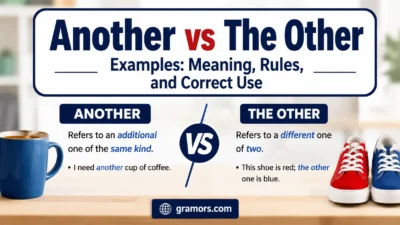
Another means one more, an additional one, or a different one. It normally introduces a nonspecific singular countable noun:
“We interviewed another applicant.”
“She ordered another drink.”
It can stand alone when the noun is understood:
“This charger is faulty. Please send another.”
Another may also introduce a number plus a plural unit:
“The project needs another two weeks.”
This is a quantity construction. It does not make “another weeks” correct.
Tone, Context, and Formality
Both words are neutral and standard. They appear naturally in conversation, workplace communication, academic writing, instructions, and news reporting.
The choice normally communicates number and specificity rather than politeness or formality.
“Could I have another glass of water?” requests one more glass.
“Other departments reported the problem” refers to multiple departments.
“The other report” identifies a known remaining or contrasting report. “Another report” means one additional or different nonspecific report.
Which One Should You Use?
Ask what kind of noun follows.
For one nonspecific singular countable item, use another:
“another meeting”
“another solution”
For a specific or restricted singular item, use a determiner plus other:
“our other meeting”
“the other solution”
For plural nouns, use other:
“other meetings”
“other solutions”
For uncountable nouns, use other:
“other equipment”
“other information”
When the noun is omitted, use another for one and others for more than one:
“I scheduled another.”
“Some devices worked; others failed.”
For an added amount, another may precede a number:
“We need another five minutes.”
When One Choice Sounds Wrong
Incorrect: “I need another documents.”
Correct: “I need other documents.”
Documents is plural.
Incorrect: “She gave me another advice.”
Correct: “She gave me other advice.”
Also correct: “She gave me another piece of advice.”
Advice is uncountable, but piece is countable.
Incorrect: “Can I speak to other manager?”
Correct: “Can I speak to another manager?”
Specific alternative: “Can I speak to the other manager?”
Incorrect: “Others students arrived late.”
Correct: “Other students arrived late.”
Use other before a noun. Use others without a following noun.
Incorrect: “I need an other customer.”
Correct: “I need another customer.”
Another is the standard single-word form.
Common Mistakes
Using another before an ordinary plural noun
Incorrect: “another books”
Correct: “other books”
Using another before an uncountable noun
Incorrect: “another information”
Correct: “other information”
Also correct: “another piece of information”
Using bare other before a singular countable noun
Incorrect: “other option”
Correct: “another option”
Also correct: “the other option”
Using others before a noun
Incorrect: “others people”
Correct: “other people”
Without the noun: “Others arrived later.”
Confusing another with the other
“Another chair” means one more or a different nonspecific chair.
“The other chair” means the known remaining or contrasting chair.
Treating the singular rule as absolute
Correct: “another two days”
Correct: “another ten dollars”
Here, another applies to the complete amount.
Everyday Examples
Food and Shopping
“I’d like another sandwich.”
“Do you sell other flavors?”
“Let’s try another store.”
“Other customers recommended this model.”
Work and School
“She asked another question.”
“We need other information before deciding.”
“We hired another designer.”
“We hired other designers.”
The first adds one designer. The second refers to multiple designers.
Travel and Time
“Can we take another route?”
“Other buses stop near the station.”
“The update needs another ten minutes.”
“We stayed for another three days.”
Technology and Customer Service
“This charger is faulty; please send another.”
“Do you have other compatible chargers?”
“My other phone is at home.”
“The other entrance is temporarily closed.”
Dictionary-Style Word Details
Verb
Other: Other can be used as a transitive verb meaning to treat someone as alien, outside, or fundamentally different: “The policy risks othering people who do not fit the dominant category.” This specialized use is separate from the everyday comparison.
Another: Another is not ordinarily used as a verb.
Noun
Other: It can refer to a different, additional, remaining, or contrasting person or thing. Others commonly means other people or things.
Another: It normally stands alone as a pronoun rather than an ordinary noun: “One solution failed, but another worked.”
Synonyms
Other: Closest alternatives include additional, different, alternative, remaining, and separate.
Another: Closest alternatives include one more, an additional one, a different one, a further, and an extra.
No single alternative fits every structure.
Example Sentences
Other: “Other employees joined the meeting.” “We need other evidence.” “My other key is in the drawer.” “Some agreed; others objected.”
Another: “She ordered another drink.” “Choose another route.” “Give me another chance.” “The repair will take another three days.”
Word History
Other: Other came through Middle English from Old English ōther and has long served several grammatical functions.
Another: Another developed from Middle English an + other and became an established single word.
Phrases Containing
Other: the other day, every other day, on the other hand, in other words, other than, each other, one or the other, some other time.
Another: one way or another, one after another, another time, another day, another one, one thing after another.
FAQs
What Is the Main Difference Between Other and Another?
Use another for one nonspecific singular countable item. Use other with plural or uncountable nouns.
“Another idea” versus “other ideas.”
Is Another Singular or Plural?
Another normally introduces a singular countable noun:
“another employee”
However, it can introduce a numbered quantity: “another four employees.”
Can Another Be Followed by a Plural Noun?
Only in a numbered amount construction:
“We need another two days.”
Do not write “another days” without a number.
Can Other Be Used With a Singular Noun?
Yes, when another determiner appears:
“the other book”
“my other bag”
“any other question”
Is Another Information Correct?
No. Information is uncountable. Use “other information” or “another piece of information.”
Is Another People Correct?
No. People is plural. Use “other people” or a countable singular phrase such as “another person.”
What Is the Difference Between Another and the Other?
Another means one more or a different nonspecific item. The other identifies the known remaining or contrasting item.
“Choose another seat.”
“Choose the other seat.”
Can Another and Other Stand Alone Without a Noun?
Another can stand alone for one item: “I’ll take another.”
For multiple items, use others: “Some stayed; others left.”
Conclusion
Choose another for one additional or different nonspecific singular countable item. Choose other for plural countable nouns and uncountable nouns. Add a determiner before other when it modifies a singular countable noun.
Remember:
- one nonspecific item → another option
- multiple or uncountable items → other options or other advice
- known singular item → the other option
- added numbered amount → another two options
The terms overlap in meaning, but their noun structures determine the natural choice.