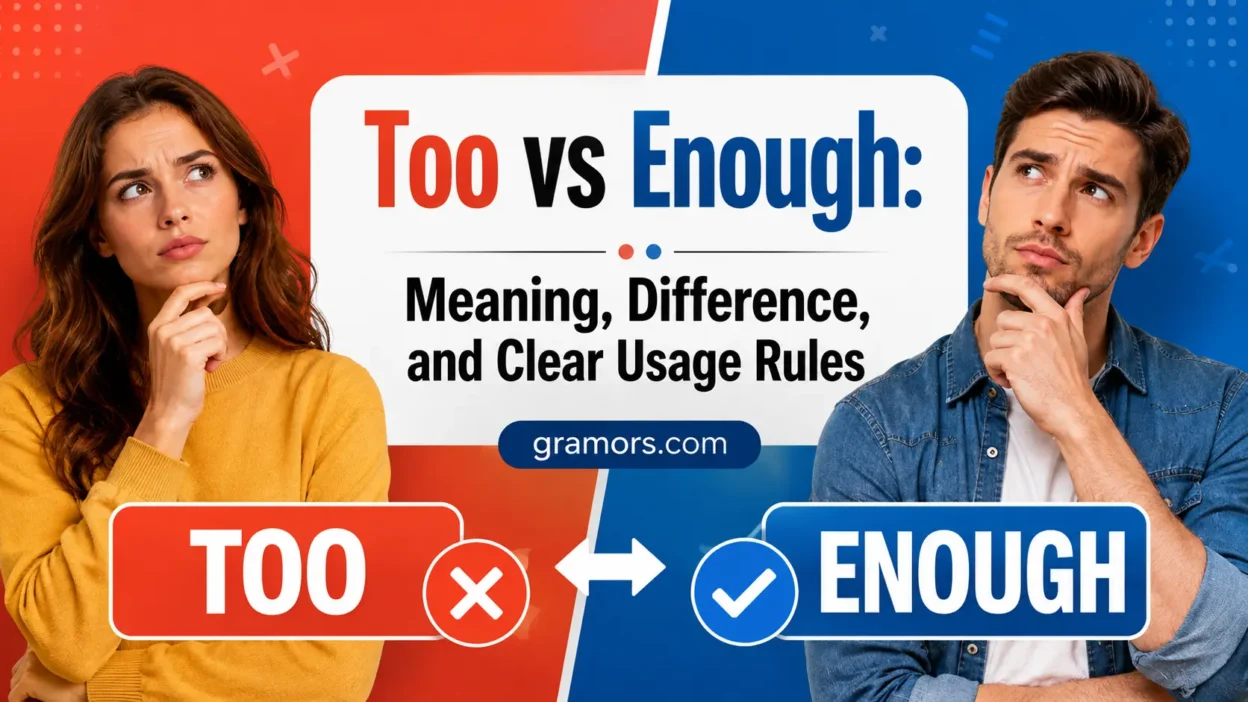
Too and enough both describe degree, quantity, or whether something meets a requirement, but they look at that requirement from different directions.
Too normally means that something has gone beyond a useful, acceptable, wanted, or possible limit:
- The coffee is too hot to drink.
Enough means that something reaches the degree or amount required for a purpose:
- The coffee is cool enough to drink.
Word order is also important. We say too hot, but hot enough. With nouns, we normally say enough money, while excessive amounts require patterns such as too much money or too many people.
2. Quick Answer
- Use too when a degree goes beyond an acceptable or useful limit:
- too expensive
- too fast
- too difficult
- Use enough when the necessary degree or quantity has been reached:
- cheap enough
- fast enough
- enough money
- Use not enough when something is insufficient:
- not enough time
- not strong enough
The main word-order patterns are:
- too + adjective/adverb
- adjective/adverb + enough
- enough + noun
3. Why People Confuse Them
Too and enough both answer questions about limits and suitability.
Compare:
- She is too tired to work.
- She is rested enough to work.
Both sentences compare her condition with the level required for working. However, they describe opposite relationships to that requirement.
Too shows that a relevant limit has been exceeded:
- He is too weak to lift it.
Enough shows that the required level has been reached:
- He is strong enough to lift it.
Not enough shows that the required level has not been reached:
- He is not strong enough to lift it.
Their similar connection to thresholds can hide an important structural difference: too normally comes before an adjective or adverb, while enough normally follows it.
4. Key Differences At A Glance
| Feature | Too | Enough |
|---|---|---|
| Core meaning | Beyond a relevant limit | Sufficient for a requirement |
| Typical implication | Excess | Adequacy/sufficiency |
| With adjective | too hot | hot enough |
| With adverb | too slowly | quickly enough |
| With uncountable noun | too much time | enough time |
| With plural count noun | too many people | enough people |
| Insufficient form | Usually needs another structure | not enough |
| With infinitive | too tired to work | rested enough to work |
| Context | Best Choice | Why |
|---|---|---|
| Excessive temperature | too | A limit has been crossed. |
| Sufficient temperature | enough | The needed degree has been reached. |
| Excessive amount | too much | The quantity is beyond what is wanted. |
| Excessive number | too many | The count is excessive. |
| Sufficient amount | enough | The quantity meets the requirement. |
| Insufficient amount | not enough | The quantity falls short. |
Too normally cannot directly modify an ordinary noun. Instead, use forms such as too much, too many, too few, or too little.
5. Meaning and Usage Difference
Too means beyond a limit
Too normally indicates that a degree is greater than is suitable, useful, wanted, safe, or possible.
- The box is too heavy to lift.
- She is driving too quickly.
- The apartment is too small for us.
The exact threshold depends on the situation.
A box might be too heavy for one person but manageable for someone else. An apartment might be too small for a family but large enough for one person.
- Enough means the requirement is met
- Enough means that the necessary degree or quantity has been reached.
- The box is light enough to lift.
- She spoke clearly enough.
- We have enough chairs.
- Enough does not mean an exact quantity. It means sufficient relative to a particular need.
Not enough means below the requirement
Use not enough when something falls short:
- The room is not big enough.
- We do not have enough time.
- She did not speak loudly enough.
Too + adjective or adverb
Too comes before adjectives and adverbs:
- too cold
- too expensive
- too slowly
- too quietly
Examples:
- The soup is too salty.
- You are driving too fast.
Adjective or adverb + enough
Enough follows the adjective or adverb:
- warm enough
- strong enough
- quickly enough
- carefully enough
Examples:
- The water is warm enough to swim in.
- She explained it clearly enough for everyone to understand.
Enough + noun
Enough normally comes before a noun:
- enough money
- enough food
- enough chairs
- enough information
Examples:
- We have enough food.
- Do you have enough money?
Too much and too many
Use too much with uncountable nouns:
- too much time
- too much traffic
- too much water
Use too many with plural countable nouns:
- too many people
- too many chairs
- too many emails
In the main comparison, too functions as an adverb. Enough can receive somewhat different grammatical labels depending on the structure and dictionary framework, including adverbial, determiner-like, adjective-like, or pronoun uses.
6. Tone, Context, and Formality
Too and enough are both standard, common words in everyday and formal English. The choice depends primarily on grammar and meaning rather than formality.
Too often sounds evaluative because it tells us that a limit has been exceeded:
- The proposal is too expensive.
Enough may sound neutral:
- The proposal is detailed enough.
But enough can also express frustration:
- That’s enough for today.
- I’ve had enough.
It can also sound merely adequate rather than enthusiastic:
- The design is good enough.
Too has a separate common meaning of also:
- I want one too.
That meaning is unrelated to the excess-versus-sufficiency comparison.
7. Which One Should You Use?
Ask one question first:
Has the relevant requirement been met?
- If yes, enough is often appropriate:
- We have enough money to buy it.
- She is old enough to drive.
- If the requirement has not been met because something is insufficient, use not enough:
- We don’t have enough money.
- She is not old enough to drive.
- If a limit has been exceeded, use too:
- It is too expensive to buy.
- He is too young to drive.
Then check the sentence structure.
With adjectives or adverbs:
- too + adjective/adverb
- adjective/adverb + enough
With nouns:
- enough + noun
- too much/many + noun
Rewriting from too to enough often requires an opposite adjective:
- too young → not old enough
- too weak → not strong enough
So do not substitute the words blindly.
8. When One Choice Sounds Wrong
Enough normally follows an adjective:
- Incorrect: She is enough old to drive.
- Correct: She is old enough to drive.
Too cannot normally appear directly before an ordinary noun:
- Incorrect: We have too chairs.
- Correct: We have too many chairs.
With uncountable nouns:
- Incorrect: We have too money.
- Correct: We have too much money.
Enough usually comes before a noun:
- Natural: We have enough money.
- Not the normal neutral modern pattern: We have money enough.
The standard everyday patterns are:
- tall enough
- enough money
- too many people
- too much water
9. Common Mistakes
Putting enough before an adjective
- Incorrect: enough fast
- Correct: fast enough
Enough follows the adjective or adverb when it refers to degree.
Putting enough after a noun
- Less natural in the ordinary basic pattern: time enough
- Natural: enough time
Using too directly before a noun
- Incorrect: too people
- Correct: too many people
Confusing very with too
Compare:
- very expensive = expensive to a high degree
- too expensive = beyond an acceptable price
Too includes the idea of a limit.
Forgetting not enough
If the problem is insufficiency, use not enough:
- The rope is not strong enough.
Do not use enough alone when the requirement has not been met.
Confusing too and to
These are separate words:
- too expensive
- to buy
Example:
- It is too expensive to buy.
10. Everyday Examples
Money
- I don’t have enough money.
- This laptop is too expensive for me.
- We have enough cash for lunch.
Time
- I don’t have enough time.
- This meeting is too long.
- We arrived early enough to get good seats.
Food
- The soup is too salty.
- We have enough food for everyone.
- There is too much sugar in this drink.
Work
- I have too much work today.
- We have enough people to finish the project.
- The deadline is too short.
Temperature
- The coffee is too hot to drink.
- The water is warm enough to swim in.
- The room isn’t cool enough.
Age
- She is old enough to drive.
- He is too young to rent the car.
- She is not old enough to apply yet.
Size
- The room isn’t big enough.
- The table is too large for this kitchen.
- We have enough space for another chair.
Speed
- You’re driving too fast.
- He didn’t react quickly enough.
- She drove slowly enough to stay safe.
Sleep
- I didn’t sleep enough last night.
- I’m too tired to drive.
- Seven hours was enough for me.
Space and crowds
- There are too many people inside.
- We don’t have enough seats.
- This hall is large enough for the event.
11. Dictionary-Style Word Details
Verb
Too
Too does not normally function as a verb.
Enough
Enough does not normally function as a verb either.
Neither word needs an invented verb meaning for this comparison.
Noun
Too
Too does not have an ordinary noun role in the target usage.
Enough
Enough can appear independently:
- I’ve had enough.
Different grammatical frameworks may label this kind of use differently. It is commonly analyzed as a pronoun, though some learner-oriented classifications may treat certain uses as nominal.
The important practical point is that enough can stand without a following noun when the quantity is understood.
Synonyms
For excessive too:
- overly
- excessively
For enough, depending on grammar:
- sufficient
- adequate
- sufficiently
- adequately
Examples:
- The room is sufficiently large.
- We have adequate time.
These alternatives may require sentence restructuring.
Example Sentences
Too
- It’s too cold.
- You’re speaking too quickly.
- We bought too much food.
- I want to go too.
The final sentence uses the separate meaning “also.”
Enough
- We have enough food.
- It’s warm enough.
- She worked quickly enough.
- I’ve had enough.
Word History
Too comes through Middle English from Old English tō and is historically connected with to. Its meanings and spelling became differentiated over time.
Enough comes from Old English genōg, with the idea of sufficiency having deep roots in English.
Modern usage and word order remain more useful than etymology when choosing between the two.
Phrases Containing
Too
- too much: excessive amount
- too many: excessive number
- too far: beyond an acceptable distance
- too late: beyond the useful time
- too good to be true: so good that it seems unbelievable
- me too / you too: also
Enough
- good enough: sufficiently good
- long enough: sufficiently long
- more than enough: greater than the required amount
- enough is enough: no more will be tolerated
- fair enough: reasonable or acceptable
- have had enough: no longer willing to tolerate more
Some are fixed expressions, while others are productive grammatical combinations.
12. FAQs
What is the main difference between too and enough?
Too usually means that a limit has been exceeded. Enough means that the required degree or amount has been reached.
- too heavy
- light enough
Is it “enough good” or “good enough”?
Use good enough.
Enough normally follows an adjective:
- This answer is good enough.
Do we say “too money” or “too much money”?
Use too much money.
Too normally needs much with an uncountable noun:
- We spent too much money.
Can enough come before a noun?
Yes.
- enough time
- enough food
- enough chairs
This is the normal pattern.
Can too mean also?
Yes.
- I want to come too.
That is a separate meaning from excessive too.
Is “not enough” the same as “too little”?
They can express related ideas of insufficiency:
- We don’t have enough time.
- We have too little time.
However, their structures and emphasis are not identical in every context.
Can both words be used before an infinitive?
Yes, as part of different structures:
- too tired to work
- rested enough to work
Too comes before the adjective; enough follows it.
Is enough always positive?
No.
Enough simply indicates sufficiency, and context can be neutral or negative:
- That’s enough.
- I’ve had enough.
It may express frustration, limitation, or simple adequacy.
13. Conclusion
Use too when a degree or quantity goes beyond a relevant limit. Use enough when the required degree or quantity has been reached, and use not enough when it falls short.
Remember the key structures:
- too + adjective/adverb
- adjective/adverb + enough
- enough + noun
- too much/many + noun
The clearest contrast is:
- The bag is too heavy for me to carry.
- The bag is light enough for me to carry.
Think about the requirement first, then choose the structure that matches the meaning.