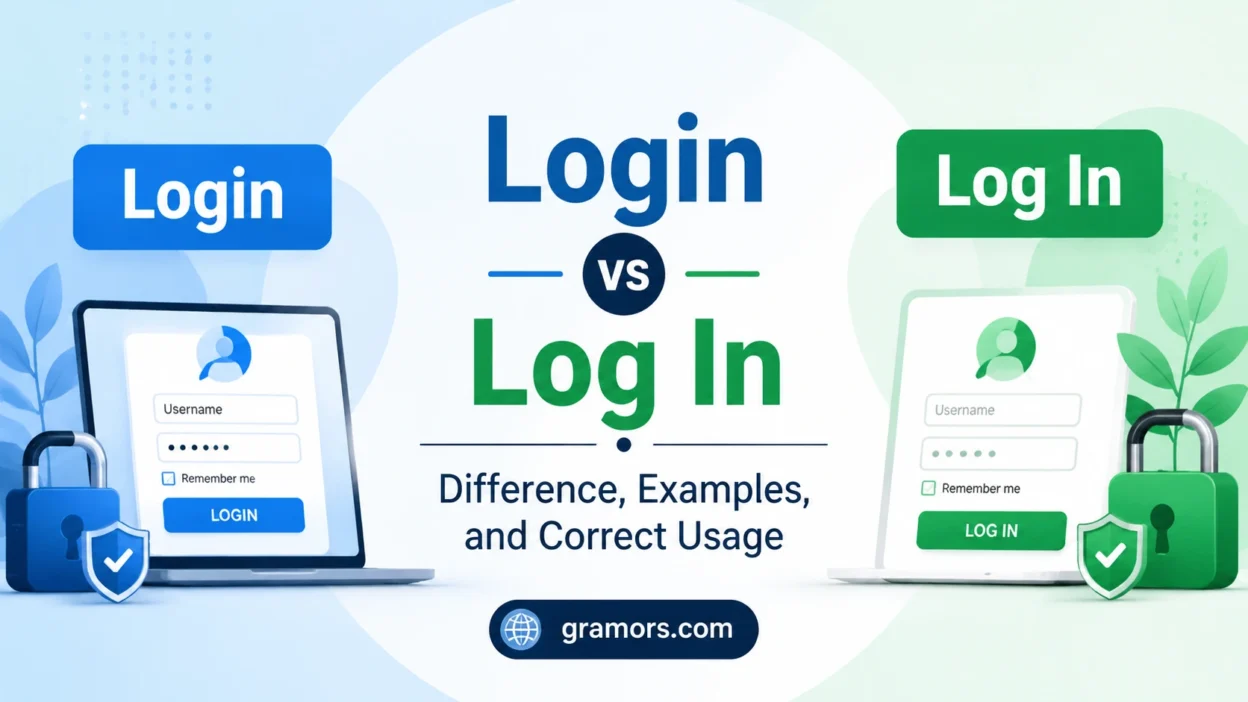
The confusion between login vs log in is common in digital English. Both appear frequently in websites, apps, and instructional texts, but they serve different grammatical roles.
Example:
- Click login to continue.
- Please log in with your credentials.
Knowing the difference ensures clear, professional writing and avoids mistakes in user interfaces, emails, and documentation.
Quick Answer
- Log in is a verb phrase. It describes the action of signing into a system.
- Login is a noun or adjective, referring to the credentials, process, or page itself.
Examples:
- Action: “Please log in to view your account.”
- Noun: “Enter your login details below.”
Most UI labels use Login as a noun. In text, follow standard grammar: verb = log in; noun/adjective = login.
Why People Confuse Them
Confusion arises because:
- They sound almost identical.
- Many apps and websites label buttons as Login even when they instruct an action.
- Developers often mix forms for brevity in interfaces.
Example: A button reading “Login Here” encourages action but technically mixes noun form with a verb context.
The key is distinguishing casual tech usage from proper grammar.
Key Differences At A Glance
| Form | Function | Typical Use |
|---|---|---|
| log in | Verb phrase | Describes the act of signing into a system |
| login | Noun / Adjective | Refers to the credentials, page, or process |
Compact view:
- Log in answers “What action should I take?”
- Login answers “Which noun or label describes the action or page?”
- Exceptions: hyphenation like log-in page is acceptable for adjective use.
Meaning and Usage Difference
Log in functions as a verb. It requires an object (the system or platform).
- “Please log in to your account.”
- “You must log in before accessing reports.”
Login functions as a noun or adjective.
- Noun: “Enter your login.”
- Adjective: “Visit the login page.”
A nuance: log into can sometimes appear, but the standard formal usage remains log in to.
- Correct: “Log in to your dashboard.”
- Avoid: “Log into the dashboard” in formal writing, though it appears colloquially.
Tone, Context, and Formality
- Log in is standard in instructional text, professional documentation, and emails.
- Login is common in UI text, casual guides, and informal messaging.
Examples:
- Professional: “Please log in using your secure credentials.”
- Casual interface: “Click Login to continue.”
- Academic/technical manual: “Your login must meet password requirements.”
Formality matters more for clarity than for grammatical correctness. Tone guides choice.
Which One Should You Use?
- Determine function:
- Action? → log in
- Noun/adjective? → login
- Follow grammar rules in text:
- “Please log in before proceeding.”
- “Your login is required to access the system.”
- Consider context:
- Emails, manuals, academic writing → log in for verbs.
- UI buttons, labels, casual writing → login often works as a noun.
When One Choice Sounds Wrong
Incorrect: “Please login to the portal.” (verb used as noun)
Correct: “Please log in to the portal.”
Incorrect: “Your log in is secure.” (verb phrase treated as noun)
Correct: “Your login is secure.”
Using the wrong form can confuse readers or look unprofessional, especially in instructions or documentation.
Common Mistakes
| Mistake | Correction |
| “Click login to access.” | “Click log in to access.” |
| “Enter your log in.” | “Enter your login.” |
| Using can’t in UI labels instead of action wording | Avoid; use standard “Log in” |
Other common issues:
- Mixing log in and log into; prefer log in to for clarity.
- Overusing login as a verb in formal text.
Everyday Examples
Instructional:
- “Log in to view your grades.”
- “Use your login credentials to proceed.”
Work/Office:
- “Please log in before attending the meeting.”
- “Check your login for errors.”
School:
- “Students must log in to the portal daily.”
- “Update your login details before exams.”
Casual UI:
- Button: “Login”
- Tooltip: “Click login if you are registered.”
Tech guides:
- “Log in using your email.”
- “The login page is at the top menu.”
Dictionary-Style Word Details
Verb
- log in: Verb phrase; describes the action of signing into a system.
- login: Not a verb; does not function as an action word.
Noun
- login: Refers to credentials, page, or session.
- log in: Not a noun.
Synonyms
- log in / login: sign in, enter credentials, access account.
- Context matters; verb = log in/sign in; noun/adjective = login/sign-in page.
Example Sentences
- log in: “You must log in to continue.”
- login: “Check your login for accuracy.”
Word History
- log in: Phrasal verb from computing/technology context; modern usage as verb phrase.
- login: Evolved from the verb to serve as noun/adjective for the process or page.
Phrases Containing
- log in: logging in, log in to system, log in now
- login: login page, login credentials, failed login
FAQs
Is “login” wrong?
No, as a noun or adjective it is correct. Wrong only if used as a verb.
Is “log in” one word?
No. Always two words for the verb.
Can “log in” be used in casual UI?
Yes, but login is often used on buttons or labels.
Do I write “login page” or “log in page”?
Login page is correct; the noun describes the page.
Is “log into” acceptable?
Informally, yes. Standard formal usage prefers log in to.
Are “login” and “log in” interchangeable?
No. The function determines usage: verb = log in; noun/adjective = login.
Conclusion
Use log in when describing the action of signing into a system. Use login when referring to the credentials, page, or process.
Best practice: In instructions or text, choose the form that matches the grammatical role, not the button label.
Please log in to your account.
Enter your login details carefully.