Many writers confuse because vs since because both words can introduce reasons. However, since also has a time meaning, which can make some sentences unclear.
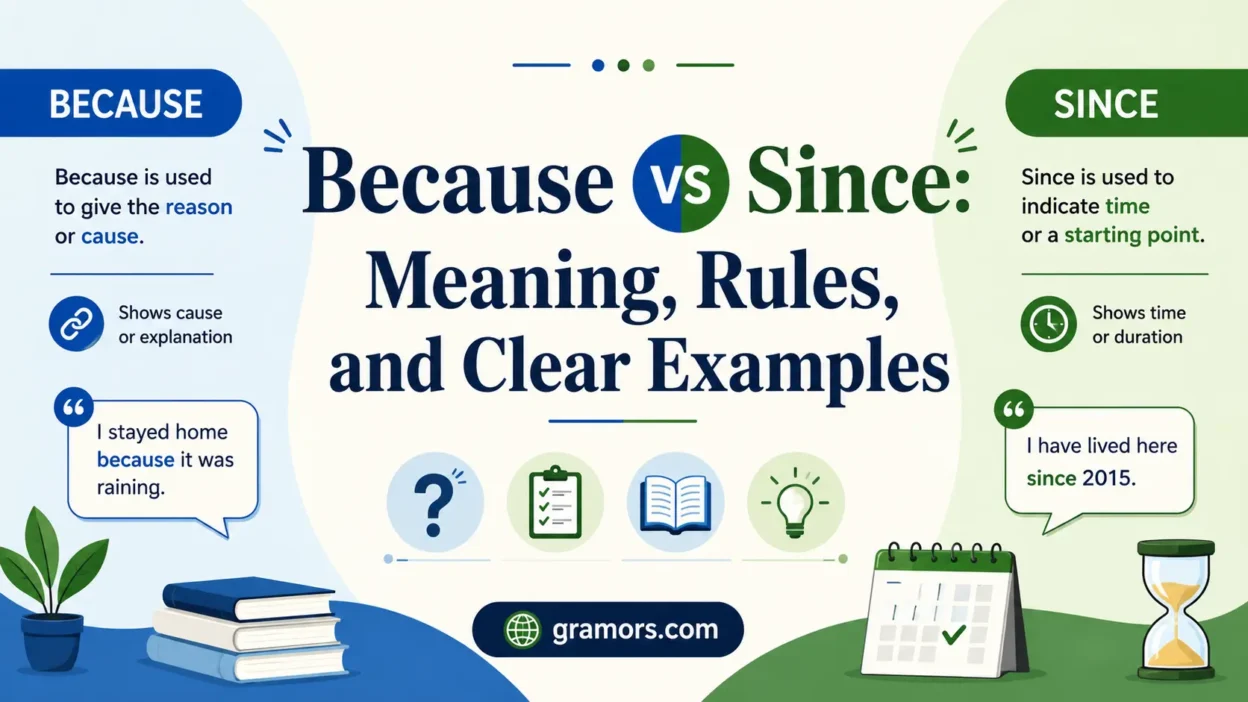
Use because when you want to give a direct reason. Use since when you mean “from a time in the past until now,” or when the reason is already clear from context.
Compare these examples:
“I stayed home because I was sick.”
“I have lived here since 2020.”
The first sentence explains why something happened. The second tells when something started.
Quick Answer
Use because for a clear reason.
Example: “We left early because traffic was heavy.”
Use since for time or for a reason when the context is clear.
Example: “Since you’re already here, let’s start.”
They can overlap when giving reasons, but because is usually clearer when the sentence directly answers “why?”
Why People Confuse Them
People confuse because and since because both can connect a reason to a result.
Examples:
“I feel better because she called.”
“Since she called, I feel better.”
The second sentence can mean two things depending on context. It may mean “because she called,” or it may mean “from the time she called.”
That double use makes since more flexible, but also more likely to create confusion.
The issue is meaning, not spelling or pronunciation.
Key Differences At A Glance
| Context | Best Choice | Why |
| Direct reason | because | It clearly answers “why?” |
| Time from a past point | since | It means from then until now or until another point. |
| Clear background reason | since | It can give a reason when no confusion is likely. |
| Direct cause question | because | It sounds clearer and more natural. |
| Formal or careful writing | because or since | Choose based on clarity, not a fixed style rule. |
| Possible ambiguity | because | It avoids confusion between time and reason. |
Meaning and Usage Difference
Because gives a direct reason.
Examples:
“She smiled because the news was good.”
“We canceled the trip because the flight was delayed.”
“He apologized because he made a mistake.”
In these sentences, because explains why something happened.
Since can refer to time.
Examples:
“She has smiled more since the news arrived.”
“I have not seen her since May.”
“We have worked together since 2021.”
In these sentences, since points to a starting time.
Since can also give a reason.
Examples:
“Since the news is good, we can relax.”
“Since you asked, I’ll explain.”
“Since the office is closed, we’ll meet online.”
This use is correct. Still, if the sentence could sound like time or cause, because is usually clearer.
Tone, Context, and Formality
Because sounds direct and clear. It works well when you want the reason to stand out.
Example:
“Because the file is missing, we cannot submit the report.”
Since can sound softer or more backgrounded when it gives a reason.
Example:
“Since the file is missing, we cannot submit the report.”
Both sentences are correct. The first puts stronger focus on the cause. The second may sound like the missing file is already known.
Do not treat this as a strict formal rule. Both words appear in casual and formal English. Context decides the better choice.
Which One Should You Use?
Use because when you are answering why.
Question: “Why did it fail?”
Answer: “Because the code had an error.”
Use since when you mean time from a past point.
Examples:
“I haven’t checked it since Friday.”
“She has lived in Denver since 2020.”
“We have been waiting since noon.”
Use because if since could confuse the reader.
Unclear:
“Since we spoke, I changed my mind.”
Clear time meaning:
“After we spoke, I changed my mind.”
Clear reason meaning:
“Because we spoke, I changed my mind.”
When One Choice Sounds Wrong
Because cannot replace time-based since.
Wrong:
“I have worked here because 2021.”
Correct:
“I have worked here since 2021.”
Since may sound unclear in direct-cause questions.
Less natural:
“Are you upset since I was late?”
Better:
“Are you upset because I was late?”
The first sentence may still be understood, but because sounds clearer because the question asks for a reason.
Since is not wrong for reasons. It simply needs a clear context.
Common Mistakes
Mistake: using because with a time point.
Wrong:
“I’ve been tired because Monday.”
Correct:
“I’ve been tired since Monday.”
Mistake: using since where time and reason are both possible.
Unclear:
“Since we spoke, I changed my mind.”
Clear time version:
“After we spoke, I changed my mind.”
Clear reason version:
“Because we spoke, I changed my mind.”
Mistake: confusing because with because of.
Wrong:
“The game was canceled because the rain.”
Correct:
“The game was canceled because of the rain.”
Also correct:
“The game was canceled because it rained.”
Use because before a clause. Use because of before a noun phrase.
Everyday Examples
“I stayed home because I had a fever.”
“I have worked from home since Monday.”
“We missed the bus because we left late.”
“We have been waiting since 8 a.m.”
“Because the store was closed, we ordered online.”
“Since the store closed, the neighborhood has been quieter.”
“She emailed the teacher because she had a question.”
“She has known that teacher since freshman year.”
“Because traffic was heavy, the meeting started late.”
“Since traffic is already heavy, let’s leave now.”
“I changed my password because I got a security alert.”
“I haven’t used that account since last summer.”
In each pair, because gives a reason. Since usually points to time, unless the context clearly makes it causal.
Dictionary-Style Word Details
Verb
• Because: Not commonly a verb. In standard use, because works mainly as a conjunction. It also appears informally before short noun-like phrases in modern casual expressions.
• Since: Not commonly a verb. It functions as an adverb, preposition, and conjunction.
Neither word should be treated as an action word in this comparison.
Noun
• Because: Not commonly a noun in standard grammar.
• Since: Not commonly a noun.
For this topic, the important uses are reason and time connections.
Synonyms
• Because: Closest alternatives include since, as, for the reason that, and seeing that.
Example:
“I called because I needed help.”
“I called since I needed help.”
Use because when you want the reason to be unmistakable.
• Since: For reason, closest alternatives include because, as, and seeing that.
Example:
“Since you asked, I’ll answer.”
“Because you asked, I’ll answer.”
For time, closest alternatives include from, after, and from the time when, depending on the sentence.
Example:
“I have lived here since 2020.”
“I have lived here from 2020 onward.”
Example Sentences
• Because:
“I called because I needed help.”
“She left early because she had an appointment.”
“The app crashed because the update failed.”
• Since:
“I have not seen her since May.”
“Since you asked, I’ll answer.”
“He has been quieter since the meeting.”
These examples show the key difference. Because gives a reason. Since can show time or reason.
Word History
• Because: The word has long been used to introduce reasons in English. A detailed history is not needed for this choice.
• Since: The causal use of since is historically established. It is not a modern mistake.
Modern readers mainly need the practical rule: use since for time, and use it for reasons only when the meaning is clear.
Phrases Containing
• Because:
because of
just because
because reasons
because science
Because of is standard before a noun phrase. Because reasons and because science are informal, playful patterns.
• Since:
ever since
since then
long since
since when
These phrases usually point to time.
FAQ and Conclusion
Can since mean because?
Yes. Since can introduce a reason.
Example:
“Since you’re here, let’s begin.”
That sentence means “because you’re here.”
Can because start a sentence?
Yes. Because can start a sentence when it introduces a complete dependent clause.
Example:
“Because the road was closed, we took another route.”
Which is better in formal writing, because or since?
Both can be correct. Use because when you want a direct reason. Use since for time or for a clear background reason.
Example:
“Because the data is incomplete, the report needs revision.”
How do I avoid ambiguity with since?
Use because for reason and after or from for time when needed.
Unclear:
“Since we talked, I changed my plan.”
Clear:
“Because we talked, I changed my plan.”
Clear:
“After we talked, I changed my plan.”
Is because of the same as because?
No. Because comes before a clause. Because of comes before a noun phrase.
Correct:
“I stayed home because I was sick.”
Correct:
“I stayed home because of my illness.”
Conclusion
Final takeaway: use because when you need a clear reason. Use since when you mean time from a past point, or when the reason is clear from context. In because vs since, clarity is the safest rule.