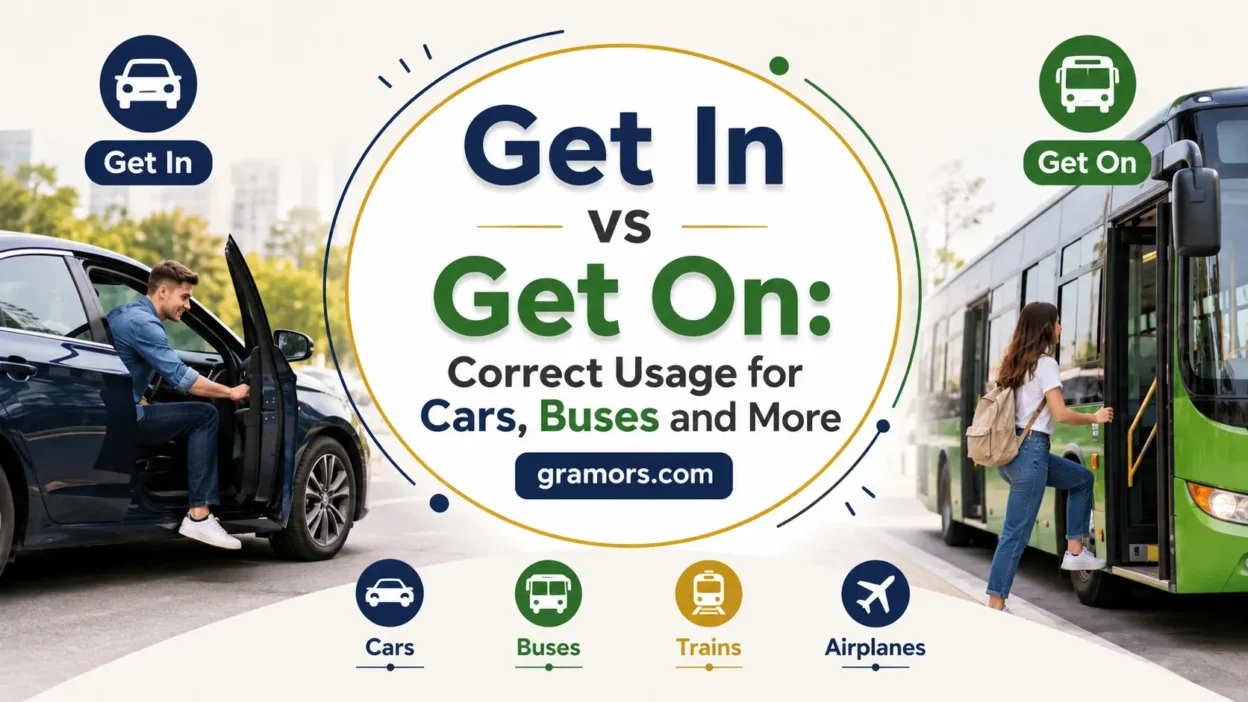
English speakers normally say get in the car but get on the bus, even though passengers are physically inside both vehicles.
Both get in and get on are correct, but they are not interchangeable in ordinary transportation language. The natural choice depends mainly on the type of vehicle and how English conventionally describes boarding it.
“Get in the car.”
“Get on the bus.”
Similarly:
“We got in a taxi and later got on the train.”
Both expressions have additional meanings outside transportation, but the main distinction here is how they describe entering or boarding vehicles.
Quick Answer
Use get in with cars, taxis, and many similar enclosed vehicles:
“Get in the car.”
Use get on with buses, trains, planes, bicycles, motorcycles, and larger passenger vessels:
“Get on the train.”
The usual opposite pairs are:
get in → get out of
get on → get off
Boats and some unusual vehicles depend more heavily on context and established usage.
Why People Confuse Them
The confusion comes partly from physical logic.
A passenger who gets on a train is physically inside the train. Someone who gets on a plane is also inside the aircraft.
However, standard English still says:
“I’m on the train.”
“She got on the plane.”
By contrast:
“He got in the car.”
This shows that literal physical position does not fully determine the preposition.
Learners often begin with the idea that in means inside and therefore expect expressions such as “get in the bus.” Although the logic is understandable, English transportation expressions follow established patterns that speakers learn as complete combinations.
Key Differences At A Glance
| Feature | Get In | Get On |
|---|---|---|
| Main transport meaning | Enter | Board or mount |
| Common vehicles | Car, taxi, cab, many small enclosed vehicles | Bus, train, subway, plane, bicycle, motorcycle |
| Typical exit phrase | Get out / get out of | Get off |
| Common concept | Entering a car-like enclosed space | Boarding or mounting transportation |
| Car | Get in the car | Usually not “get on the car” |
| Taxi | Get in a taxi | Usually not “get on a taxi” |
| Bus | Usually not “get in the bus” for boarding | Get on the bus |
| Train | Usually not “get in the train” for boarding | Get on the train |
| Plane | Usually not “get in the plane” for normal passenger boarding | Get on the plane |
| Bicycle | Not normally used | Get on the bike |
Boats require more context. Someone may get in a canoe or small boat but get on a ferry or ship.
These are common usage patterns rather than a perfect scientific classification based only on vehicle size.
Meaning and Usage Difference
Both expressions use the verb get, but they form different established constructions.
Get In
In its transportation sense, get in means to enter an enclosed vehicle, especially a car, taxi, or similar vehicle.
“Get in the car.”
“She got in a taxi outside the hotel.”
“They got in the van.”
You can also use get into:
“She got into the car.”
Both are natural, although get into explicitly includes the movement into the vehicle.
Sometimes the object is understood:
“The car is waiting. Get in!”
Get in also has meanings unrelated to transportation.
It can mean arrive:
“What time did you get in last night?”
It can refer to gaining admission:
“She got in to her first-choice college.”
It can also appear in expressions involving fitting something into available time:
“I managed to get in a short workout before work.”
These meanings should not be confused with the transportation comparison.
Get On
In transportation, get on commonly means to board or mount something.
“We got on the subway.”
“She got on the plane.”
“He got on his motorcycle.”
“Everyone got on the ferry.”
It is standard with:
- buses
- trains
- subways
- planes
- bicycles
- motorcycles
- ships
- ferries
- many larger boats
Get on also has several unrelated meanings.
It may refer to progress or managing:
“How are you getting on?”
It can describe continuing an activity:
“Let’s get on with the meeting.”
It can also appear in expressions about relationships or aging.
Those meanings are separate from the transportation rule.
Boats and Similar Vehicles
Boats demonstrate why the distinction cannot be reduced to one rigid physical test.
You might say:
“Carefully get in the canoe.”
But:
“We got on the ferry.”
And:
“The passengers got on the ship.”
The established expression depends partly on the type of vessel and how people normally board or use it.
Tone, Context, and Formality
Both get in and get on are completely natural in everyday English.
Everyday:
“We got on the plane at noon.”
“Get in the car.”
The verb get is especially common in speech and ordinary writing.
In more formal or transportation-specific contexts, board may replace get on:
Everyday:
“Passengers got on the plane.”
More formal:
“Passengers boarded the aircraft.”
Similarly, enter can sometimes replace physical get in:
Everyday:
“Get in the car.”
More formal or general:
“Enter the vehicle.”
However, board and enter are not automatically better choices. Natural everyday English strongly favors get in and get on in many situations.
The central vehicle distinction does not depend on an important American-versus-British difference.
Which One Should You Use?
Use get in with vehicles such as:
- cars
- taxis and cabs
- rideshare cars
- many small private vans
- some small boats
Examples:
“Get in the Uber.”
“She got in the taxi.”
“They got in the van.”
“Carefully get in the canoe.”
Use get on with:
- buses
- school buses
- trains
- subways
- planes
- ships
- ferries
- bicycles
- motorcycles
Examples:
“We got on the airport shuttle.”
“She got on the subway.”
“They got on the plane.”
“He got on his motorcycle.”
“We got on the ferry at noon.”
A useful practical test is:
Is the vehicle conventionally boarded or mounted?
Use get on in most cases.
Is it a car- or taxi-like enclosed vehicle that you enter directly?
Use get in in most cases.
However, check the established expression when you are unsure. Vans, boats, and unusual forms of transportation show why physical size alone cannot provide a perfect rule.
When One Choice Sounds Wrong
Using the wrong preposition can create an unnatural meaning or even change the physical action being described.
Incorrect for normal passenger boarding:
“We got in the train.”
Natural:
“We got on the train.”
Incorrect:
“Get on the taxi.”
Natural:
“Get in the taxi.”
Incorrect for ordinary travel:
“She got on the car.”
Natural:
“She got in the car.”
The expression get on the car can have a literal interpretation, but it means climbing onto the exterior surface of the car rather than entering its passenger compartment.
For example:
“The child climbed on the car.”
Similarly, in a bus can describe physical location:
“There were thirty passengers in the bus.”
But when describing the ordinary act of boarding, English normally uses:
“They got on the bus.”
The distinction is therefore between what a sentence can literally mean and what sounds idiomatic for normal transportation.
Common Mistakes
Mistake: Using “in” for every enclosed vehicle
Incorrect for normal boarding:
“We got in the bus.”
Correct:
“We got on the bus.”
Being physically inside a vehicle does not automatically mean English uses get in.
Mistake: Using “on” simply because a vehicle is large
Vehicle size is only a rough clue.
Do not rely on it as an absolute rule. Established usage matters more.
Mistake: Forgetting bikes and motorcycles
Correct:
“Get on the bike.”
“She got on her motorcycle.”
Because riders mount these vehicles, English uses on.
Mistake: Using the wrong exit expression
Car:
“Get in the car.”
“Get out of the car.”
Bus:
“Get on the bus.”
“Get off the bus.”
Train:
“Get on the train.”
“Get off the train.”
Mistake: Saying “get off the car” for leaving the passenger compartment
Incorrect for ordinary travel:
“Get off the car.”
Correct:
“Get out of the car.”
Mistake: Confusing “get in” and “get into”
Both may work with cars:
- “Get into the car.”
- Get into emphasizes movement into the enclosed space, while get in is extremely common in ordinary instructions.
Mistake: Applying one rule to every boat
Natural:
“Get in the canoe.”
Also natural:
“Get on the ferry.”
The correct choice depends on the type of vessel and normal usage.
Everyday Examples
Cars and Taxis
“Get in the car before it starts raining.”
“She got in the taxi outside the hotel.”
“I got in the Uber and checked the destination.”
“Everyone got out of the car at the restaurant.”
Vans and Buses
“They got in the van and drove downtown.”
“We got on the bus at Fifth Avenue.”
“The children got on the school bus at seven.”
“Remember to get off at the next stop.”
Trains and Subways
“He got on the train just before the doors closed.”
“We got on the subway near Times Square.”
“Hundreds of passengers got off the train.”
“Which station did you get on at?”
Airplanes
“They got on the plane early.”
“We need to get on the plane before the gate closes.”
“The passengers got off the aircraft after landing.”
Bicycles and Motorcycles
“I got on my bike and rode home.”
“She put on her helmet and got on the motorcycle.”
“He got off his bike near the entrance.”
Boats, Ferries, and Ships
“Carefully get in the canoe.”
“They got in the small fishing boat.”
“We got on the ferry at noon.”
“The passengers got on the cruise ship in Miami.”
Other Meanings
“What time did you get in last night?”
Here, get in means arrive.
“How are you getting on with your new job?”
Here, getting on refers to how someone is progressing or managing. It is not about transportation.
Dictionary-Style Word Details
Verb
Get In
This category fully applies.
Get in is an established verb or phrasal-verb construction with several meanings.
Relevant meanings include:
- enter
- arrive
- gain admission or acceptance
- manage to include or accomplish something
For this comparison, the important meaning is entering a car-like vehicle:
“She got in the car.”
Get On
This category also fully applies.
In the transportation sense, get on means to board or mount:
“They got on the bus.”
“She got on her bike.”
Other meanings may involve:
- progressing or managing
- continuing with something
- relationships
- increasing age or advancing time
These additional meanings do not directly contrast with the transportation meaning of get in.
Noun
Neither get in nor get on normally functions as a noun in the transportation comparison.
The base word get has other noun uses, but they are unrelated here.
It is more accurate to treat both target expressions as verb-based constructions rather than inventing noun definitions for them.
Synonyms
Closest alternatives for physical get in include:
- enter
- get into
- climb into, when appropriate
For the arrival sense of get in:
- arrive
- come in
Examples:
“Get in the car” → “Get into the car.”
“What time did you get in?” → “What time did you arrive?”
Closest alternatives for transportation get on include:
- board
- climb aboard
- mount, especially for bicycles and motorcycles
Examples:
“Get on the plane” → “Board the plane.”
“Get on the motorcycle” → “Mount the motorcycle.”
These are closest alternatives rather than exact replacements in every sentence.
Example Sentences
Get In
“Get in the car.”
“She got in a taxi outside the airport.”
“They got in the van before the storm started.”
“We carefully got in the small boat.”
“The door is open, so get in.”
“What time did you get in last night?”
Here, get in means arrive.
Get On
“We got on the bus downtown.”
“He got on the train just before departure.”
“They got on the plane at Gate 12.”
“She got on her bicycle and left.”
“We got on the ferry around noon.”
“How are you getting on?”
Here, get on has a non-transport meaning related to progress or managing.
Word History
Both expressions share the history of the base verb get.
The verb entered Middle English from Old Norse geta and developed a very wide range of meanings over time.
Get in has long been used with entry-related meanings.
Get on likewise developed several established constructions, including the modern transportation sense of boarding or mounting.
There is no good reason to explain the difference through a folk story about passengers literally standing “on top” of early buses, trains, or other vehicles. Modern usage is best learned through established English patterns.
Phrases Containing
Common larger expressions with get in include:
- get in on something
- get in with someone
- get in the way
- get a word in
- get in touch
These expressions have meanings that may be unrelated to entering transportation.
Common larger expressions with get on include:
- get on with something
- get on with someone
- get on well
- get on to something
- get on someone’s nerves
Again, these meanings do not make get in and get on interchangeable in transportation contexts.
FAQs
Is it “get in the car” or “get on the car”?
Say get in the car when entering the passenger compartment: “Get in the car; we’re leaving.” Get on the car normally suggests climbing onto its exterior.
Do you get in or get on a bus?
Use get on the bus when boarding: “We got on the bus downtown.” The usual opposite is get off the bus.
Why do we get in a car but get on a bus?
English conventionally treats cars and taxis with get in, while buses belong to the get on/get off pattern. Physical size can help as a rough guide, but established usage is more reliable.
Is it “get on the train” or “get in the train”?
For ordinary passenger boarding, say get on the train: “She got on the train in Boston.”
Do you get in or get on a plane?
Use get on the plane when boarding it. Passengers get on a plane and get off after the flight.
Do you get in or get on a boat?
It depends on the vessel. Get in is natural for many small boats or canoes, while get on is usual for ferries, ships, and many larger passenger vessels.
Conclusion
Use get in normally with cars, taxis, and similar enclosed vehicles.
Use get on normally with buses, trains, planes, bicycles, motorcycles, ferries, and larger passenger transportation.
The most useful opposite pairs are:
get in → get out of
get on → get off
English convention matters more than one rigid rule based only on vehicle size.
Remember the contrast:
“Get in the car, then get on the train.”