Many writers confuse as vs because in reason clauses. Both words can introduce a reason, but they do not always feel equally clear.
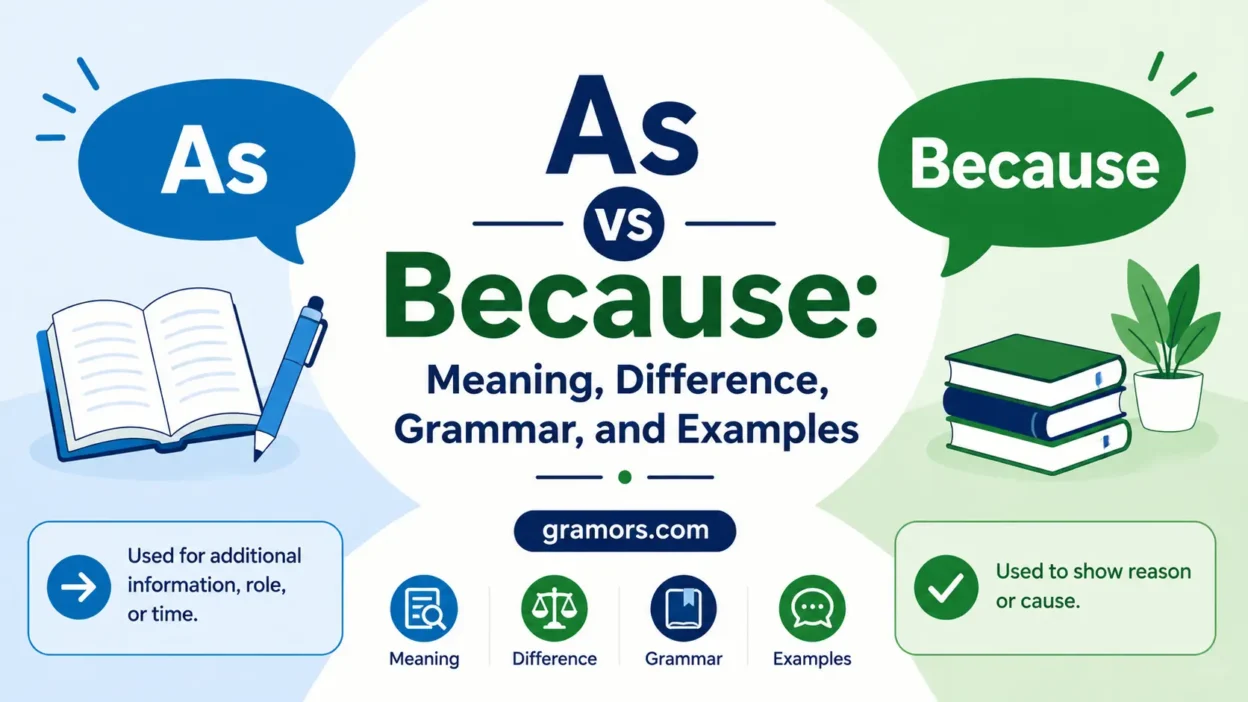
Use because when you want to give a direct reason. Use as when the reason is background information, already known, or less important than the result.
Compare these examples:
“We stayed home because it was raining.”
“As it was raining, we stayed home.”
Both sentences can be correct. Still, because makes the reason clearer, while as can sound more formal or slightly less direct.
Quick Answer
Use because for a direct reason.
Example: “I left because I felt sick.”
Use as when the reason is background information or already clear.
Example: “As I felt sick, I left early.”
The choice is about clarity and emphasis, not absolute correctness. As is not wrong, but because is usually safer when the reason matters most.
Why People Confuse Them
People confuse as and because because both can work as subordinating conjunctions. Both can connect a result with a reason.
Examples:
“As the train was late, we drove.”
“We drove because the train was late.”
The confusion grows because as has several other meanings. It can mean when, while, although, or in the way that.
Example:
“As the train arrived, people stood up.”
Here, as means “when” or “while,” not “because.”
So, every use of as is not causal. That is why because is often clearer when you want to show a reason.
Key Differences At A Glance
| Context | Best Choice | Why |
|---|---|---|
| Direct answer to why | because | It gives a clear cause. |
| Background reason | as | The reason supports the main result. |
| Everyday conversation | because | It sounds plain and direct. |
| Formal or polished writing | as | It can sound smoother when the cause is secondary. |
| Possible time meaning | because | It avoids confusion with “when” or “while.” |
| Sentence-starting reason clause | because or as | Both can start a sentence when the clause is complete. |
Meaning and Usage Difference
Because means for the reason that. It gives a direct cause.
Examples:
“I apologized because I was wrong.”
“She stayed inside because the weather was bad.”
“We changed the plan because the client asked.”
In these sentences, because puts clear focus on the reason.
As can mean because, but only in one of its conjunction uses.
Examples:
“As I was wrong, I apologized.”
“As the store was closed, we ordered online.”
“As the report was incomplete, the meeting was postponed.”
In these sentences, as gives a reason, but it sounds more backgrounded than because.
Here is the practical difference:
• Because: direct cause; best when the reason is important.
• As: background cause; best when the reason is already known or less central.
• Because: clearer in questions and explanations.
• As: can be ambiguous because it has other meanings.
Non-causal as examples:
“Do as I say.”
“As I opened the door, the phone rang.”
The first means “in the way that.” The second means “when” or “while.”
Tone, Context, and Formality
Because is common, plain, and direct. It works in casual speech, school writing, emails, reports, and formal writing.
Example:
“I stayed home because I was tired.”
As can sound more formal, polished, or slightly stiff in causal use.
Example:
“As the report was incomplete, the meeting was postponed.”
That does not mean as is always formal. It also does not mean because is only casual. Both can appear in many kinds of writing.
The difference is emphasis. Because highlights the reason. As often presents the reason as background information.
Which One Should You Use?
Choose because for clarity, direct reasons, questions, and everyday writing.
Examples:
“Are you upset because I canceled?”
“I missed the call because my phone was on silent.”
“We left early because traffic was getting bad.”
Choose as when the reason is background information and the sentence remains clear.
Examples:
“As the office was closed, we called instead.”
“As the deadline had passed, we submitted a new request.”
“As everyone was already seated, the meeting began.”
When in doubt, choose because. It is usually the safer choice for a clear cause.
When One Choice Sounds Wrong
As can sound unclear when readers may understand it as “while” or “when.”
Unclear:
“She smiled as he entered.”
This could mean she smiled while he entered. If the reason matters, use because.
Clearer causal version:
“She smiled because he entered.”
Because can sound heavy if the reason is only background.
Heavy:
“Because the weather was already bad, the outdoor event was moved inside.”
Smoother:
“As the weather was already bad, the outdoor event was moved inside.”
Also remember that because of is needed before a noun phrase.
Correct:
“The flight was delayed because of the storm.”
Correct:
“The flight was delayed because the storm was severe.”
Common Mistakes
Mistake: using as where it can mean “while.”
Unclear:
“As I walked in, everyone laughed.”
If you mean reason:
“Everyone laughed because I walked in.”
If you mean time:
“Everyone laughed when I walked in.”
Mistake: using because of before a full clause.
Wrong:
“We canceled because of it was raining.”
Correct:
“We canceled because it was raining.”
Also correct:
“We canceled because of the rain.”
Mistake: thinking a sentence cannot start with because.
Wrong idea:
“Never start a sentence with because.”
Correct:
“Because the road was closed, we took another route.”
Mistake: overusing as to sound formal.
Stiff:
“As I needed help, I called support.”
Clearer:
“I called support because I needed help.”
Everyday Examples
“I missed the call because my phone was on silent.”
“As my phone was on silent, I missed the call.”
“We left early because traffic was getting bad.”
“As traffic was getting bad, we left early.”
“She emailed the teacher because she missed the assignment.”
“As she missed the assignment, she emailed the teacher.”
“The team stayed late because the project was behind schedule.”
“As the project was behind schedule, the team stayed late.”
“I booked a hotel because the flight was canceled.”
“As the flight was canceled, I booked a hotel.”
“Please resend the file because the first version would not open.”
“As the first version would not open, please resend the file.”
In these pairs, because sounds more direct. As sounds more like background setup.
Dictionary-Style Word Details
Verb
• As: Not commonly used as a verb in this comparison. Treat as as a conjunction, preposition, or adverb, not as an action word.
• Because: Not a verb.
This category does not commonly apply to either word.
Noun
• As: Not commonly a noun in this grammar comparison. Unrelated technical or symbol uses do not help with this topic.
• Because: Not commonly a noun.
For this guide, both words are better understood by their connecting roles.
Synonyms
• As: In causal use, closest plain alternatives include because, since, seeing that, and given that.
Example:
“As the store was closed, we ordered online.”
“Because the store was closed, we ordered online.”
These are not always exact replacements because tone and emphasis can change.
• Because: Closest plain alternatives include since, as, for the reason that, and seeing that.
Example:
“I called because I needed help.”
“I called for the reason that I needed help.”
The second version is grammatical but much less natural in everyday writing.
Example Sentences
• As:
“As the store was closed, we ordered online.”
“As I walked home, it started raining.”
“As the room was full, we waited outside.”
The first and third examples use as for reason. The second uses as for time.
• Because:
“We ordered online because the store was closed.”
“I called because I needed help.”
“She smiled because the news was good.”
These examples show direct cause.
Word History
• As: As has long had several conjunction uses in English. That helps explain why it can mean different things in different sentences.
• Because: Because developed from an older phrase connected with cause. In modern English, it clearly introduces a reason.
The history is less important than the modern rule: use because when you want the reason to be unmistakable.
Phrases Containing
• As:
as long as
as soon as
as if
as though
as well as
These are separate structures. Do not assume every phrase with as means “because.”
• Because:
because of
just because
simply because
because reasons
Because of, just because, and simply because are common. Informal patterns like because reasons are playful and should be avoided in formal writing.
FAQs
Is as the same as because?
Sometimes, but not always. As can mean because when it introduces a reason.
Example:
“As the store was closed, we left.”
Still, as can also mean “when,” “while,” or “in the way that.”
Is as more formal than because?
In causal use, as can sound more formal or polished.
Example:
“As the report was incomplete, we delayed the meeting.”
But because is also correct in formal writing.
Can I start a sentence with because?
Yes. A sentence can start with because if the full sentence is complete.
Example:
“Because the road was icy, we drove slowly.”
Can I start a sentence with as?
Yes, but make sure the meaning is clear.
Example:
“As the office was closed, we called customer service.”
Here, as means “because.”
Which is better in American English?
For direct reasons, because is usually clearer and more natural.
Example:
“I left because I felt sick.”
Use as when the reason is background information.
Is because of the same as because?
No. Because comes before a clause. Because of comes before a noun phrase.
Correct:
“We canceled because it rained.”
Correct:
“We canceled because of the rain.”
Conclusion
Use because when the reason matters most. It is the safest choice for direct cause, questions, and clear everyday writing.
Use as when the reason supports the main result and the sentence stays clear.
Final pair:
“Use because when the reason matters most.”
“Use as when the reason supports the main result.”
As is not wrong, but because is usually clearer.