The confusion between speak vs talk is common because both words describe using spoken language. At first glance, they seem interchangeable, but English uses them in slightly different ways.
The main difference is not just meaning—it is how the communication happens and the situation it happens in.
For example:
- “I need to speak to you.”
- “We need to talk.”
Both are correct, but they feel different in tone and context. That’s why learners often mix them up.
2. Quick Answer
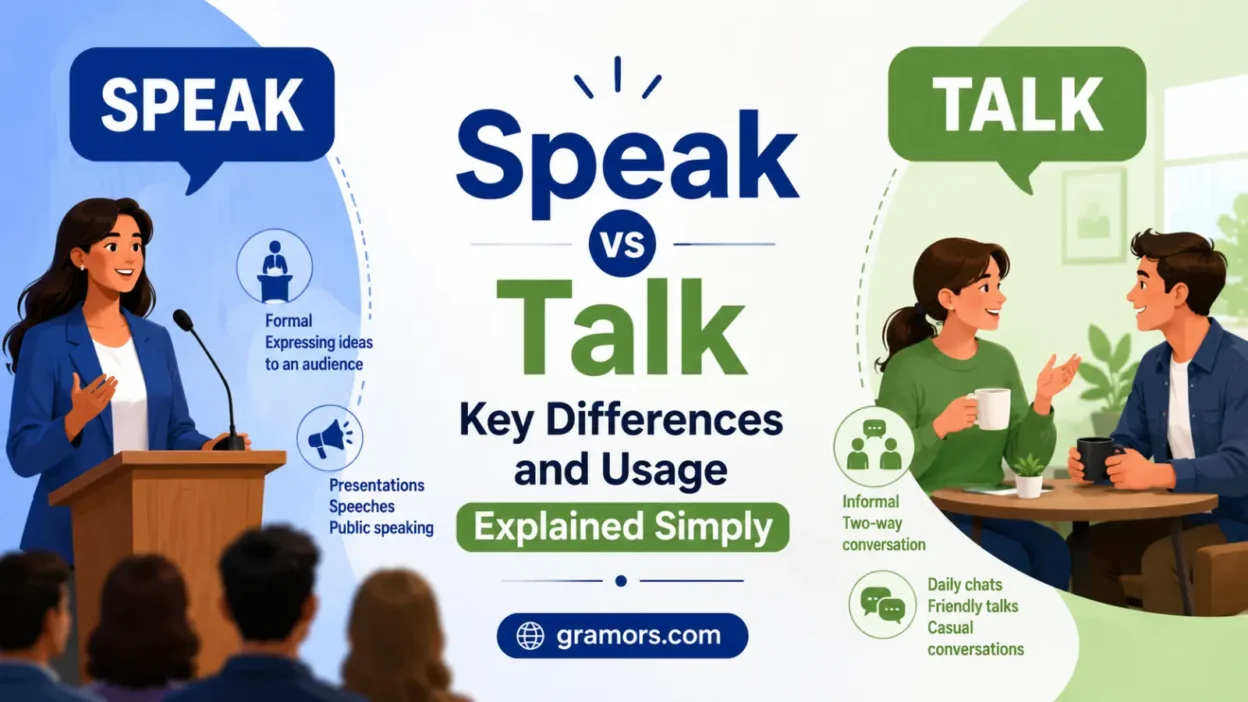
“Speak” is usually used for more formal, structured, or ability-based communication.
“Talk” is used for informal conversation or interaction between people.
They can overlap, but they are not always interchangeable.
Examples:
- “She can speak English.”
- “We talked for hours.”
Simple rule:
- Speak = formal / ability / structured communication
- Talk = casual / conversation / interaction
3. Why People Confuse Them
People confuse speak and talk because both involve verbal communication. In many situations, both can technically fit.
The confusion grows because learners often translate directly from their native language, where this distinction may not exist.
Examples:
- “I need to speak to you.” (formal or serious)
- “I need to talk to you.” (more casual and personal)
Since both appear in real conversations, the difference feels unclear at first.
4. Key Differences At A Glance
| Context | Best Choice | Why |
|---|---|---|
| Formal communication | Speak | Used in structured or official settings |
| Casual conversation | Talk | Used in everyday interaction |
| Language ability | Speak | “Speak English” is standard usage |
| General discussion | Talk | Focuses on exchange between people |
Extra Comparison
| Feature | Speak | Talk |
|---|---|---|
| Style | More formal | More casual |
| Focus | Expression or ability | Interaction between people |
5. Meaning and Usage Difference
Speak focuses on the act of producing words, often in formal or structured contexts.
Example: “She will speak at the conference.”
Talk focuses on conversation between people.
Example: “We talked about the plan.”
Both can appear in similar situations, but the tone changes:
- “Speak to the manager.” (formal)
- “Talk to your friend.” (casual)
There is overlap, but context decides the natural choice.
6. Tone, Context, and Formality
In everyday American English, speak often feels more formal, while talk feels more relaxed and social.
Examples:
- “I need to speak with you.” (serious or professional tone)
- “Let’s talk later.” (friendly or casual tone)
- “She spoke at the meeting.” (public/formal setting)
- “We talked after class.” (informal interaction)
Tone depends heavily on situation, not just grammar.
7. Which One Should You Use?
Use this simple guide:
- Use speak for formal situations, speeches, or language ability
- Use talk for conversations and casual interaction
Examples:
- “He can speak three languages.”
- “We talked about school yesterday.”
If unsure, think: Is this a conversation or a structured statement?
8. When One Choice Sounds Wrong
Some sentences sound unnatural because they don’t match typical usage patterns.
Wrong: “I will talk at the conference.”
Correct: “I will speak at the conference.”
Wrong: “She speaked to me yesterday.”
Correct: “She talked to me yesterday.”
Wrong: “Talk English.”
Correct: “Speak English.”
The issue is not meaning—it is natural usage.
9. Common Mistakes (and Quick Fixes)
Mistake → Correction:
- “Talk a speech.” → “Give a speech / speak at a speech”
- “Speak with my friend for hours” (can sound stiff) → “Talk with my friend for hours”
- “Talk English” → “Speak English”
Most mistakes happen when learners ignore fixed patterns.
10. Everyday Examples
- “She speaks English fluently.”
- “We talked about the project.”
- “He spoke at the meeting yesterday.”
- “They talked for a long time after school.”
- “I need to speak to my manager.”
- “Let’s talk later tonight.”
- “The teacher spoke clearly.”
- “We talked on the phone.”
- “She speaks three languages.”
- “We talked about our plans for the weekend.”
- “He spoke in front of the class.”
- “They talked things through calmly.”
11. Dictionary-Style Word Details
Verb
- speak: used for formal communication, speech, or language ability
- talk: used for informal conversation or interactive communication
Noun
- speak: rarely used as a noun in modern English
- talk: commonly used (“a talk,” “give a talk,” “small talk”)
Synonyms
- speak: address, express, talk (context-dependent)
- talk: chat, converse, discuss
Note: synonyms depend heavily on context and are not always interchangeable.
Example Sentences
- speak: “She will speak at the event tomorrow.”
- talk: “We talked for hours after dinner.”
Word History
- Both speak and talk come from Old English roots related to speech and communication.
- Over time, their usage split into formal vs conversational patterns in modern English.
Phrases Containing
- speak: speak up, speak out, speak English
- talk: talk back, talk over, talk things through
12. FAQ
Can I use speak and talk the same way?
Sometimes, but not always. Context matters.
Why do we say “speak English” but not “talk English”?
Because “speak” is used for language ability.
Is speak more formal than talk?
Yes, generally in modern usage.
Can both be used in conversation?
Yes, but tone and situation decide which sounds natural.
13. Conclusion
The difference between speak vs talk is mainly about context. “Speak” is used for formal communication and language ability, while “talk” is used for casual conversation.
Both are common in everyday English, but choosing the right one depends on situation and tone.
Example:
- “She speaks clearly in meetings.”
- “We talked after school.”
Understanding this difference helps your English sound more natural and accurate