Many English learners confuse “beside” and “besides” because the words look and sound almost identical. However, that extra “s” changes the meaning significantly.
In modern English, the two words usually serve different purposes:
- “Beside” usually relates to physical position.
- “Besides” usually adds information or introduces another point.
Examples:
- The chair is beside the desk.
- Besides math, she studies science.
Because the words sound similar in fast speech, writers and speakers often mix them up.
2. Quick Answer
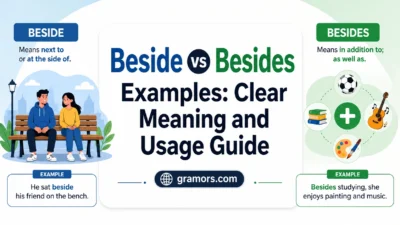
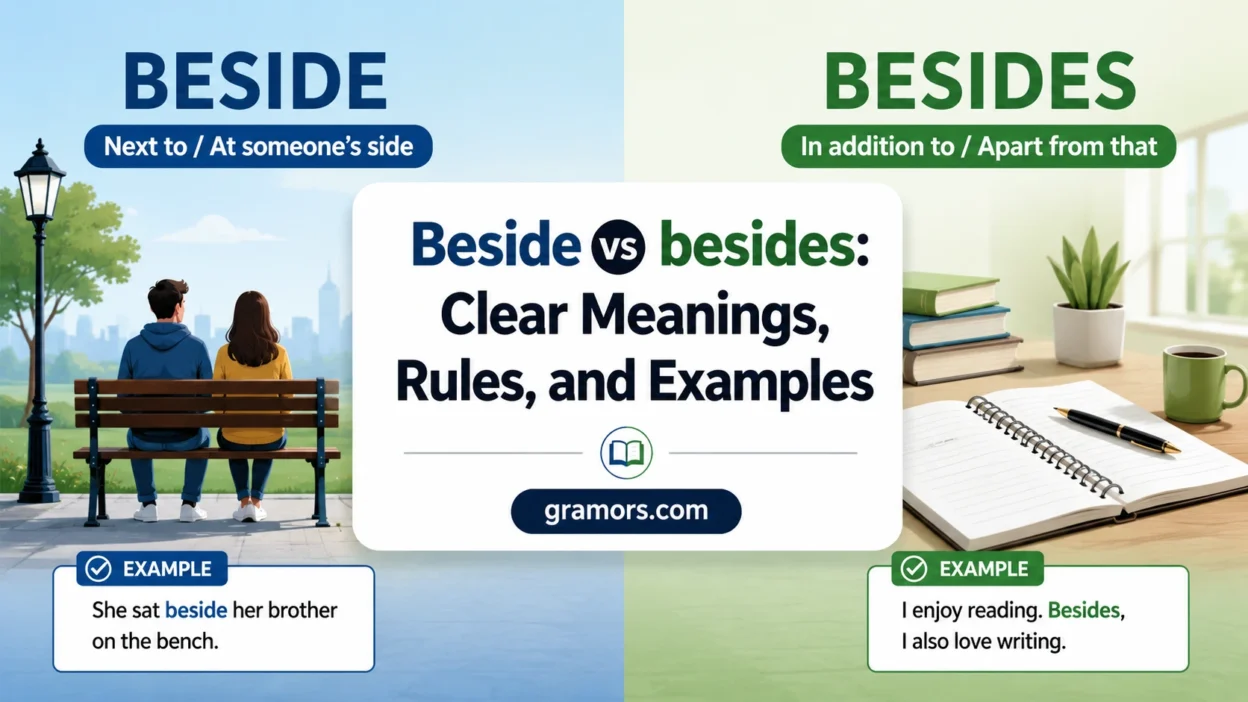
Use beside when you mean:
- next to
- alongside
Example:
- The backpack is beside the door.
Use besides when you mean:
- in addition to
- apart from
- except for
Example:
- Besides history, he also enjoys art.
Incorrect:
- Besides the bed was a lamp.
Correct:
- Beside the bed was a lamp.
Quick memory trick:
- The extra “s” in “besides” can remind you of “something extra.”
3. Why People Confuse Them
The confusion comes from several factors:
- similar spelling
- similar pronunciation
- shared historical roots
- fast conversational speech
Some learners also assume “besides” is simply a plural version of “beside,” which is not true in modern English.
Typing and autocorrect errors can make the problem worse:
- beside me
- besides me
These phrases have completely different meanings depending on context.
Although the words historically overlapped in some uses, modern English usually keeps them separate.
4. Key Differences At A Glance
Context | Best Choice | Why
Physical position | beside | means “next to”
Adding information | besides | means “in addition to”
Excluding something | besides | can mean “except for”
Idiomatic expression | beside | appears in fixed phrases
Modern interchangeability | limited | meanings differ clearly today
| Feature | Beside | Besides |
|---|---|---|
| Main meaning | next to | in addition to |
| Grammar role | mainly preposition | preposition or adverb |
| Common phrases | beside the point | besides that |
| Typical tone | neutral | conversational or explanatory |
| Interchangeable? | rarely | rarely |
5. Meaning and Usage Difference
Beside
“Beside” is mainly a preposition meaning “next to” or “alongside.”
Examples:
- She sat beside her friend.
- The hotel is beside the beach.
It also appears in idioms:
- beside the point
- beside oneself
Examples:
- That comment is beside the point.
- He was beside himself with excitement.
Besides
“Besides” has broader modern usage.
As a preposition, it means:
- in addition to
- apart from
Examples:
- Besides English, she speaks Spanish.
- Besides my brother, nobody knew the secret.
As an adverb, it adds extra information:
- Besides, we were already late.
- I didn’t want to go. Besides, it was raining.
“Besides” can also mean “except for” in some contexts:
- Nobody besides Jake arrived early.
6. Tone, Context, and Formality
Both words are neutral in modern American English, but they appear naturally in different situations.
“Besides” is very common in conversation when adding another reason:
- Besides, it’s too expensive.
“Beside” appears naturally in descriptions and idioms:
- Please sit beside me.
- That issue is beside the point.
Workplace examples:
- Besides the budget concerns, we also face scheduling problems.
- The printer is beside the reception desk.
Academic examples:
- Besides economics, the student studies political science.
- The library stands beside the science building.
The difference is mainly about meaning, not strict formality.
7. Which One Should You Use?
A simple decision method works well.
Ask yourself:
- Are you talking about physical position?
→ Use beside - Are you adding information or another reason?
→ Use besides
Substitution tests:
- beside = next to
- besides = in addition to
Examples:
- The cat slept beside the fireplace.
- Besides coffee, we ordered dessert.
The memory trick helps, but understanding the meaning matters most.
8. When One Choice Sounds Wrong
Switching the words often changes the sentence completely.
Incorrect:
- Besides the window stood a lamp.
Correct:
- Beside the window stood a lamp.
Incorrect:
- Beside soccer, she enjoys tennis.
Correct:
- Besides soccer, she enjoys tennis.
Reader interpretation changes quickly because the extra “s” signals a different meaning.
Awkward:
- Beside, I already told you.
Natural:
- Besides, I already told you.
9. Common Mistakes
Mistake → Fix
- besides the chair → beside the chair
- beside math class → besides math class
- beside, we need more time → besides, we need more time
- beside the point confusion → remember this is a fixed idiom
Editing examples:
- Wrong: Besides the couch was a table.
- Correct: Beside the couch was a table.
- Wrong: Beside science, she studies music.
- Correct: Besides science, she studies music.
10. Everyday Examples
School:
- Besides science, Maya enjoys art class.
- The teacher stood beside the whiteboard.
Family:
- My little brother sat beside me during dinner.
- Besides pizza, we ordered salad.
Workplace:
- Besides scheduling issues, the team faced budget cuts.
- The coffee machine is beside the printer.
Travel:
- We parked beside the hotel entrance.
- Besides New York, they visited Boston and Chicago.
Conversation:
- Besides, nobody asked for my opinion.
- Your shoes are beside the door.
Daily life:
- The dog slept beside the couch.
- Besides homework, I still need to clean my room.
11. Dictionary-Style Word Details
Verb
• BESIDE: Not commonly used as a verb.
• BESIDES: Not commonly used as a verb.
• Applicability: Rarely applies to either term.
Noun
• BESIDE: Not commonly used as a noun.
• BESIDES: Not commonly used as a noun.
• Applicability: Rarely applies to either term.
Synonyms
• BESIDE:
- next to
- alongside
• BESIDES:
- in addition to
- apart from
- also
• Applicability: Meaning depends on context.
Example Sentences
• BESIDE:
- The lamp stood beside the sofa.
- His argument was beside the point.
• BESIDES:
- Besides math, she studies chemistry.
- Besides, we were already running late.
Word History
• BESIDE: Historically connected to spatial and positional meaning in English.
• BESIDES: Developed broader additive and conversational meanings over time.
• Applicability: The words share roots but now serve different common functions.
Phrases Containing
• BESIDE:
- beside the point
- beside oneself
• BESIDES:
- besides that
- besides the fact that
12. FAQs
Is it “beside me” or “besides me”?
Use:
- beside me → next to me
- besides me → apart from me / in addition to me
Examples:
- Please sit beside me.
- Nobody besides me understood the joke.
Can “besides” mean “except for”?
Yes.
Example:
- Nobody besides Sarah finished early.
Here, “besides” means “except for.”
Is “beside” outdated?
No. “Beside” is still very common in modern English, especially for physical position and idioms.
Examples:
- beside the bed
- beside the point
Can both words appear in the same sentence?
Yes.
Example:
- Besides Jake, nobody sat beside me.
Which one is more common?
“Besides” appears more often overall because it works as both a preposition and an adverb.
“Beside” is still extremely common for location-based meanings.
13. Conclusion
The difference in beside vs besides becomes simple once you focus on meaning.
- Beside usually relates to position or location.
- Besides usually adds information or means “apart from.”
Final comparison:
- The bike is beside the garage.
- Besides the bike, we also bought a scooter.
Remember: the extra “s” in “besides” often signals something extra in the sentence.