The words setup and set up often confuse writers because they sound identical but serve different grammatical roles.
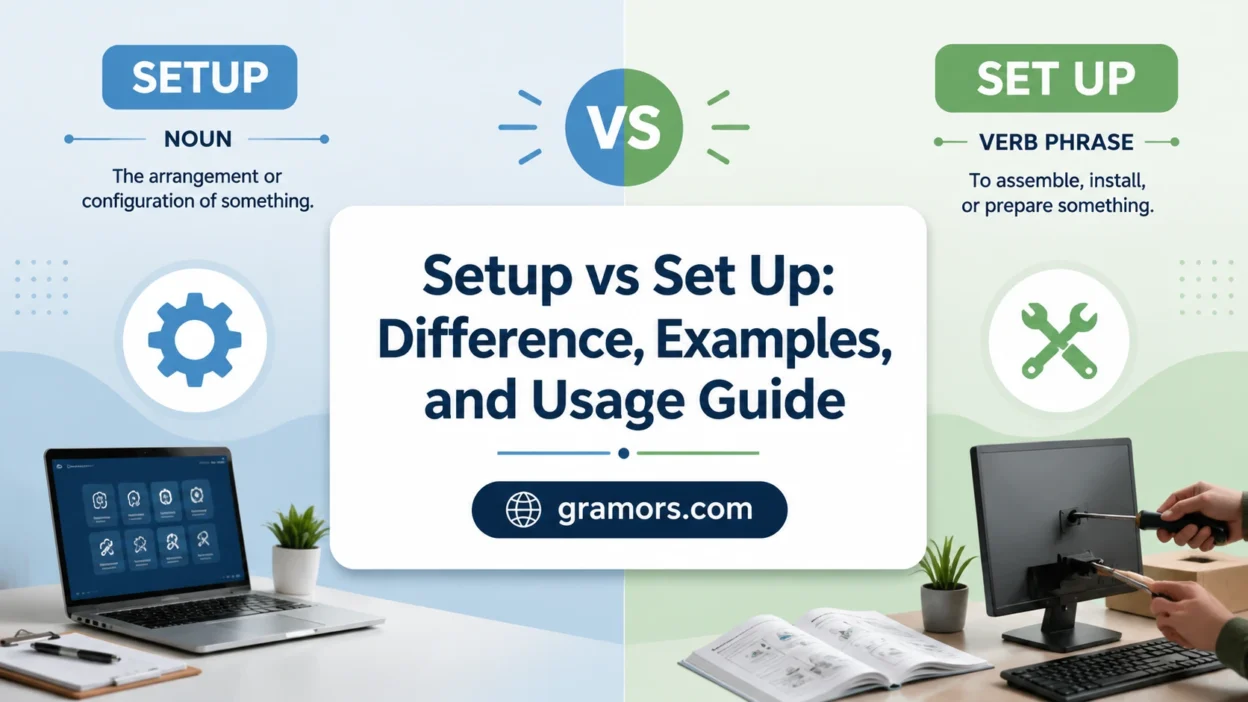
- Setup is a noun or sometimes an adjective.
- Set up is a verb phrase indicating action.
Examples:
- Noun: “The setup was easy.”
- Verb: “Please set up the room for the meeting.”
Understanding the distinction ensures clarity in emails, manuals, and everyday writing.
Quick Answer
- Setup = noun (or adjective). It names the arrangement, system, or preparation.
- Set up = verb phrase. It describes the action of arranging or preparing something.
Examples:
- Noun: “The server setup is complete.”
- Adjective: “A setup guide is included.”
- Verb: “We will set up the new equipment tomorrow.”
Note: Hyphenated set‑up can sometimes appear as a noun, mostly in older or regional usage.
Why People Confuse Them
Confusion arises because:
- Both forms use the same base words: set + up.
- They sound identical in speech.
- Context often determines whether the term is an action or a thing.
Example: “Can you set up the setup?”
- Without knowing the function, this sentence looks odd but is grammatically correct.
Always check whether the word is acting as a verb or noun.
Key Differences At A Glance
| Term | Part of Speech | Role in Sentence | Example |
|---|---|---|---|
| setup | Noun / Adjective | Names an arrangement or preparation | “The setup was straightforward.” |
| set up | Verb phrase | Describes the action of arranging or preparing | “Please set up the chairs.” |
Key point: Do not use set up as a noun unless hyphenated as set‑up in some style guides.
Meaning and Usage Difference
- Setup identifies a thing, arrangement, or configuration.
- Example: “The software setup took 10 minutes.”
- Adjective: “A setup manual is included.”
- Set up describes the action of arranging or preparing.
- Example: “We need to set up the projector before the meeting.”
Remember: Set up cannot serve as a noun in standard US usage. Only setup names the arrangement itself.
Tone, Context, and Formality
- Setup is common in technical, business, and instructional writing.
- Set up appears in actions, instructions, or everyday conversational contexts.
Examples:
- Business manual: “Ensure the setup complies with safety regulations.”
- Instructional email: “Please set up your workstation before the call.”
- Informal: “I’ll set up the table for dinner.”
Tone is guided by context, not by grammar rules.
Which One Should You Use?
- Ask the function:
- Naming an arrangement? → setup
- Showing an action? → set up
- Test substitution:
- Replace setup with arrangement. If it works, noun/adjective is correct.
- Replace set up with organize or arrange. If it works, verb phrase is correct.
Examples:
- “The setup was ready.” → “The arrangement was ready.” ✅
- “Please set up the chairs.” → “Please arrange the chairs.” ✅
Exceptions: Adjective usage is less common but follows the noun form.
When One Choice Sounds Wrong
Incorrect: “I will setup the projector.” ❌ (verb used as noun)
Correct: “I will set up the projector.” ✅
Incorrect: “The team will set up was easy.” ❌
Correct: “The team’s setup was easy.” ✅
Hyphenation may appear in regional or older usage (set‑up), but modern US English prefers setup.
Common Mistakes
- Mistake: Using setup for action
- Wrong: “I will setup the chairs.”
- Correct: “I will set up the chairs.”
- Mistake: Confusing hyphenated set‑up
- Wrong: “Complete the set-up before starting.” (if style guide prefers setup)
- Correct: “Complete the setup before starting.”
- Mistake: Mislabeling UI buttons
- Wrong: Button labeled “Set Up” for logging in.
- Correct: Button labeled “Login” (not related but shows clarity importance).
- Mistake: Verb phrase treated as noun
- Wrong: “The set up took an hour.”
- Correct: “The setup took an hour.”
Everyday Examples
- Tech: “The server setup was complete before the launch.”
- Meeting: “Please set up the conference room.”
- Event: “The setup for the event went smoothly.”
- Informal: “I’ll set up the tent later.”
- Instructions: “Follow the setup guide carefully.”
- Online tutorial: “Learn how to set up your account.”
Diverse contexts ensure readers can distinguish function.
Dictionary-Style Word Details
Verb
- set up: Transitive phrasal verb describing arranging, preparing, or establishing.
- setup: Not used as a verb.
Noun
- setup: Refers to a system, arrangement, or process.
- set up: Not a noun except in hyphenated variants (set‑up).
Synonyms
- setup: arrangement, configuration, preparation.
- set up: arrange, organize, establish, prepare.
Example Sentences
- setup: “The setup of the new lab took two hours.”
- set up: “We need to set up the experiment before starting.”
Word History
- setup: Developed from set + up, fixed as noun/adjective.
- set up: Originates as the verb phrase; action-oriented use.
Phrases Containing
- setup: system setup, event setup, setup guide.
- set up: set up shop, set up a meeting, set up the equipment.
FAQs
Is “setup” ever a verb?
No. Use set up for actions.
Can “set up” be hyphenated?
Yes, in some regional or style-guide variants (set‑up) when treated as a noun.
When should I use “setup” vs “set up”?
Use setup for nouns/adjectives; set up for verbs.
Can I use “setup” in casual emails?
Yes, when referring to an arrangement: “The setup was quick.”
Is “set up” okay in instructional text?
Always. Example: “Set up the software before launching.”
Conclusion
Setup names an arrangement or configuration; set up describes the action of arranging it.
Final examples:
- Noun: “The conference room setup was efficient.”
- Verb: “Please set up the conference room before the meeting.”
Check the function before choosing the form, and your writing will be clear and professional.