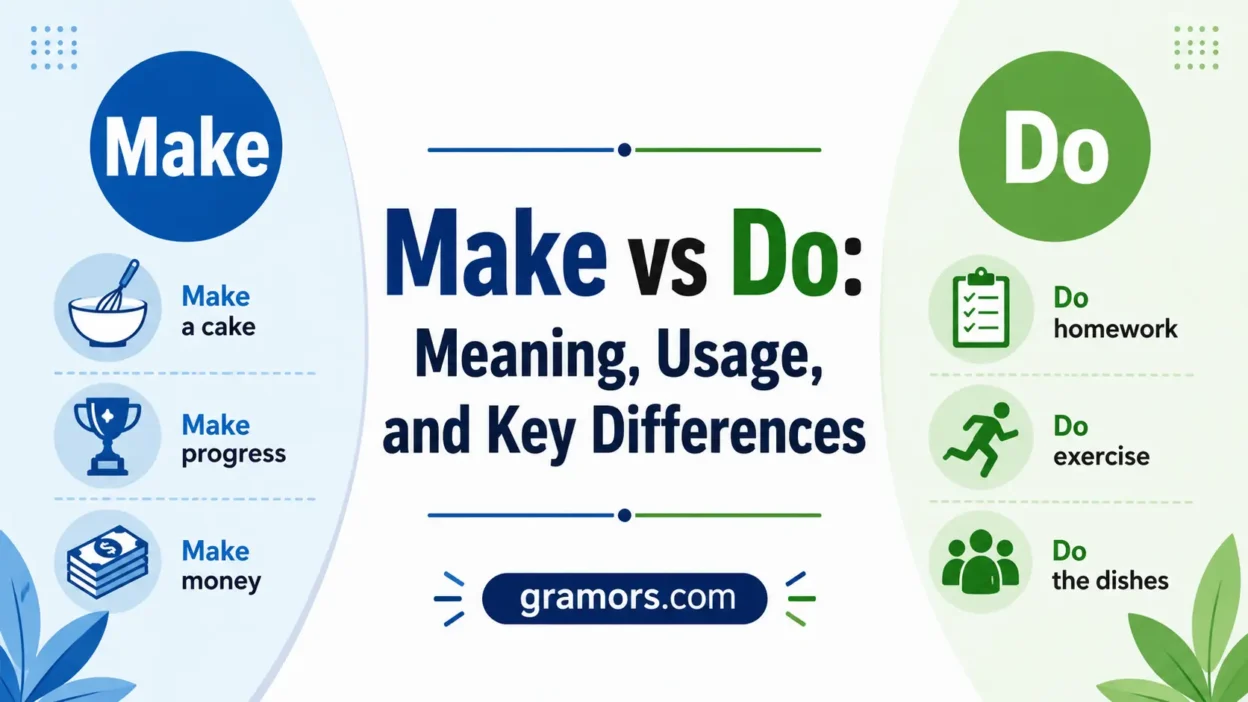
Many English learners struggle with make and do because both are extremely common verbs. They also appear in hundreds of everyday expressions.
The confusion usually comes from collocations. English speakers naturally say:
- “make a cake”
- “do homework”
But they do not usually stop to explain why.
In make vs do, the basic difference is this:
- make is usually connected to creating, producing, or causing something
- do is usually connected to tasks, work, and activities
Still, fixed phrases matter more than simple rules.
2. Quick Answer
Use make when something is created, produced, planned, or caused.
Use do when talking about tasks, work, duties, or activities.
Examples:
- “make a decision”
- “do the dishes”
These verbs are not interchangeable in standard English, even when the meaning seems similar.
3. Why People Confuse Them
People confuse these verbs because both are very general. They can describe many different actions.
Learners also try to translate directly from their first language. That often leads to mistakes like:
- “do a mistake”
- “make homework”
The biggest challenge is that many expressions are fixed. Native speakers memorize them naturally through use.
4. Key Differences At A Glance
| Context | Best Choice | Why |
|---|---|---|
| Creating something | Make | Produces a result |
| Tasks and duties | Do | Focuses on activity |
| Plans and decisions | Make | Creates an outcome |
| Work and chores | Do | Ongoing responsibilities |
| Feature | Make | Do |
|---|---|---|
| Main idea | Create or produce | Perform or complete |
| Common focus | Result | Activity or task |
| Typical examples | make breakfast | do homework |
| Usage style | Collocation-based | Collocation-based |
5. Meaning and Usage Difference
Make usually means to create, build, produce, or cause something.
Examples:
- “She made breakfast.”
- “They made a plan.”
- “The joke made me laugh.”
Do usually means to perform an action or complete a task.
Examples:
- “I need to do my homework.”
- “He does the laundry every Sunday.”
- “She did a great job.”
A helpful way to remember the difference:
- make → result
- do → activity
But English does not always follow pure logic. Some phrases simply need to be memorized.
For example:
- “make money”
- “do business”
6. Tone, Context, and Formality
Both verbs are neutral in tone. The difference is not about formal versus informal English.
Instead, the correct choice depends on established usage patterns.
Examples:
- “make a phone call”
- “do work”
- “make progress”
- “do exercise”
In school, work, and daily conversation, native speakers follow these collocations automatically.
7. Which One Should You Use?
Ask yourself this question:
Is the sentence about creating a result or performing an activity?
Choose make for:
- food
- plans
- decisions
- sounds
- mistakes
- money
Choose do for:
- chores
- homework
- jobs
- tasks
- exercise
- business
Examples:
- “make a schedule”
- “do the dishes”
The safest approach is to learn common phrase groups instead of guessing.
8. When One Choice Sounds Wrong
Some combinations sound unnatural immediately to native speakers.
Incorrect:
- “do a cake”
- “make homework”
- “do a decision”
Correct:
- “make a cake”
- “do homework”
- “make a decision”
These errors happen because English uses fixed verb pairings.
9. Common Mistakes (and Quick Fixes)
Mistake → Quick Fix
- “do a mistake” → “make a mistake”
- “make homework” → “do homework”
- “do breakfast” → “make breakfast”
- “make exercise” → “do exercise”
- “do a plan” → “make a plan”
A quick memory trick:
- If something is produced or created → usually make
- If something is completed or performed → usually do
10. Everyday Examples
- “I made coffee this morning.”
- “She does yoga every day.”
- “We made dinner together.”
- “He did the dishes after lunch.”
- “They made a decision quickly.”
- “I need to do more work.”
- “She made a new friend at school.”
- “Did you do your homework?”
- “He made a mistake in the report.”
- “We did a lot of shopping today.”
- “She made a list before traveling.”
- “I have to do laundry tonight.”
- “They made progress on the project.”
- “He did a good job during the interview.”
11. Dictionary-Style Word Details
Verb
- make: used as a verb for creating, producing, preparing, or causing something
- do: used as a verb for performing actions, tasks, or activities
Noun
- make: not commonly used as a noun in this comparison sense
- do: not commonly used as a noun in this comparison sense
Synonyms
- make: create, produce, build (closest alternatives)
- do: perform, carry out, complete (closest alternatives)
Example Sentences
- make: “She made a cake for the party.”
- do: “He did his homework after dinner.”
Word History
- make: comes from Old English roots meaning “construct” or “prepare”
- do: comes from Old English roots meaning “perform” or “act”
Phrases Containing
- make: make a decision, make money, make a plan, make progress
- do: do homework, do work, do the dishes, do business
12. FAQ & Conclusion
Can I use make and do interchangeably?
No. Most expressions use fixed verb pairings.
Why do we say “make a mistake”?
Because English treats a mistake as something produced or created.
Is there one simple rule?
The basic rule helps, but many phrases must be memorized through use.
What is the easiest way to learn make and do?
Learn them in common phrase groups instead of translating word by word.
Final takeaway:
- make usually focuses on creating or causing a result
- do usually focuses on tasks and activities
In make vs do, collocations matter most. The more natural English you hear and read, the easier these patterns become