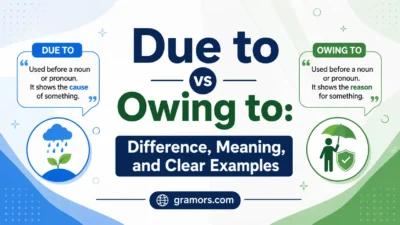
Due to vs because of can be confusing because both phrases explain a cause. You might hear “The delay was due to traffic” and “We were late because of traffic,” and both sentences sound normal.
The difference is not only meaning. It is also grammar, sentence structure, and tone. Once you know where each phrase fits best, the choice becomes much easier.
Quick Answer
Use because of when you want to explain the reason an action happened.
Use due to when it means caused by or attributable to, especially after a form of be, such as is, was, or were.
These phrases are often close in meaning, but they are not always the best fit in the same sentence.
Correct: “The cancellation was due to rain.”
Correct: “The event was canceled because of rain.”
Why People Confuse Them
People confuse due to and because of because both answer the question “why?”
Both are also followed by a noun, pronoun, gerund, or noun phrase.
Examples:
“because of bad weather”
“due to bad weather”
“because of a scheduling issue”
“due to a scheduling issue”
The main difference is structure. Because of usually explains why an action happened. Due to is cleanest when it describes the cause of a noun or condition.
Key Differences At A Glance
| Context | Best Choice | Why |
|---|---|---|
| Explaining why an action happened | because of | It naturally connects the reason to the action. |
| Describing what caused a noun or condition | due to | It works well when it means caused by or attributable to. |
| After “is,” “was,” or “were” | due to | It often links the subject to its cause. |
| Everyday speech | because of | It sounds natural and clear. |
| Formal notice or announcement | due to | It often sounds official or polished. |
| When unsure | because of | It is usually the safer general choice. |
Meaning and Usage Difference
Due to means caused by, attributable to, or as a result of.
Example: “The delay was due to heavy traffic.”
This means heavy traffic caused the delay.
Because of means by reason of, on account of, or as a result of.
Example: “We arrived late because of heavy traffic.”
This means heavy traffic was the reason we arrived late.
A simple way to test due to is to replace it with caused by.
Natural: “The closure was due to repairs.”
Test: “The closure was caused by repairs.”
A simple way to test because of is to ask what caused the action.
Natural: “The store closed because of repairs.”
Question: Why did the store close?
Compact comparison:
• Due to: best when it describes the cause of a noun or condition.
• Because of: best when it explains the reason an action happened.
• Due to: often fits after “is,” “was,” or “were.”
• Because of: often fits after action verbs.
Tone, Context, and Formality
Due to often sounds more formal, official, or announcement-like.
Example: “The meeting was postponed due to a power outage.”
You may see this style in office notices, school messages, reports, and public updates.
Because of sounds natural in everyday speech, but it also works in formal writing.
Example: “We moved the meeting because of a power outage.”
In careful professional writing, due to is often strongest when it follows a noun or a linking verb. Because of is usually smoother when the sentence focuses on an action.
Which One Should You Use?
Use because of when the sentence explains why something happened.
Correct: “We left early because of snow.”
Correct: “She missed class because of a doctor’s appointment.”
Correct: “The flight was delayed because of storms.”
Use due to when the sentence names a thing, result, problem, delay, closure, change, or condition and then explains its cause.
Correct: “The delay was due to snow.”
Correct: “Her absence was due to a doctor’s appointment.”
Correct: “The flight delay was due to storms.”
When unsure, choose because of. It is clear, common, and less likely to sound stiff.
When One Choice Sounds Wrong
Some uses of due to are common but less ideal in careful editing.
Less careful: “We canceled due to rain.”
Better: “We canceled because of rain.”
Also good: “The cancellation was due to rain.”
The first version is common in speech and casual writing. Still, strict editors may prefer because of because the phrase explains the action canceled.
Sometimes because of is understandable but less polished.
Less polished: “The cancellation was because of rain.”
Better: “The cancellation was due to rain.”
Here, the sentence is about the cancellation, so due to fits neatly.
Common Mistakes
- Mistake: Using due to just to sound formal.
- Less natural: “We changed the time due to a conflict.”
- Better: “We changed the time because of a conflict.”
- Mistake: Using due to the fact that when because is cleaner.
- Wordy: “Due to the fact that it rained, the game was postponed.”
- Better: “Because it rained, the game was postponed.”
- Mistake: Putting because of before a full subject-verb idea.
- Wrong: “Because of it rained, we stayed home.”
- Correct: “Because it rained, we stayed home.”
- Correct: “Because of the rain, we stayed home.”
Mistake: Confusing due to with do to.
Wrong: “The delay was do to traffic.”
Correct: “The delay was due to traffic.”
Everyday Examples
“The delay was due to a traffic jam.”
“We were late because of a traffic jam.”
“The school closed early because of icy roads.”
“The early closure was due to icy roads.”
“She missed the meeting because of a family emergency.”
“Her absence was due to a family emergency.”
“The project slowed down because of budget changes.”
“The slowdown was due to budget changes.”
“Our flight changed because of severe weather.”
“The flight change was due to severe weather.”
“He felt tired because of the long drive.”
“His tiredness was due to the long drive.”
“The store opened late because of a staffing issue.”
“The late opening was due to a staffing issue.”
Dictionary-Style Word Details
Verb
• Due to: Not a verb. In this comparison, due to functions as a causal phrase. It is often treated like a preposition or prepositional phrase in modern usage.
• Because of: Not a verb. Because of functions as a prepositional phrase that introduces a reason.
Noun
• Due to: Not a noun. The word due can be a noun in other contexts, but due to is not used as a noun in this comparison.
• Because of: Not a noun. It is a phrase used to introduce a cause or reason.
Synonyms
• Due to: Closest plain alternatives include caused by, attributable to, as a result of, owing to, and sometimes because of.
• Because of: Closest plain alternatives include due to, on account of, by reason of, as a result of, and owing to.
Not every alternative fits every sentence. Check the sentence structure before swapping one phrase for another.
Example Sentences
• Due to: “The delay was due to heavy traffic.”
• Due to: “Her success was due to years of practice.”
• Due to: “The outage was due to a system failure.”
• Because of: “We arrived late because of heavy traffic.”
• Because of: “She improved because of years of practice.”
• Because of: “The team paused work because of a system failure.”
Word History
• Due to: The causal use of due to became established later than the older word due itself. A major dictionary records its causal use from the late 1800s.
• Because of: Because is much older, and because of has long been used to introduce a reason.
The history is useful, but it does not change the main rule for modern writing. Sentence structure matters more than age.
Phrases Containing
• Due to: due to rain, due to illness, due to delays, due to a lack of funding, due to circumstances beyond our control.
• Because of: because of rain, because of you, because of traffic, because of the weather, because of a scheduling conflict.
FAQs
Is due to or because of correct?
Both due to and because of can be correct, but they fit different sentence structures. Use because of to explain why an action happened. Use due to when it means caused by or attributable to, especially after is, was, or were.
What is the main difference between due to and because of?
The main difference is grammar. Because of usually explains the reason for an action: “We were late because of traffic.” Due to usually describes the cause of a noun or condition: “The delay was due to traffic.”
Can I say “due to rain”?
Yes, due to rain is correct when it fits the sentence. For example, “The cancellation was due to rain” sounds natural. However, “We canceled due to rain” is common, but careful editors may prefer “We canceled because of rain.”
Is because of more natural than due to?
In everyday speech, because of often sounds more natural. It is simple, clear, and useful in many situations. Due to can sound more formal or official, especially in notices, reports, and announcements.
Is “due to the fact that” correct?
Due to the fact that is grammatically possible, but it is usually wordy. In most sentences, because is cleaner and stronger. Instead of “Due to the fact that it rained,” write “Because it rained.”
What is a simple trick for due to vs because of?
Replace due to with caused by. If the sentence still sounds natural, due to is probably a good choice. For example, “The delay was due to traffic” becomes “The delay was caused by traffic.” For actions, because of is usually safer: “We were late because of traffic.”
Should I use due to or because of in formal writing?
Both can work in formal writing. Use due to when the sentence describes a cause linked to a noun or condition, such as “The outage was due to a system failure.” Use because of when the sentence explains why someone did something or why an action happened.
Is “do to” the same as “due to”?
No. Do to is not correct when you mean because of or caused by. The correct phrase is due to. Write “The delay was due to traffic,” not “The delay was do to traffic.”
Conclusion
The easiest rule is this: use because of for the reason an action happened, and use due to when it means caused by or attributable to.
“The closure was due to repairs” focuses on the closure and its cause. “The store closed because of repairs” focuses on the action and the reason.
For due to vs because of, choose the phrase that fits the sentence structure, not the one that only sounds more formal.