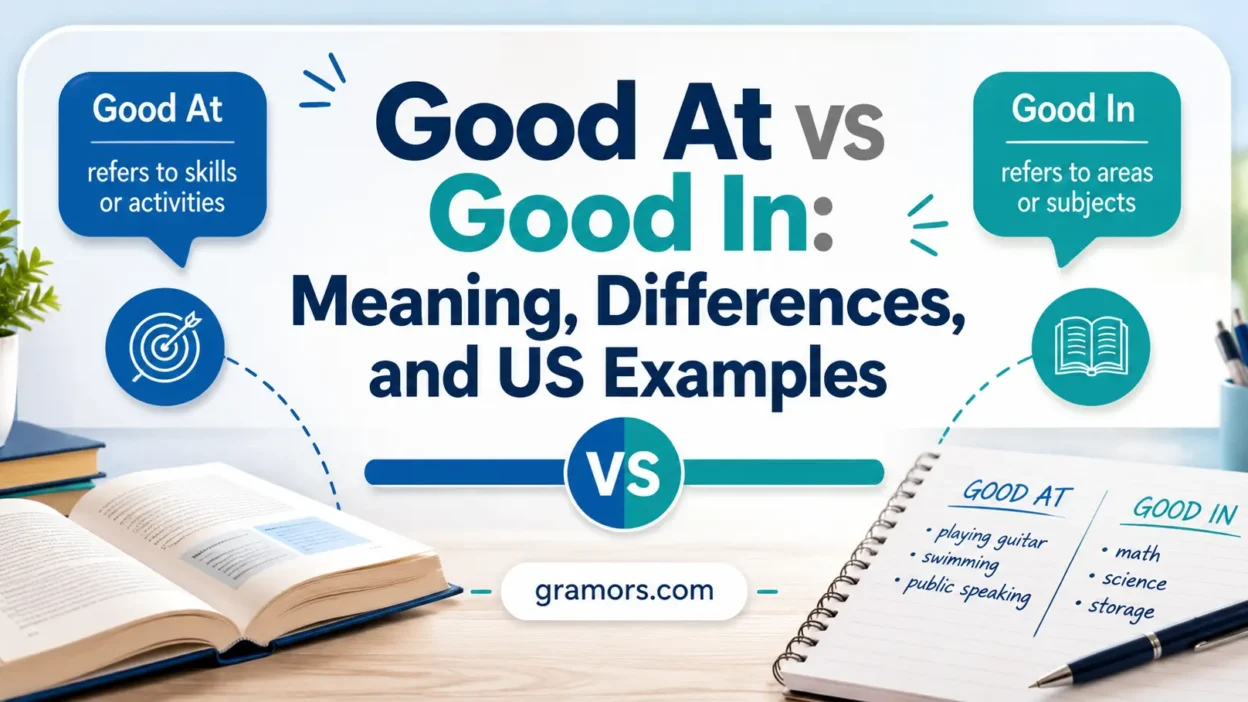
The choice between good at vs good in depends on what follows good and what the sentence evaluates.
Use good at for a skill, activity, task, or subject. Use good in when describing performance, appearance, or suitability within a situation, setting, role, or condition.
“Maya is good at math.”
“Maya is good in high-pressure situations.”
Both expressions can be correct, but they are not freely interchangeable. The difference comes from meaning and established sentence patterns rather than a simple choice between two prepositions.
Quick Answer
Use good at when naming an ability, activity, task, or school subject:
“She is good at explaining grammar.”
Use good in when in introduces the situation or environment where someone or something performs well:
“She is good in a crisis.”
For general language and math ability, use good at English and good at math.
Why People Confuse Them
Other ability words commonly use in. For example, someone may be proficient in Spanish or excel in mathematics. Learners sometimes transfer those patterns to good.
However, each adjective and verb has its own natural preposition pattern:
- “She is proficient in Spanish.”
- “She is good at Spanish.”
- “She excels in mathematics.”
School subjects can also represent either an ability or a setting. “She is good at Spanish” evaluates her language ability. “She did well in Spanish class” evaluates her performance within a particular class.
Because both constructions can describe positive performance, the distinction may initially seem small.
Key Differences At A Glance
| Feature | Good at | Good in |
|---|---|---|
| Main focus | Skill or ability | Performance or suitability within a context |
| Common complements | Activity, subject, task, pronoun, or gerund | Situation, setting, role, environment, or condition |
| Typical question | What can the person do well? | Where or under what conditions do they perform well? |
| School subjects | “Good at math” | Context-specific: “Good in math class” |
| Activities | “Good at public speaking” | Usually unsuitable for the ability itself |
| Situations | Usually unnatural | “Good in stressful situations” |
| Performances | “Good at acting” | “Good in the final scene” |
| Default for English ability | “Good at English” | Usually not the neutral choice |
| Interchangeable | Not normally | Not normally |
A simple distinction is:
- Good at identifies what someone does well.
- Good in identifies where, when, or under what conditions someone or something performs well.
Meaning and Usage Difference
Good at means capable, competent, or skillful at an activity.
It may be followed by a noun:
“He is good at chess.”
It may be followed by a pronoun:
“He is good at it.”
It may also be followed by a gerund:
“He is good at solving puzzles.”
Because at is a preposition, a following verb normally takes the -ing form. Say good at writing, not “good at write” or “good at to write.”
Good in evaluates a person or thing within a situation, environment, role, production, period, or condition.
“She is good in meetings.”
“The actor was good in the final scene.”
“These tires are good in snow.”
“You look good in that jacket.”
These examples do not all express the same type of goodness. A person may perform effectively in meetings, an actor may give a strong performance in a scene, tires may function well in snow, and clothing may improve someone’s appearance.
Both constructions contain the adjective good followed by a prepositional phrase. Neither complete expression is a verb.
Tone, Context, and Formality
Both good at and good in can appear in casual or formal English. The main difference is meaning, not formality.
In conversation:
“I’m pretty good at cooking.”
At work:
“She is good in client meetings.”
In a résumé or professional evaluation, more precise wording may sound stronger:
“She is skilled at resolving customer complaints.”
“She performs well in client-facing situations.”
Possible alternatives include skilled at, proficient in, effective in, and performs well in. The best choice depends on the intended meaning.
Neither expression belongs exclusively to American or British English.
Which One Should You Use?
Ask whether the following words name a skill or activity.
When they do, use good at:
“She is good at negotiation.”
“He is good at basketball.”
“They are good at solving technical problems.”
For a following action, use good at + gerund:
“She is good at negotiating.”
“He is good at remembering names.”
Next, ask whether the following words name a setting, condition, or situation.
When they do, good in may be correct:
“She is good in difficult negotiations.”
“He is good in unfamiliar situations.”
“This camera is good in low light.”
Some nouns can represent either an activity or a context:
“She is good at negotiations.”
This focuses on negotiation as a skill.
“She is good in difficult negotiations.”
This focuses on her performance within challenging situations.
When the distinction remains unclear, rewrite the sentence:
“She performs well in difficult negotiations.”
When One Choice Sounds Wrong
Good in sounds unnatural when the complement directly names the ability.
Unnatural: “She is good in painting.”
Natural: “She is good at painting.”
Unnatural: “He is good in speaking English.”
Natural: “He is good at speaking English.”
By contrast, good at sounds wrong when the complement is a situation rather than a skill.
Unnatural: “He is good at emergencies.”
Natural: “He is good in emergencies.”
The preposition can also distinguish ability from performance:
“She is good at acting.”
This means acting is one of her skills.
“She was good in the film.”
This evaluates her performance in a particular production.
Appearance follows another good in pattern:
Incorrect: “You look good at black.”
Correct: “You look good in black.”
Common Mistakes
Mistake: Using “in” before an activity
Incorrect: “She is good in swimming.”
Correct: “She is good at swimming.”
Mistake: Using a bare verb after “good at”
Incorrect: “He is good at play soccer.”
Correct: “He is good at playing soccer.”
Mistake: Using an infinitive after “good at”
Incorrect: “She is good at to explain ideas.”
Correct: “She is good at explaining ideas.”
Mistake: Using “good in English” as the neutral ability expression
Less natural for general ability: “I am good in English.”
Preferred: “I am good at English.”
A contextual sentence can still use in: “I performed well in English class.”
Mistake: Confusing skill with a particular performance
Incorrect for a movie performance: “He was good at the movie.”
Correct: “He was good in the movie.”
Mistake: Using “in” when “with” is needed
Incorrect: “She is good in children.”
Correct: “She is good with children.”
Use good with for handling or relating successfully to people, animals, money, or equipment.
Everyday Examples
School and Language Learning
“Jordan is good at math.”
“Jordan was especially good in math class this semester.”
“Leah is good at English.”
“She performs well in English-language discussions.”
Sports and Hobbies
“My brother is good at basketball.”
“Kara is good at drawing portraits.”
“The goalkeeper is good in one-on-one situations.”
Work and Professional Skills
“I’m good at remembering faces.”
“She is good at managing deadlines.”
“Our supervisor is good in difficult meetings.”
“He is good in high-pressure environments.”
Emergencies and Stressful Situations
“Rosa is calm and effective in emergencies.”
“The new manager is good in a crisis.”
“He is good at working under pressure.”
Acting and Performances
“That actor was good in the new series.”
“She is good at acting, especially in comedy.”
“He was excellent in the supporting role.”
Clothing and Appearance
“You look good in green.”
“She looked good in that formal jacket.”
Objects and Conditions
“This camera is good in low light.”
“These boots are good in wet weather.”
“The battery performs well in cold conditions.”
Dictionary-Style Word Details
Verb
Good at: The expression is not a verb. Good is usually an adjective following a linking verb such as be, seem, become, or get. The preposition at introduces the complement.
A following action takes a gerund:
“She is good at writing.”
Good in: This expression is also not a verb. Good remains an adjective, while in introduces a context, role, setting, or condition.
For greater precision, use a separate performance verb:
“She performs well in meetings.”
Neither expression is a phrasal verb.
Noun
Good at: The complete phrase is not a noun. Its complement may be a noun or noun phrase:
- “Good at math.”
- “Good at customer service.”
- Good in: The complete phrase is not a noun. The word good can function separately as a noun in expressions such as “the good in people,” but that structure is outside this comparison.
Synonyms
Closest alternatives for good at include:
- skilled at
- adept at
- talented at or in
- proficient at or in
- capable of
- competent at
The preposition may change when the substitute changes.
Closest paraphrases for good in include:
- performs well in
- effective in
- comfortable in
- successful in
- suitable for use in
No single substitute covers every meaning of good in.
Example Sentences
Good at
“She is good at science.”
“He is good at it.”
“They are good at finding practical solutions.”
“Marcus is good at explaining complicated ideas.”
“She became good at managing her time.”
Good in
“She is good in a crisis.”
“He was good in the supporting role.”
“You look good in that jacket.”
“The phone’s camera is good in low light.”
“Our new employee is good in group discussions.”
Word History
Good at is a long-established adjective-plus-preposition construction. No separate coinage date or special origin story is needed to explain its modern use.
Good in is generally a compositional combination of the adjective good and an in phrase identifying a context, condition, role, or environment.
The present distinction is best understood through modern sentence patterns rather than a speculative historical explanation.
Phrases Containing
Common patterns with good at include:
- good at something
- good at doing something
- not good at
- no good at
- any good at
- very good at
- really good at
- better at
- best at
Common patterns with good in include:
- good in a crisis
- good in emergencies
- good in meetings
- good in a role
- good in the movie
- look good in
- good in low light
- good in cold weather
These good in combinations do not all express the same meaning. Some evaluate performance, some describe appearance, and others describe suitability under certain conditions.
FAQs
Is it “good at English” or “good in English”?
Use good at English for general language ability:
“She is good at English.”
Good in English may appear in a specific context, such as “She did well in English class,” but it is not the usual neutral ability expression.
Is “good in” grammatically correct?
Yes. It is correct when in introduces a situation, role, environment, production, or condition:
“She is good in a crisis.”
Should I say “good at math” or “good in math”?
Use good at math for mathematical ability:
“Diego is good at math.”
A sentence such as “He did well in math this year” describes performance in a class or subject period.
Can “good at” be followed by a verb?
It can be followed by a gerund, which is the -ing form of a verb:
Correct: “She is good at writing.”
Incorrect: “She is good at write.”
Why do we say “good in a crisis”?
A crisis is the situation in which someone performs well. It is not usually treated as an activity or learned ability.
“She remains calm and makes good decisions in a crisis.”
Are “good at” and “good in” interchangeable?
Not normally. Good at evaluates a skill, while good in evaluates performance or suitability within a context.
“He is good at acting, and he was especially good in the final scene.”
Is there a reliable US-versus-UK difference?
No major regional rule changes the basic distinction. Both forms are used according to meaning in American and British English.
Which expression should I use in a résumé or job interview?
Use good at when naming a skill:
“I am good at analyzing financial reports.”
Use good in or a more precise alternative when naming a situation:
“I perform well in fast-paced environments.”
Conclusion
Choose good at when naming a skill, activity, task, or subject. Choose good in when naming the situation, role, setting, environment, or conditions in which someone or something performs well.
“She is good at solving problems.”
“She is good in difficult situations.”
Remember the central contrast: good at tells what someone does well, while good in tells where or under what conditions that strong performance appears.