Many English learners confuse beside and besides because the words look almost identical but have different meanings.
The simplest way to remember the difference is this:
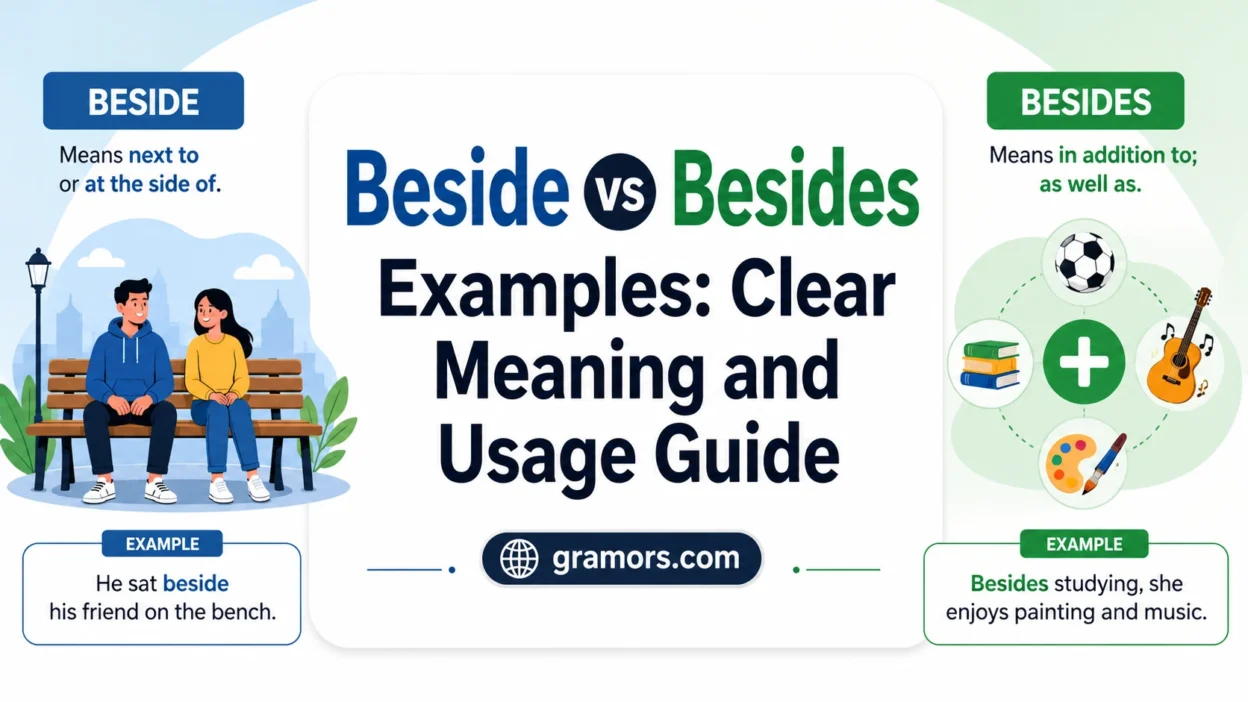
- Beside = next to or alongside
- Besides = in addition to or except
Examples:
- She sat beside me during the meeting.
- Besides that, I agree with your idea.
Understanding the distinction helps you avoid common writing mistakes and makes your sentences clearer.
2. Why People Confuse Them
The confusion comes mainly from spelling. The only visible difference is the final s, yet that small change creates a different meaning.
Many learners also see both words in similar sentence positions and assume they can be swapped.
Incorrect:
- Beside that, I agree.
Correct:
- Besides that, I agree.
Incorrect:
- She stood besides me.
Correct:
- She stood beside me.
When the words are swapped, the sentence meaning changes or sounds unnatural.
3. Key Differences At A Glance
| Context | Best Choice | Why |
|---|---|---|
| Physical location | beside | Means next to or alongside |
| Adding information | besides | Means in addition to |
| Exception meaning | besides | Means except for |
| Position near someone | beside | Refers to proximity |
| Extra reason or point | besides | Adds supporting information |
Quick Comparison
- Beside → next to, by, alongside
- Besides → also, in addition to, except
4. Meaning and Usage Difference
Beside
Beside is a preposition that usually describes physical position.
Examples:
- The lamp is beside the couch.
- He parked beside the building.
- She sat beside her friend.
In each example, the meaning is physical proximity.
Besides
Besides has two common meanings.
Meaning 1: In Addition To
Examples:
- Besides math, she studies science.
- Besides working full-time, he volunteers on weekends.
- Besides coffee, we also serve tea.
Meaning 2: Except For
Examples:
- Besides John, everyone attended the meeting.
- Besides a few delays, the trip went smoothly.
This second meaning is often overlooked, but it is an important part of modern usage.
5. Tone, Context, and Formality
Both words appear in formal and informal English.
Beside is common when describing location:
- The office is beside the bank.
- She sat beside the professor.
Besides frequently appears in essays, emails, and conversations when adding information:
- Besides the cost, we should consider the schedule.
- Besides that, the proposal has several benefits.
Neither word is restricted to casual speech or formal writing.
6. Which One Should You Use?
Ask yourself one simple question:
Are you talking about location or addition?
If you mean next to, use beside.
Examples:
- The dog slept beside the fireplace.
- He stood beside his brother.
If you mean also, in addition to, or except, use besides.
Examples:
- Besides English, she speaks Spanish.
- Besides that, I have nothing to add.
This decision process works in nearly every situation.
7. When One Choice Sounds Wrong
Some mistakes sound immediately unnatural.
Wrong:
- Beside that, I agree.
Correct:
- Besides that, I agree.
Wrong:
- Besides me sat the teacher.
Correct:
- Beside me sat the teacher.
Wrong:
- The car is besides the house.
Correct:
- The car is beside the house.
The reason these examples fail is that the intended meaning does not match the word being used.
8. Common Mistakes
Mistake 1
Wrong:
- Besides the window stood a chair.
Correct:
- Beside the window stood a chair.
Mistake 2
Wrong:
- Beside that, we need more time.
Correct:
- Besides that, we need more time.
Mistake 3
Wrong:
- She sat besides me.
Correct:
- She sat beside me.
Quick Memory Trick
- Beside = Side → both suggest physical position.
- Besides = Plus → both suggest adding information.
9. Everyday Examples
Here are practical examples from daily English.
Beside
- I parked beside the grocery store.
- The teacher stood beside the whiteboard.
- My backpack is beside the chair.
- She sat beside me on the bus.
Besides
- Besides English, he studies history.
- Besides that, the plan looks great.
- Besides the cost, there are no major concerns.
- Besides working, she attends college.
Besides
- Besides a few mistakes, the report was excellent.
- Besides Tom, everyone arrived on time.
10. Dictionary-Style Word Details
Verb
Beside: Not commonly used as a verb.
Besides: Not commonly used as a verb.
Noun
Beside: Rarely functions as a noun.
Besides: Rarely functions as a noun.
Both words primarily function as prepositions, and besides can also function as an adverb.
Synonyms
Beside
- next to
- by
- alongside
Besides
- in addition to
- also
- except
Example Sentences
Beside
- He stood beside the car.
- The hotel is beside the beach.
Besides
- Besides studying, he works part-time.
- Besides that, I completely agree.
Word History
Beside comes from older English forms connected to the idea of being at someone’s side or nearby.
Besides developed from the same root but evolved into a word that commonly expresses addition or exception.
Although related historically, their modern meanings are clearly separated.
Phrases Containing
Beside
- beside the point
- beside oneself
Besides
- besides that
- besides the fact
- besides all that
11. FAQs
What is the difference between beside and besides?
Beside means next to or alongside.
Besides means in addition to or except.
Can beside and besides be used interchangeably?
No. They usually have different meanings and are not interchangeable in standard English.
Is besides correct in formal writing?
Yes. It is commonly used in essays, reports, and professional communication.
Example:
- Besides the financial benefits, the proposal improves efficiency.
Does beside always refer to physical location?
Usually yes.
Example:
- The restaurant is beside the hotel.
It can also appear in expressions such as beside the point.
What does besides mean as a preposition?
It usually means in addition to or except for.
Examples:
- Besides chemistry, she studies biology.
- Besides a few issues, everything worked well.
12. Conclusion
The difference between beside and besides is straightforward once you focus on meaning.
Use beside when talking about something physically next to another thing.
Use besides when adding information or mentioning an exception.
Quick recap:
- She sat beside me.
- Besides that, I agree.
Remembering this simple distinction will help you choose the correct word confidently in both speaking and writing.