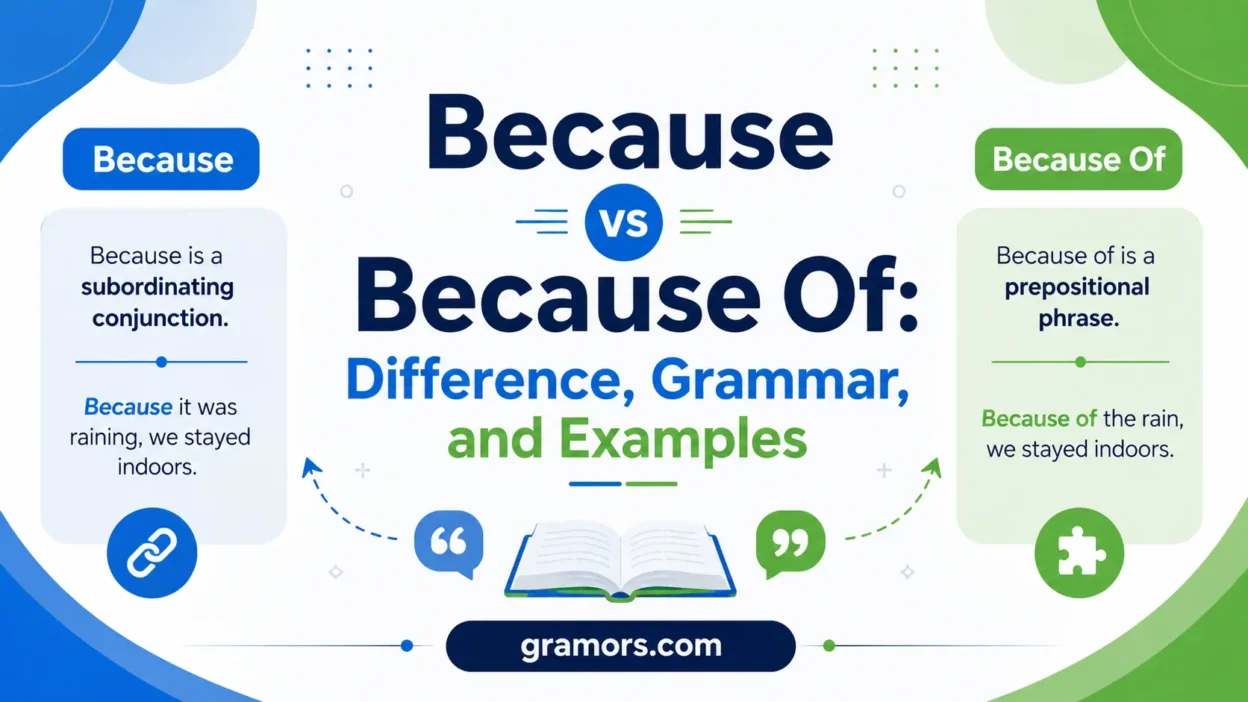
Because vs because of is a common grammar question because both phrases explain reasons. They often point to the same cause, but they do not use the same sentence pattern.
Use because before a full clause: “I stayed home because I was sick.” Use because of before a noun-style reason: “I stayed home because of my illness.” Both are correct when the grammar after them fits.
Quick Answer
Use because before a full clause with a subject and verb.
Correct: “I stayed home because I was sick.”
Correct: “The game was canceled because it was raining.”
Use because of before a noun, pronoun, noun phrase, or gerund.
Correct: “I stayed home because of my illness.”
Correct: “The game was canceled because of the rain.”
Why People Confuse Them
People confuse because and because of because both express cause. Both can mean “for the reason that” or “as a result of.”
The problem is not the meaning. The problem is the structure that follows each phrase.
Wrong: “I was late because of the traffic was bad.”
Correct: “I was late because the traffic was bad.”
Correct: “I was late because of bad traffic.”
Learners often focus on the reason and miss the grammar after the phrase.
Key Differences At A Glance
| Context | Best Choice | Why |
|---|---|---|
| Before a subject and verb | because | It introduces a full reason clause. |
| Before a noun phrase | because of | It introduces a reason phrase. |
| Before a pronoun | because of | Pronouns can follow because of. |
| Before a gerund | because of | A gerund works like a noun. |
| Formal writing | because / because of | Both are standard when used correctly. |
| Common mistake | because of + full clause | Because of should not introduce a full subject-verb clause. |
Meaning and Usage Difference
Because introduces a reason clause. A clause has a subject and a verb.
- Correct: “The game was canceled because it rained.”
- Correct: “She missed class because she was sick.”
- Correct: “We left early because we had another meeting.”
Because of introduces a reason phrase. It is followed by a noun, pronoun, noun phrase, or gerund.
- Correct: “The game was canceled because of the rain.”
- Correct: “She missed class because of the flu.”
- Correct: “We left early because of another meeting.”
- Correct: “He improved because of practicing every day.”
The meaning can be close, but the structure changes.
Compact comparison:
• Because: use before a full clause.
• Because of: use before a noun-style reason.
• Because: “because it was raining.”
• Because of: “because of the rain.”
• Because: often gives a fuller explanation.
• Because of: often gives a shorter reason phrase.
In very informal writing, people sometimes use because before a short noun or adjective, as in “because science” or “because tired.” That style is casual and playful. It does not belong in formal school, business, or professional writing.
Tone, Context, and Formality
Because is standard in both everyday and formal English. It is clear, direct, and natural.
Everyday: “We left early because we were tired.”
Formal: “The request was denied because the form was incomplete.”
Because of is also standard. It often sounds concise when the reason is a noun phrase.
Concise: “The delay happened because of traffic.”
Formal: “The shipment was delayed because of a processing error.”
Neither phrase is automatically more correct. The better choice depends on what comes next.
Informal patterns like “because science” may work in jokes, captions, or casual posts, but they are not standard for polished writing.
Which One Should You Use?
Look at the words after the phrase.
Use because if the next words form a clause with a subject and verb.
- Correct: “She passed because she studied.”
- Correct: “We stayed inside because it was cold.”
- Correct: “The store closed because the power went out.”
Use because of if the next words form a noun-style reason.
Correct: “She passed because of her studying.”
More natural: “She passed because of her effort.”
Correct: “We stayed inside because of the cold.”
Correct: “The store closed because of a power outage.”
Do not rewrite every because sentence with because of. Sometimes the clause is clearer and more natural.
When One Choice Sounds Wrong
Because of sounds wrong before a full clause.
Wrong: “We stayed inside because of it was cold.”
Correct: “We stayed inside because it was cold.”
Wrong: “The flight was delayed because of the weather was bad.”
Correct: “The flight was delayed because the weather was bad.”
Correct: “The flight was delayed because of bad weather.”
Because sounds wrong before a bare noun phrase in standard formal writing.
Wrong: “We stayed inside because the cold.”
Correct: “We stayed inside because of the cold.”
Wrong: “She missed work because the flu.”
Correct: “She missed work because of the flu.”
Correct: “She missed work because she had the flu.”
Casual speech may bend this rule, but clear standard writing should keep the difference.
Common Mistakes
Mistake: Using because of before a full clause.
Wrong: “I left early because of I felt sick.”
Correct: “I left early because I felt sick.”
Mistake: Using because before a noun phrase.
Wrong: “The picnic was canceled because the rain.”
Correct: “The picnic was canceled because of the rain.”
Mistake: Making the sentence wordy.
Wordy: “The delay happened because of the fact that the road was closed.”
Better: “The delay happened because the road was closed.”
Better: “The delay happened because of the road closure.”
Mistake: Forgetting the comma after a fronted reason phrase or clause.
Correct: “Because it rained, we canceled the picnic.”
Correct: “Because of the rain, we canceled the picnic.”
A comma is usually used when the reason comes first. When the reason comes at the end, a comma is often not needed.
Correct: “We canceled the picnic because it rained.”
Correct: “We canceled the picnic because of the rain.”
Everyday Examples
“She missed class because she was sick.”
“She missed class because of the flu.”
“The flight was delayed because the weather was bad.”
“The flight was delayed because of bad weather.”
“I was late because traffic was heavy.”
“I was late because of traffic.”
“We moved the meeting because the manager was unavailable.”
“We moved the meeting because of a scheduling conflict.”
“He got the job because he prepared well.”
“He got the job because of his preparation.”
“The store closed early because the power went out.”
“The store closed early because of a power outage.”
“They stayed home because their child had a fever.”
“They stayed home because of their child’s fever.”
Dictionary-Style Word Details
Verb
• Because: Does not commonly function as a verb. It is used to introduce a reason clause.
• Because of: Does not function as a verb. It introduces a reason phrase.
Noun
• Because: Does not commonly function as a noun in standard usage.
• Because of: Does not function as a noun. It is a phrase used before a noun-style reason.
Synonyms
• Because: Closest plain alternatives include since, as, and for the reason that. These choices depend on sentence context.
• Because of: Closest plain alternatives include due to, owing to, on account of, and as a result of.
These are not always plug-in replacements. Grammar and tone can change when you swap one phrase for another.
Example Sentences
• Because: “I left early because I had another meeting.”
• Because: “She smiled because the news was good.”
• Because: “They practiced more because they wanted to improve.”
• Because of: “I left early because of another meeting.”
• Because of: “She smiled because of the good news.”
• Because of: “They improved because of extra practice.”
Word History
• Because: Because has long been used to introduce reasons in English.
• Because of: Because of is an established phrase meaning “by reason of” or “on account of.”
The useful point for modern writers is simple: because introduces a clause, while because of introduces a phrase.
Phrases Containing
• Because: just because, simply because, because I said so, because it matters, informal because science.
• Because of: because of you, because of this, because of that, because of the weather, because of traffic.
Use informal phrases like “because science” only in casual or playful writing.
FAQs
What is the difference between because and because of?
Because comes before a full clause. Because of comes before a noun-style reason.
Correct: “We left because it was late.”
Correct: “We left because of the time.”
Is because of followed by a noun?
Yes. Because of is followed by a noun, pronoun, noun phrase, or gerund.
Correct: “because of the rain”
Correct: “because of you”
Correct: “because of working late”
Can I say because of it was raining?
No. That structure is wrong in standard English.
Wrong: “Because of it was raining, we stayed home.”
Correct: “Because it was raining, we stayed home.”
Correct: “Because of the rain, we stayed home.”
Can a sentence start with because?
Yes. A sentence can start with because when the sentence has a complete main clause.
Correct: “Because I was tired, I went to bed early.”
Can a sentence start with because of?
Yes. A sentence can also start with because of.
Correct: “Because of the storm, the game was canceled.”
Use a comma after the fronted reason phrase.
Is because more formal than because of?
No. Both are standard. Because works well before clauses, and because of works well before noun phrases. Formality depends on the full sentence.
Which is safer for school writing?
Both are safe if the structure is correct. Use because before a subject and verb. Use because of before a noun-style reason.
Conclusion
The rule is simple: because goes before a clause, and because of goes before a noun-style reason.
Correct: “I stayed home because I was tired.”
Correct: “I stayed home because of fatigue.”
For because vs because of, neither phrase is better in every sentence. The correct choice depends on what comes after it.