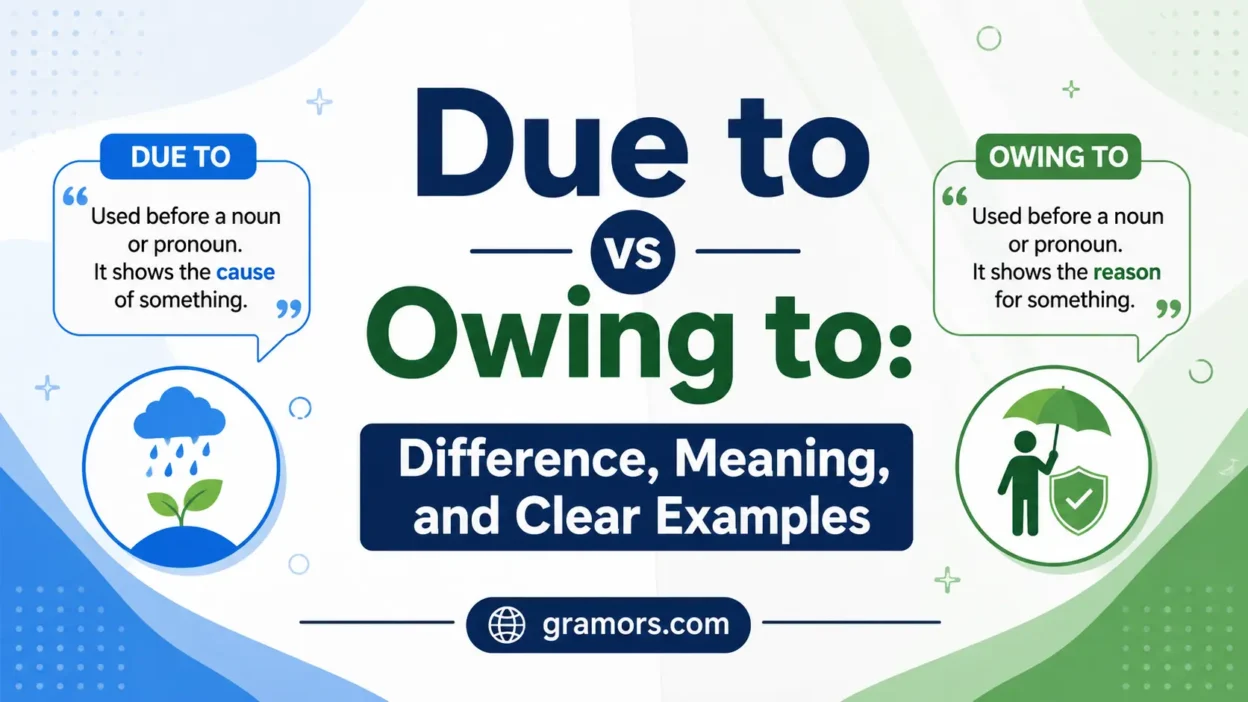
Due to vs owing to can be confusing because both phrases introduce a cause. You can say, “The event was canceled due to rain” or “Owing to heavy rain, the event was canceled,” and both are understandable.
The real difference is tone, structure, and naturalness. Due to is more common in everyday US English. Owing to is correct, but it sounds more formal and less conversational.
Quick Answer
Both due to and owing to are correct.
Use due to for most modern US writing, especially after is, was, or were: “The delay was due to traffic.”
Use owing to when you want a formal or official tone: “Owing to staff shortages, service is limited.”
They often overlap, but style and sentence structure can affect the better choice.
Why People Confuse Them
People confuse due to and owing to because both phrases mean “because of” in many sentences.
Both are followed by a noun or noun phrase:
“due to snow”
“owing to snow”
“due to a power outage”
“owing to a power outage”
Another reason is that due has other meanings. It can mean owed, expected, or scheduled.
“The payment is due Friday.”
“The train is due to arrive soon.”
“The delay was due to snow.”
Only the third sentence uses due to in the causal sense.
Key Differences At A Glance
| Context | Best Choice | Why |
|---|---|---|
| Everyday US English | due to | It sounds more common and natural. |
| Formal notice | owing to / due to | Both can work, but owing to sounds more formal. |
| After “is,” “was,” or “were” | due to | It fits naturally after linking verbs. |
| Sentence-opening cause | due to / owing to | Both are used; owing to sounds more formal. |
| Casual conversation | due to | Owing to may sound stiff. |
| Strict formal editing | owing to / because of | Some editors still prefer older distinctions. |
Meaning and Usage Difference
Due to can mean because of, as a result of, caused by, or attributable to.
Example: “The outage was due to a software issue.”
That sentence means the software issue caused the outage.
Owing to means because of or on account of.
Example: “Owing to a software issue, the system was unavailable.”
That sentence also explains the cause, but the tone is more formal.
A traditional grammar rule treats due to as more adjectival. In that view, it works best after a linking verb.
Natural: “The delay was due to traffic.”
Natural: “The problem was due to a billing error.”
Owing to works more freely as a causal phrase at the beginning or middle of a sentence.
Natural: “Owing to heavy demand, shipping may take longer.”
Natural: “Shipping may take longer owing to heavy demand.”
Modern usage is more flexible, though. Many careful writers now use due to broadly as a causal phrase.
Be careful with due to + verb. It can mean “expected to,” not “because of.”
“The flight is due to leave at 8:00.”
This means the flight is scheduled to leave at 8:00.
Compact comparison:
• Due to: common, neutral, natural in modern US English.
• Owing to: correct, formal, more official in tone.
• Due to: best after “is,” “was,” or “were.”
• Owing to: useful at the start of formal notices.
• Due to + infinitive: often means expected or scheduled.
Tone, Context, and Formality
Due to sounds neutral in modern US English. It works in everyday writing, business emails, school notices, and reports.
Casual: “We were late due to traffic.”
Workplace: “The meeting was postponed due to illness.”
Notice: “The office is closed due to a power outage.”
Owing to sounds more formal. It often fits official notices, academic writing, policy updates, and public announcements.
Formal: “Owing to limited seating, registration is required.”
Official: “Owing to staff training, the front desk will open late.”
In casual writing, owing to can sound stiff.
Stiff: “I missed lunch owing to a meeting.”
Natural: “I missed lunch due to a meeting.”
Plain: “I missed lunch because of a meeting.”
When clarity matters most, because of is often the plainest choice.
Which One Should You Use?
Use due to for most everyday US sentences.
“The meeting was postponed due to illness.”
“The package was delayed due to severe weather.”
“The error was due to a system update.”
Use owing to when you want a more formal or official tone.
“Owing to unforeseen circumstances, the office will close early.”
“Owing to limited space, guests must register in advance.”
Use because of when you want the clearest plain-English choice.
“Because of the storm, school was canceled.”
“We arrived late because of traffic.”
Do not use owing to just to sound more polished. In many everyday sentences, it sounds less natural than due to.
When One Choice Sounds Wrong
Due to is especially natural after is, was, and were.
Natural: “The closure was due to flooding.”
Less natural: “The closure was owing to flooding.”
The second sentence is not impossible, but it sounds stiff for everyday writing.
Owing to often works better at the start of a formal sentence.
Formal: “Owing to flooding, the road is closed.”
Natural: “Due to flooding, the road is closed.”
Both are acceptable, but owing to makes the sentence sound more official.
Be careful when due to is followed by a verb.
Different meaning: “The train is due to arrive soon.”
Meaning: The train is expected or scheduled to arrive soon.
That sentence does not mean the train is arriving “because of” something.
Common Mistakes
Mistake: Using due to before a full clause.
Weak: “The game was canceled due to it rained.”
Better: “The game was canceled because it rained.”
Better with a noun phrase: “The game was canceled due to rain.”
Mistake: Using due to the fact that when because is cleaner.
Wordy: “The game was canceled due to the fact that it rained.”
Better: “The game was canceled because it rained.”
Mistake: Assuming owing to is always better.
Stiff: “I stayed home owing to a headache.”
Natural: “I stayed home due to a headache.”
Plain: “I stayed home because of a headache.”
Mistake: Confusing causal due to with scheduled due to.
Causal: “The delay was due to snow.”
Scheduled: “The bus is due to arrive at noon.”
Everyday Examples
“The package was delayed due to severe weather.”
“Owing to high demand, delivery may take longer than usual.”
“The office closed early due to a power outage.”
“Owing to staff training, the front desk will open late.”
“The field trip was postponed due to rain.”
“Owing to limited seating, parents must reserve tickets.”
“Her absence was due to a medical appointment.”
“Owing to construction, the main entrance is closed.”
“The app crashed due to a server issue.”
“Owing to maintenance, online payments are unavailable.”
“The flight delay was due to fog.”
“Owing to a scheduling conflict, the meeting has been moved.”
“Our plans changed due to the storm.”
“Owing to safety concerns, the event will be held indoors.”
Dictionary-Style Word Details
Verb
• Due to: Not a verb. Due is not used as a normal verb in this phrase. In this comparison, due to functions as a causal phrase.
• Owing to: Not a verb phrase in this use. Owing comes from owe, but owing to functions as a fixed causal phrase.
Noun
• Due to: Not a noun phrase. Due can appear in other noun-related uses, such as dues, but that is outside this comparison.
• Owing to: Not a noun. It introduces a cause or reason.
Synonyms
• Due to: Closest plain alternatives include because of, as a result of, caused by, and attributable to.
• Owing to: Closest plain alternatives include because of, on account of, and as a result of.
These phrases do not have clean one-word opposites. The best replacement depends on sentence structure.
Example Sentences
• Due to: “The delay was due to heavy traffic.”
• Due to: “Due to a power outage, the store closed early.”
• Due to: “The train is due to arrive soon.”
• Owing to: “Owing to heavy traffic, the delivery arrived late.”
• Owing to: “The store closed early owing to a power outage.”
• Owing to: “Owing to staff shortages, the clinic will reduce weekend hours.”
Word History
• Due to: Due is older as an adjective meaning owed, proper, or expected. Its causal use has been debated, but it is now widely accepted in modern English.
• Owing to: Owing relates to owe. Over time, owing to developed as a fixed phrase meaning “because of” or “on account of.”
The history explains why some editors treat the phrases differently, but modern choice depends mostly on tone and sentence structure.
Phrases Containing
• Due to: due to bad weather, due to illness, due to technical issues, due to arrive, payment due.
• Owing to: owing to bad weather, owing to illness, owing to staff shortages, owing to circumstances beyond our control.
Remember that due to arrive is not the same structure as due to bad weather. One means expected or scheduled; the other explains a cause.
FAQS
Are due to and owing to both correct?
Yes. Both are correct. Due to is more common in modern US English, while owing to sounds more formal.
Example: “The delay was due to traffic.”
Example: “Owing to traffic, we arrived late.”
Which is more common in US English?
Due to is more common in everyday US English. It sounds natural in emails, notices, reports, and casual writing.
Example: “The event was canceled due to rain.”
Is owing to formal?
Yes, owing to usually sounds formal, official, or slightly old-fashioned in casual contexts.
Example: “Owing to limited seating, registration is required.”
Can a sentence start with due to?
Yes. A sentence can start with due to, especially in modern usage.
Example: “Due to severe weather, school will open late.”
Some strict editors may prefer owing to or because of in that position, but due to is widely used.
Should I use because of instead?
Use because of when you want the clearest plain-English option.
Example: “Because of the storm, the game was canceled.”
It is often smoother than owing to and less formal than due to in some contexts.
Is due to the fact that wordy?
Yes. Due to the fact that is usually wordy. Use because instead.
Wordy: “Due to the fact that it rained, we stayed home.”
Better: “Because it rained, we stayed home.”
Can due to mean expected to?
Yes. Due to can mean expected or scheduled when it comes before a verb.
Example: “The train is due to arrive soon.”
That sentence does not mean “because of arrive.” It means the train is expected to arrive soon.
Conclusion
Both due to and owing to are correct. Due to is the common modern choice in US English. Owing to is useful when you want a formal or official tone.
“The delay was due to traffic” sounds natural and direct. “Owing to traffic, we arrived late” sounds more formal.
For due to vs owing to, choose based on tone, sentence structure, and clarity. Do not treat either phrase as always wrong or always better.