Many writers and English learners struggle with choosing between between and among because both words describe relationships, positions, and distribution.
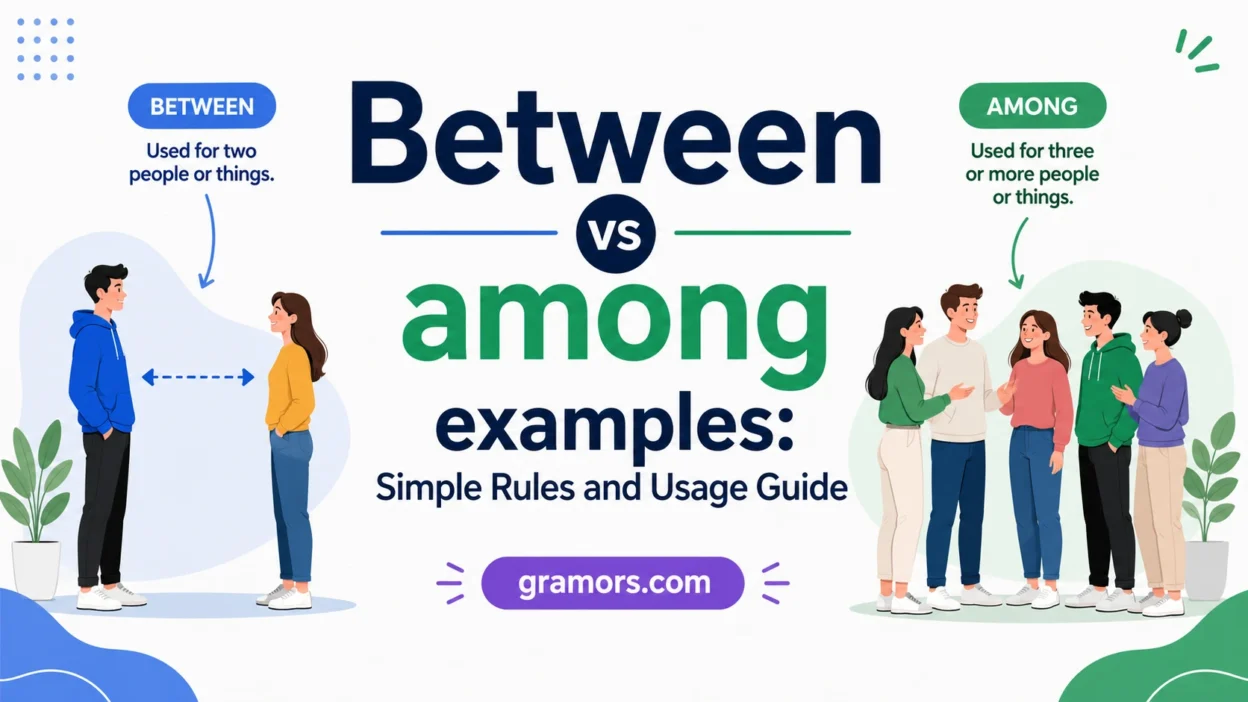
Traditionally, people were taught that between is for two things and among is for three or more. Modern English usage is more nuanced than that.
Examples:
- between John and Mary
- among friends
The real difference usually depends on whether you are thinking about separate individuals or a group as a whole.
2. Quick Answer
Use between when focusing on distinct, identifiable people, things, places, or relationships.
Examples:
- A treaty between three nations.
- An agreement between the departments.
Use among when focusing on a group viewed collectively.
Examples:
- A discussion among researchers.
- She felt comfortable among friends.
The number of people or things matters less than how the relationship is viewed.
3. Why People Confuse Them
Many people learned the simple rule:
- between = two
- among = three or more
While this rule sometimes works, it does not explain many real-world sentences.
Examples:
- The agreement was made between the three companies.
- The agreement was discussed among the three companies.
Both can be correct, but they focus on different ideas.
The first sentence highlights individual relationships. The second highlights the companies as a group.
This is why older grammar advice can sometimes create confusion.
4. Key Differences At A Glance
| Context | Best Choice | Why |
|---|---|---|
| Relationship between separate entities | between | focuses on individuals |
| Membership within a group | among | focuses on the collective |
| Choices between options | between | compares distinct alternatives |
| Distribution throughout a group | among | emphasizes the group |
| Agreements and differences | between | focuses on identifiable participants |
| Feature | Between | Among |
| Focus | Individuals | Group |
| Relationship Type | Separate entities | Collective body |
| Common Uses | Agreements, choices, differences | Groups, crowds, communities |
| Example | Between the three nations | Among the students |
5. Meaning and Usage Difference
Between is generally used when separate people or things are considered individually.
Examples:
- The difference between math, science, and history is clear.
- The secret remained between the three friends.
- The agreement between the departments improved communication.
Notice that each participant is viewed separately.
Among is used when people or things are viewed as part of a larger group.
Examples:
- There was excitement among the students.
- The rumor spread among employees.
- Cooperation among committee members improved morale.
In distribution situations, the choice changes the emphasis.
Examples:
- Divide the work among the team members.
- The negotiations occurred between the team members.
One emphasizes the group. The other emphasizes relationships among individuals.
6. Tone, Context, and Formality
Both words appear naturally in formal and informal English.
Formal writing:
- The treaty between the nations lasted decades.
- Debate among scholars continues today.
Business writing:
- Communication between departments improved.
- Collaboration among employees increased.
Everyday conversation:
- The argument was between my cousins.
- I felt relaxed among friends.
The difference is based on meaning, not formality.
7. Which One Should You Use?
Ask yourself a simple question:
Are you focusing on separate individuals or a group?
Use between when:
- comparing options
- describing agreements
- discussing relationships
- identifying differences
Examples:
- Choose between the three proposals.
- The connection between the offices is strong.
Use among when:
- describing group membership
- discussing distribution
- referring to a crowd or collection
Examples:
- She was popular among her classmates.
- The prizes were distributed among the winners.
8. When One Choice Sounds Wrong
Some sentences sound awkward because the word does not match the intended meaning.
Awkward:
- The difference among the two products is significant.
Better:
- The difference between the two products is significant.
Awkward:
- He hid between the trees.
Better:
- He hid among the trees.
Why?
Trees in a forest are viewed as a collective group, so “among” sounds more natural.
Likewise:
- The agreement among the contract terms
sounds awkward because agreements usually exist between identifiable parties.
9. Common Mistakes
- Mistake:
- Between is only for two things.
Correction:
- Between can be used with three or more distinct entities.
Example:
- The treaty was signed between the three countries.
- Mistake:
- Use among whenever there are more than two items.
Correction:
- Consider whether the focus is on individuals or the group.
Example:
- The differences between the three plans were obvious.
- Mistake:
- Divide the money between twenty students.
Correction:
- Divide the money among twenty students.
Reason:
- Distribution across a group usually favors “among.”
10. Everyday Examples
School
- The difference between algebra and geometry is easy to explain.
- Team spirit grew among the students.
Workplace
- Communication between departments improved.
- Trust developed among employees.
Family
- The disagreement was between the siblings.
- Laughter spread among family members.
Travel
- Flights operate between major cities.
- We met travelers from many countries among the tour group.
Social Situations
- The secret stayed between friends.
- She felt welcome among neighbors.
Additional Examples
- Choose between these three restaurants.
- Respect among coworkers improves productivity.
- Cooperation between agencies increased.
- The prizes were shared among participants.
- Tension existed between the leaders.
- Excitement spread among fans.
- The differences between the options were obvious.
- He was sitting among strangers.
- Negotiations continued between all parties.
- Support grew among voters.
11. Dictionary-Style Word Details
Verb
• BETWEEN: Not commonly used as a verb.
• AMONG EXAMPLES: Not commonly used as a verb.
• Applicability: Not commonly applicable to either term.
Noun
• BETWEEN: Not commonly used as a noun.
• AMONG EXAMPLES: Not commonly used as a noun.
• Applicability: Not commonly applicable to either term.
Synonyms
- • BETWEEN:
- Closest alternatives include “in relation to” and “connecting.”
- • AMONG EXAMPLES:
- Closest alternatives include “amid,” “amidst,” and “within a group.”
- • Applicability:
- Partly applicable because exact substitutions depend on context.
Example Sentences
• BETWEEN:
- The discussion occurred between the three managers.
- The difference between the products was noticeable.
- Trust developed between the partners.
• AMONG EXAMPLES:
- Excitement spread among the crowd.
- The funds were distributed among employees.
- She felt comfortable among friends.
Word History
• BETWEEN:
Comes from Old English and has historically been used with both two and more than two entities when they are viewed individually.
• AMONG EXAMPLES:
Comes from Old English and has long been associated with groups, crowds, and collective settings.
Phrases Containing
• BETWEEN:
- between you and me
- between a rock and a hard place
- difference between
• AMONG EXAMPLES:
- among friends
- among other things
- among ourselves
12. FAQs
Can between be used for three people?
Yes.
Example:
- The agreement was reached between the three partners.
Modern grammar authorities accept this usage because the partners are viewed individually.
Is among always for more than two?
No.
The focus is on the group rather than the number.
Example:
- There was trust among the committee members.
Can either word be correct?
Sometimes.
Example:
- Negotiations between the companies continued.
- Cooperation among the companies improved.
The meaning emphasis changes.
Should I say divide between or divide among?
Usually use among when distributing something throughout a group.
Example:
- The profits were divided among the shareholders.
What do modern style guides recommend?
Most modern guides recommend focusing on:
- individual relationships → between
- collective groups → among
rather than relying only on the old two-versus-three rule.
13. Conclusion
The difference in between vs among examples is not mainly about numbers.
Use between when focusing on distinct relationships, comparisons, agreements, or choices between identifiable entities.
Use among when focusing on a group, crowd, or collective setting.
Final comparison:
- The negotiations occurred between the three countries.
- Unity grew among the three countries.
Both are correct, but each highlights a different way of viewing the same participants.