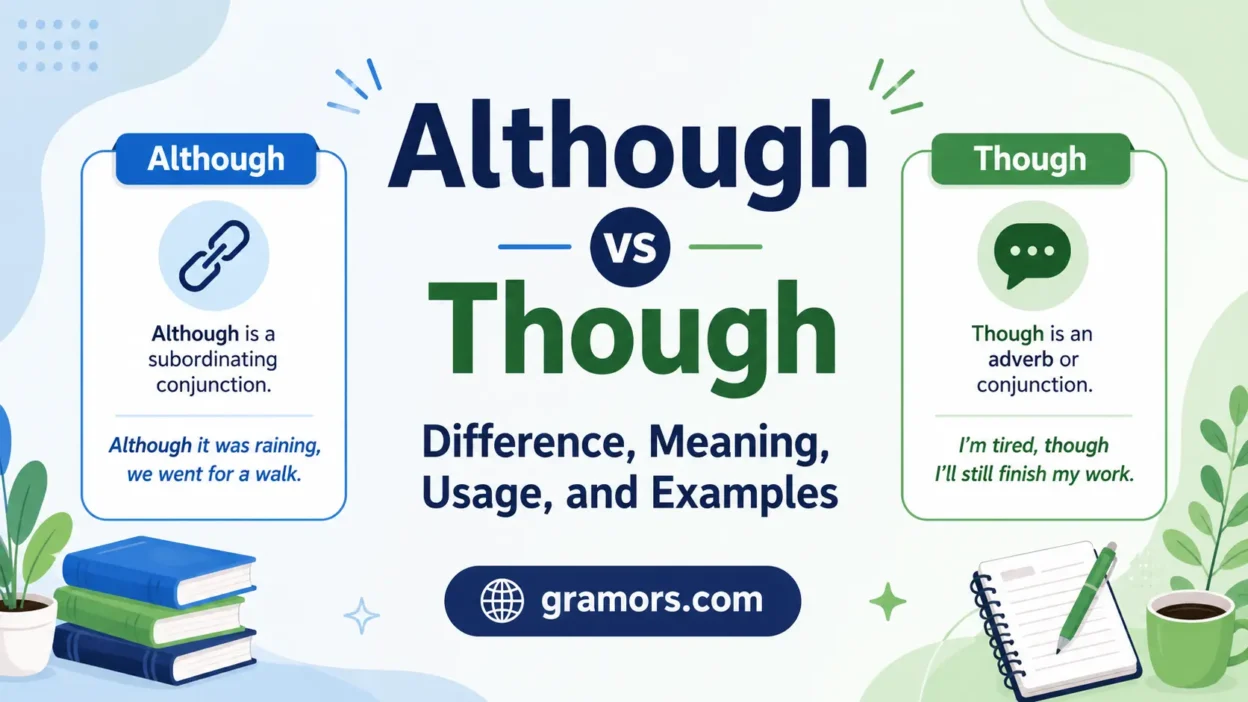
Although vs though can be confusing because both words show contrast. They often mean nearly the same thing when they introduce a clause.
The main difference is grammar role and tone. Although usually works as a slightly more formal contrast word. Though can work the same way, but it can also appear at the end of a sentence.
Correct: “Although it was raining, we went outside.”
Correct: “Though it was raining, we went outside.”
Correct: “It was raining. We went outside, though.”
Quick Answer
Use although for a clear, slightly more formal contrast clause.
Correct: “Although I was tired, I finished the work.”
Use though for a more conversational contrast clause or as an ending word meaning however or nevertheless.
Correct: “I was tired. I finished the work, though.”
Why People Confuse Them
People confuse although and though because they share a core meaning. Both can introduce surprising or contrasting information.
Correct: “Although she was nervous, she spoke clearly.”
Correct: “Though she was nervous, she spoke clearly.”
The confusion grows because though has an extra use. It can appear at the end of a sentence as a soft contrast marker.
Correct: “She was nervous. She spoke clearly, though.”
Both words also contain gh, but pronunciation is not the main issue. The real issue is how each word works in a sentence.
Key Differences At A Glance
| Context | Best Choice | Why |
|---|---|---|
| Formal contrast clause | although | It sounds more polished and written. |
| Conversational contrast clause | though | It sounds natural in speech and casual writing. |
| End of a sentence | though | It can mean however or nevertheless. |
| End of a sentence with although | not although | Although does not work as a sentence-final adverb. |
| Beginning of a sentence | although / though | Both can introduce a contrast clause. |
| Main grammar difference | though | Though can be a conjunction or an adverb. |
Meaning and Usage Difference
Although is commonly used as a subordinating conjunction. It introduces a subordinate clause that contrasts with the main clause.
Correct: “Although he studied hard, he failed the test.”
This sentence means he studied hard, but the result was still surprising.
Though can also be a subordinating conjunction.
Correct: “Though he studied hard, he failed the test.”
In that use, though is close in meaning to although, but it sounds a little more conversational.
Though can also work as an adverb at the end of a sentence.
Correct: “He studied hard. He failed the test, though.”
Here, though means something close to however, nevertheless, or still.
Compact comparison:
• Although: introduces a contrast clause.
• Though: introduces a contrast clause.
• Though: can also appear at the end of a sentence.
• Although: usually sounds more polished.
• Though: often sounds more conversational.
Tone, Context, and Formality
Although often sounds more formal, polished, or written.
Formal: “Although the policy is useful, it has limits.”
This makes although a strong choice for school essays, business writing, reports, and careful explanations.
Though often sounds more conversational and natural in speech.
Conversational: “The policy is useful. It has limits, though.”
Though can also appear in the middle of a sentence.
Natural: “The policy is useful, though it has limits.”
Formality is not a hard rule. Both words can appear in formal and informal writing. Still, although usually feels more polished, while though usually feels more relaxed.
Which One Should You Use?
Use although when you want a clear and polished contrast clause.
Correct: “Although the report is short, it is complete.”
Correct: “Although I left early, I still hit traffic.”
Use though when you want a more conversational tone.
Correct: “Though the report is short, it is complete.”
Correct: “Though I left early, I still hit traffic.”
Use though at the end when you want to add a contrast after the main statement.
Correct: “The report is short. It is complete, though.”
Correct: “I left early. I still hit traffic, though.”
Do not avoid though in professional writing. Just make sure the tone and sentence position fit.
When One Choice Sounds Wrong
Although sounds wrong at the end of a sentence when you mean however.
Wrong: “I liked the movie, although.”
Correct: “I liked the movie, though.”
Though works naturally in that ending position.
Correct: “The restaurant was crowded. The food was good, though.”
Both although and though need a real contrast when they introduce a clause.
Awkward: “Although the food was delicious, I ate a lot.”
Better: “Because the food was delicious, I ate a lot.”
The first sentence is awkward because eating a lot is not a contrast to delicious food. It is the expected result.
Common Mistakes
Mistake: Using although and but together in the same clause pattern.
Wrong: “Although it was raining, but we went outside.”
Correct: “Although it was raining, we went outside.”
Correct: “It was raining, but we went outside.”
Mistake: Using although at the end of a sentence.
Wrong: “The test was hard, although.”
Correct: “The test was hard, though.”
Mistake: Using although before only a noun phrase.
Wrong: “Although the rain, we went outside.”
Correct: “Although it was raining, we went outside.”
Mistake: Using either word when there is no contrast.
Awkward: “Though I was hungry, I ate dinner.”
Better: “Because I was hungry, I ate dinner.”
Reduced clauses exist in formal writing, such as “Although tired, she continued.” Beginners should first learn the full-clause pattern: “Although she was tired, she continued.”
Everyday Examples
“Although I left early, I still hit traffic.”
“I left early, though I still hit traffic.”
“I left early. I still hit traffic, though.”
“Although the team lost, they played well.”
“The team lost. They played well, though.”
“Although the store was busy, the line moved fast.”
“The store was busy. The line moved fast, though.”
“Though I wanted to go, I had to work.”
“I wanted to go. I had to work, though.”
“Although the class was difficult, I passed.”
“The class was difficult. I passed, though.”
“Though the price was high, the quality was excellent.”
“The price was high. The quality was excellent, though.”
Dictionary-Style Word Details
Verb
• Although: Not commonly used as a verb. It is a function word used to introduce contrast.
• Though: Not commonly used as a verb. It is used as a conjunction or an adverb.
Noun
• Although: Not commonly used as a noun in normal modern English.
• Though: Not commonly used as a noun in normal modern English.
Both words are best understood as function words, not as nouns or verbs.
Synonyms
• Although: Closest plain alternatives include though, even though, while, but, and despite the fact that, depending on structure.
• Though: As a conjunction, close alternatives include although and even though. As an adverb, close alternatives include however, nevertheless, still, and all the same.
These are not perfect one-for-one replacements. The right choice depends on grammar role, sentence position, and tone.
Example Sentences
• Although: “Although the class was difficult, I passed.”
• Although: “I enjoyed the trip, although the weather was bad.”
• Though: “Though the class was difficult, I passed.”
• Though: “The class was difficult. I passed, though.”
The first though example overlaps with although. The second works only with though, not although.
Word History
• Although: Although developed from all plus though in Middle English.
• Though: Though is older and has long-standing uses as both a conjunction and an adverb.
This history helps explain why the words are related, but modern usage depends more on sentence role and tone.
Phrases Containing
• Although: The most common pattern is although + subject + verb, as in “although I agree” or “although it changed.” The spelling altho appears informally, but although is the standard spelling.
• Though: Common phrases include even though, as though, and sentence-final though.
Note: As though usually means as if, so it is not the same as the basic contrast in although vs though.
FAQs
Can I use though instead of although?
Yes, often. When both words introduce a contrast clause, they can be close in meaning.
Correct: “Although I was tired, I kept working.”
Correct: “Though I was tired, I kept working.”
Although sounds more polished. Though sounds more conversational.
Can I end a sentence with though?
Yes. Though can appear at the end of a sentence.
Correct: “I did not love the ending. The movie was good, though.”
In this position, though means something close to however.
Is although more formal than though?
Usually, yes. Although often sounds more formal or written. Though often sounds more conversational.
Still, both words can appear in many types of writing.
Is although but correct?
No. Avoid using although and but together in that same sentence pattern.
Wrong: “Although it was late, but we stayed.”
Correct: “Although it was late, we stayed.”
Correct: “It was late, but we stayed.”
Can though start a sentence?
Yes. Though can start a sentence.
Correct: “Though I was busy, I replied.”
This is standard. It is not wrong or too casual by itself.
Can although go at the end of a sentence?
No, not in the normal however meaning.
Wrong: “I liked it, although.”
Correct: “I liked it, though.”
Use though for that sentence-final contrast.
Do although and though need commas?
When the contrast clause comes first, a comma usually follows it.
Correct: “Although it was raining, we went outside.”
Correct: “Though it was raining, we went outside.”
When the contrast clause comes second, the comma depends on flow and emphasis.
Conclusion
Use although for clear, polished contrast clauses. Use though for the same basic clause meaning in a more conversational tone, or at the end of a sentence to mean however or nevertheless.
Correct: “Although I was busy, I replied.”
Correct: “I was busy. I replied, though.”
For although vs though, the best choice depends on grammar role, sentence position, and tone.