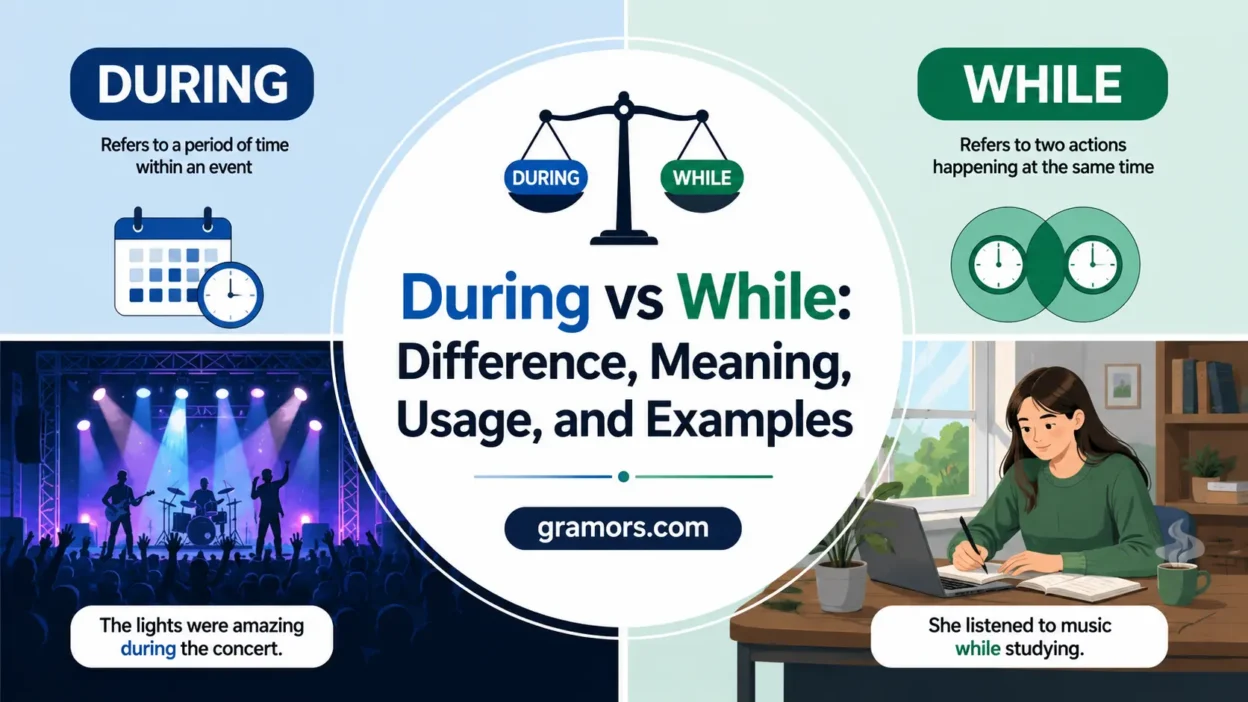
During vs while can confuse writers because both words connect ideas to time. The difference is not basic meaning only. The real difference is what comes after each word.
Use during before a noun or noun phrase: “during the meeting.” Use while before a clause or action: “while we were meeting.” Both are standard, but they do not fit the same sentence structure.
Quick Answer
Use during before a noun or noun phrase.
Correct: “I slept during the flight.”
Use while before a clause or action.
Correct: “I slept while I was flying.”
You can also use while + -ing when the subject is understood.
Correct: “I listened to music while waiting.”
Why People Confuse Them
People confuse during and while because both can mean “at the same time as another event.”
Correct: “We talked during lunch.”
Correct: “We talked while I ate lunch.”
The meaning overlaps, but the structure changes. During points to a named time, event, or period. While introduces an action or situation happening at the same time.
Key Differences At A Glance
| Context | Best Choice | Why |
|---|---|---|
| Before a noun | during | It points to a named time or event. |
| Before a noun phrase | during | It fits phrases like “the meeting” or “my stay.” |
| Before a subject and verb | while | It introduces a full clause. |
| Before an action | while | It can show two actions happening together. |
| For contrast | while | It can also mean whereas. |
| Common mistake | depends on structure | Do not use “during I worked” or “while the meeting.” |
Meaning and Usage Difference
During points to something happening in, within, or throughout a named time period or event.
Correct: “The power went out during the storm.”
Correct: “She took notes during class.”
Correct: “We visited three museums during our stay.”
While connects two actions or situations happening at the same time.
Correct: “The power went out while we were watching TV.”
Correct: “She took notes while the teacher explained the lesson.”
Correct: “We took photos while we walked through the city.”
The key rule is simple: during does not normally come before a full subject-verb clause.
Wrong: “During we were watching TV, the power went out.”
Correct: “While we were watching TV, the power went out.”
Compact comparison:
• During: before a named time, event, or period.
• While: before a clause, action, or understood action.
• During: “during the storm.”
• While: “while it was storming.”
• While: can also show contrast, as in “The first plan is cheaper, while the second is faster.”
Tone, Context, and Formality
The difference between during and while is mostly grammatical, not tonal. Both words work in casual, academic, and professional writing.
Casual: “Text me during lunch.”
Professional: “Please stay quiet during the presentation.”
Casual: “Call me while you are on break.”
Professional: “Please remain seated while the meeting is in progress.”
While can sound slightly more formal when it shows contrast.
Example: “The first plan is cheaper, while the second is faster.”
A related word, whilst, appears in some formal or British-style writing. In modern US English, while is the normal choice.
Which One Should You Use?
Choose during before a named event, time, or period.
Correct: “during the interview”
Correct: “during the game”
Correct: “during the summer”
Correct: “during my stay”
Choose while before an action or full subject-verb idea.
Correct: “while I was answering questions”
Correct: “while she was driving”
Correct: “while we waited”
Correct: “while the kids were playing”
You can often rewrite a sentence to use the other word, but you must change the structure.
Correct: “I took notes during the lecture.”
Correct: “I took notes while the professor was lecturing.”
When One Choice Sounds Wrong
During sounds wrong before a full clause.
Wrong: “During I was driving, my phone rang.”
Correct: “While I was driving, my phone rang.”
Wrong: “During we waited, it started raining.”
Correct: “While we waited, it started raining.”
While does not replace during before event nouns in this comparison.
Wrong: “I took notes while the meeting.”
Correct: “I took notes during the meeting.”
Wrong: “She felt nervous while the exam.”
Correct: “She felt nervous during the exam.”
The phrase for a while is different. In that phrase, while is a noun meaning a period of time.
Correct: “We waited for a while.”
Common Mistakes
Mistake: Using during before a clause.
Wrong: “During I was studying, my phone rang.”
Correct: “While I was studying, my phone rang.”
Mistake: Using while before an event noun.
Wrong: “She called me while the meeting.”
Correct: “She called me during the meeting.”
Mistake: Using during for duration.
Wrong: “I studied during two hours.”
Correct: “I studied for two hours.”
Mistake: Missing the comma after an opening while clause.
Correct: “While I was studying, my phone rang.”
When the while clause comes first, a comma usually follows it. When it comes second, the comma is often not needed.
Correct: “My phone rang while I was studying.”
Everyday Examples
“We talked during dinner.”
“We talked while we were eating dinner.”
“She felt nervous during the exam.”
“She felt nervous while she was taking the exam.”
“I slept during the flight.”
“I slept while the plane was in the air.”
“The kids played inside during the storm.”
“The kids played inside while it was storming.”
“He checked his email during the meeting.”
“He checked his email while his manager was speaking.”
“They took pictures during the game.”
“They took pictures while the team was warming up.”
“I listened to a podcast during my commute.”
“I listened to a podcast while driving to work.”
Dictionary-Style Word Details
Verb
• During: Does not commonly function as a verb in modern English.
• While: Can function as a verb in the phrase while away, meaning to pass time pleasantly.
Example: “We whiled away the afternoon at the park.”
Noun
• During: Does not commonly function as a noun.
• While: Can function as a noun meaning a period of time.
Examples: “for a while,” “after a while,” “once in a while.”
Synonyms
• During: Closest plain alternatives include throughout, in, over, and in the course of. The best choice depends on context.
• While: Closest plain alternatives include when, as, whereas, and although. The right replacement depends on whether while shows time or contrast.
Example Sentences
• During: “She asked a question during class.”
• During: “We stayed inside during the storm.”
• During: “They traveled during the summer.”
• While: “She asked a question while I was teaching.”
• While: “We stayed inside while it was raining.”
• While: “We waited for a while.”
Word History
• During: During is connected to older forms related to lasting or continuing through time.
• While: While has long been used in English to refer to time. It also developed uses for contrast, as in “whereas.”
The history is less important than the modern structure: during takes a noun-style time expression, while while often introduces an action or clause.
Phrases Containing
• During: during the day, during the night, during the meeting, during the summer, during my stay.
• While: for a while, after a while, once in a while, while away the time, while you wait.
These phrases show why the words can feel similar but behave differently.
FAQs
Is it during or while I was sleeping?
Use while before “I was sleeping.”
Correct: “The storm started while I was sleeping.”
Use during before a noun phrase.
Correct: “The storm started during the night.”
Can I say during I was working?
No. Use while before a full clause.
Wrong: “During I was working, someone called.”
Correct: “While I was working, someone called.”
Is while the meeting correct?
Not in this meaning. Use during the meeting.
Wrong: “I took notes while the meeting.”
Correct: “I took notes during the meeting.”
What comes after during?
A noun or noun phrase usually follows during.
Correct: “during class”
Correct: “during the storm”
Correct: “during my stay”
What comes after while?
A clause, action, or understood action usually follows while.
Correct: “while I studied”
Correct: “while she was driving”
Correct: “while waiting”
Can while mean whereas?
Yes. While can show contrast.
Correct: “The first option is cheaper, while the second option is faster.”
That use is different from the time meaning.
Should I use during or for with time length?
Use for with a length of time.
Wrong: “I slept during eight hours.”
Correct: “I slept for eight hours.”
Use during for a named period.
Correct: “I slept during the flight.”
Conclusion
Use during to name the time, event, or period.
Correct: “We talked during the movie.”
Use while to introduce the action happening at that time.
Correct: “We talked while we watched the movie.”
For during vs while, both words are standard. The right choice depends on the grammar that comes after the word.