While vs when can be confusing because both words connect actions in time. You might say, “I was cooking when the phone rang” or “I listened to music while I was cooking.”
Both sentences talk about time, but they do not focus on time in the same way. While often points to an ongoing action or background situation. When often points to a time, event, moment, condition, or repeated situation.
Quick Answer
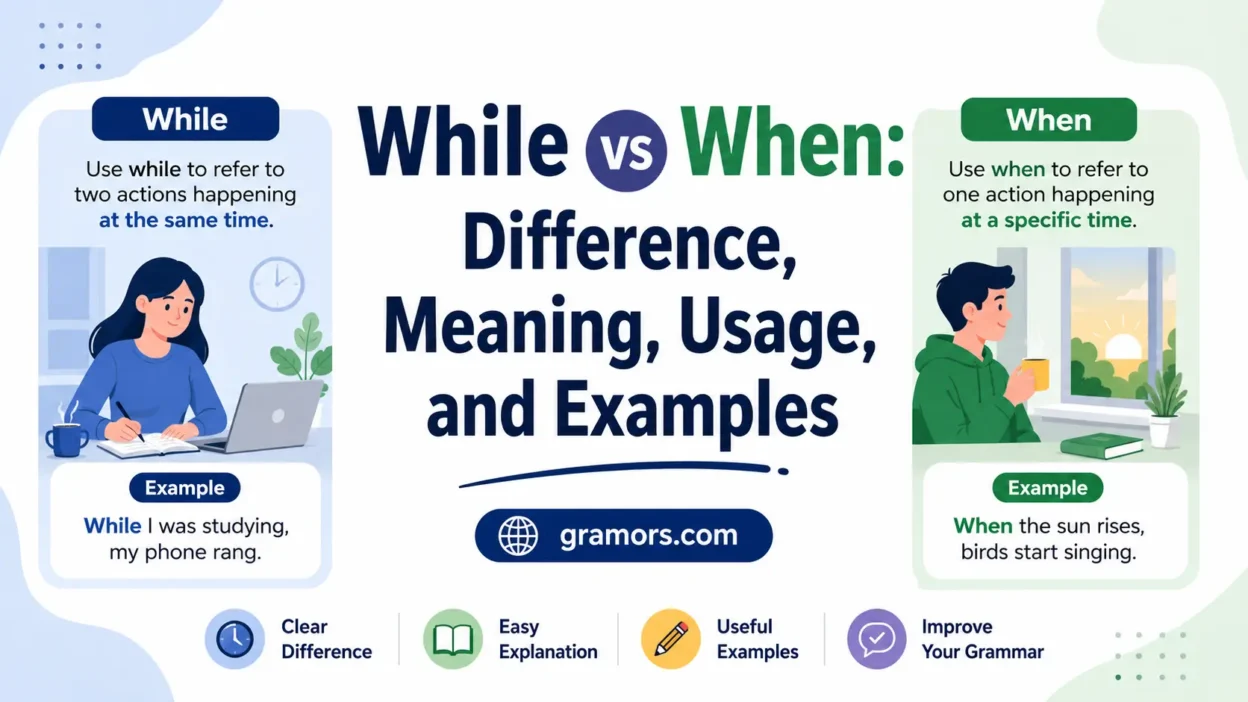
Use while for ongoing actions, background actions, or two actions happening at the same time.
Correct: “She called while I was driving.”
Use when for a specific time, event, moment, condition, or repeated situation.
Correct: “She called when I got home.”
Both can overlap, but the best choice depends on what the sentence emphasizes.
Why People Confuse Them
People confuse while and when because both can show that one thing happens at the same time as another.
Correct: “I was studying when he arrived.”
Correct: “I was studying while he was watching TV.”
Both words also introduce subordinate clauses. That means they can begin a smaller part of a sentence that depends on the main idea.
The confusion often appears in past continuous sentences because one action is already happening when another action starts.
Key Differences At A Glance
| Context | Best Choice | Why |
|---|---|---|
| Ongoing action | while | It focuses on an action in progress. |
| Specific event or moment | when | It points to a time or event. |
| Background action | while | It sets the scene for another action. |
| Repeated situation | when | It can mean whenever. |
| Future time event | when | It works naturally with arrival, finish, start, and return. |
| Contrast meaning | while | It can mean although or whereas. |
| Same-time action | while / when | Both may work when the focus is simply time overlap. |
Meaning and Usage Difference
While often means during the time that. It usually focuses on an action or situation that continues for some time.
Correct: “While I was reading, the lights went out.”
Correct: “She listened to music while she worked.”
Correct: “The kids played while I made dinner.”
When often means at the time that, at the moment that, or whenever. It can point to one event, a repeated condition, or a future time.
Correct: “The lights went out when I was reading.”
Correct: “When it rains, the road floods.”
Correct: “Call me when you arrive.”
The first two examples below are close, but they do not feel exactly the same.
“While I was reading, the lights went out.”
This makes reading the background action.
“The lights went out when I was reading.”
This tells us the time the lights went out.
Compact comparison:
• While: during the time that something is happening.
• When: at the time or moment that something happens.
• While: best for background action or duration.
• When: best for events, conditions, habits, and life periods.
• While: can also show contrast, as in “While I agree, I still have questions.”
Tone, Context, and Formality
Both while and when are standard in US English. The choice usually affects naturalness and meaning more than formality.
Natural: “When I was a kid, I loved cartoons.”
Less natural: “While I was a kid, I loved cartoons.”
Use when for ages, life stages, and broad periods of life.
Correct: “When I lived in Chicago, I took the train.”
Correct: “When she was younger, she played soccer.”
Use while when you want to stress duration or an action in progress.
Correct: “While I was living in Chicago, I worked downtown.”
Correct: “While she was studying, her phone kept buzzing.”
While can also sound formal or polished when it shows contrast.
Correct: “While I agree with you, I need more proof.”
Which One Should You Use?
Choose while for an action in progress.
Correct: “Use your seat belt while you are driving.”
Correct: “Please wait while I check the file.”
Correct: “I listened to a podcast while cleaning the kitchen.”
Choose when for a point, event, condition, age, life period, or repeated situation.
Correct: “Text me when you get there.”
Correct: “When I lived in Chicago, I took the train.”
Correct: “When it gets cold, the pipes can freeze.”
Choose while for contrast when it means although or whereas.
Correct: “While the first plan is cheaper, the second plan is faster.”
When One Choice Sounds Wrong
Some sentences are possible in grammar but sound unnatural because the time relationship is wrong.
Awkward: “While I was a child, we moved often.”
Better: “When I was a child, we moved often.”
Childhood is a life period, so when sounds more natural.
Awkward: “Call me while you arrive.”
Better: “Call me when you arrive.”
Arrival is a moment or event, so when fits better.
Awkward: “I started dinner while the guests arrived.”
Better: “I started dinner when the guests arrived.”
Use while when the action continues. Use when when the sentence points to an event or moment.
Common Mistakes
Mistake: Using while for a single arrival or start point.
Wrong: “I’ll call you while I arrive.”
Correct: “I’ll call you when I arrive.”
Mistake: Using when when the focus is duration.
Possible: “Don’t talk when I’m speaking.”
Smoother: “Don’t talk while I’m speaking.”
Mistake: Missing a comma after an opening when or while clause.
Correct: “When I got home, I called her.”
Correct: “While I was driving, she called me.”
A comma usually follows when the time clause comes first.
Mistake: Forgetting that while can mean contrast.
Correct: “While I understand your point, I disagree.”
Here, while does not mean “during the time.” It means something closer to although.
Everyday Examples
“I checked my email while I waited.”
“I checked my email when I got to work.”
“The kids were playing while I made dinner.”
“The kids ran inside when it started raining.”
“She listened to music while she studied.”
“She smiled when she saw the message.”
“I was leaving when the phone rang.”
“I kept the door open while the movers carried boxes.”
“When the meeting ended, everyone left.”
“While the team practiced, the coach took notes.”
“When I was in high school, I played basketball.”
“While I was working from home, I took short breaks.”
“Call me when your flight lands.”
“Please stay seated while the plane is landing.”
Dictionary-Style Word Details
Verb
• While: Applies partly. While can be a verb in the phrase while away the time, meaning to pass time pleasantly or idly.
Example: “We whiled away the afternoon at the park.”
• When: Not commonly used as a verb.
In this comparison, both words are mainly being discussed as time words, not action words.
Noun
• While: Applies fully. A while means a period of time.
Example: “Wait a while.”
Example: “I stayed for a while.”
• When: Applies rarely. When can appear as a noun in expressions like “the when and where,” but this is not the main everyday use.
Synonyms
• While: Closest plain alternatives include during the time that, as, and sometimes although or whereas in contrast use.
• When: Closest plain alternatives include at the time that, once, whenever, and sometimes after, depending on the sentence.
These are closest alternatives, not exact replacements in every sentence.
Example Sentences
• While: “Please wait while I check the file.”
• While: “She listened to music while she worked.”
• While: “While I agree, I still have questions.”
• When: “Call me when you arrive.”
• When: “I was leaving when it started raining.”
• When: “When I was younger, I played soccer.”
Word History
• While: While is an old English time word connected with a period of time.
• When: When is also an old English time word. It is used in questions and in time clauses.
The history is less important than the modern pattern: while often focuses on duration, and when often points to a time, event, or condition.
Phrases Containing
• While: for a while, after a while, once in a while, while away the time, while supplies last.
• When: since when, when it comes to, if and when, as and when, when in doubt.
These phrases show how both words connect strongly to time, but they do not always work in the same sentence pattern.
FAQs
Is it while I was sleeping or when I was sleeping?
Both can work, but they can feel different.
Correct: “The storm started while I was sleeping.”
Correct: “The storm started when I was sleeping.”
While stresses the ongoing sleep. When points to the time the storm started.
Can I use when and while together?
Yes, but only when the sentence needs both ideas.
Correct: “I was cooking when the phone rang while the kids were playing.”
This is possible, but it may feel crowded. A simpler sentence is usually better.
Is while always past continuous?
No. While often appears with ongoing actions, but it is not limited to past continuous.
Correct: “Please wait while I check your order.”
Correct: “While supplies last, the discount is available.”
Can while mean but?
Yes. While can show contrast.
Correct: “While I understand your concern, I disagree.”
In this sentence, while means something close to although, not “during the time.”
Is when used for future?
Yes. Use when for future time events.
Correct: “Call me when you arrive.”
Correct: “I’ll text you when the meeting ends.”
Do not use will after when in this pattern.
Wrong: “Call me when you will arrive.”
Correct: “Call me when you arrive.”
Which is better: when I was young or while I was young?
When I was young is usually more natural.
Correct: “When I was young, I loved soccer.”
While I was young is possible, but it often sounds less natural unless you want to stress a continuing period.
Is while better for two actions happening together?
Usually, yes.
Correct: “I cooked while he cleaned.”
Correct: “She talked while I drove.”
While clearly shows two actions happening at the same time.
Conclusion
Use while for ongoing action, background action, or contrast.
Correct: “I cooked while he cleaned.”
Use when for a time, moment, event, condition, or repeated situation.
Correct: “I left when he arrived.”
For while vs when, some overlap exists. Still, the best word depends on whether you want to stress duration, contrast, a moment, or a repeated time pattern.