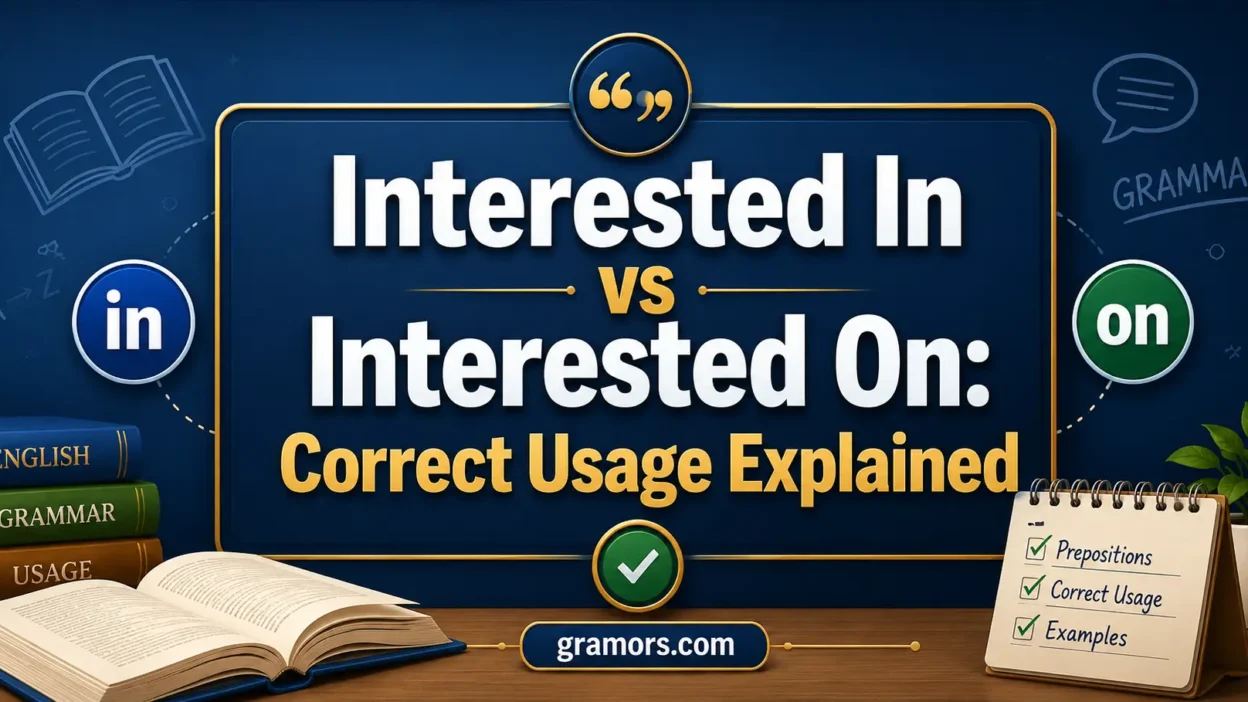
The choice between interested in vs interested on often confuses English learners because both prepositions appear in many common expressions.
However, only interested in normally introduces the person, subject, activity, or opportunity that attracts someone’s attention.
- Correct: “I am interested in history.”
- Incorrect: “I am interested on history.”
The words interested on can appear next to each other in a grammatical sentence, but they do not form an alternative to interested in. In those cases, on usually introduces a time expression or belongs to another part of the sentence.
Quick Answer
Use interested in before the subject, person, opportunity, or activity that attracts someone’s interest.
- Correct: “She is interested in photography.”
- Incorrect: “She is interested on photography.”
The words can appear together in another structure:
“She became interested on Monday.”
Here, on Monday tells us when she became interested. It does not identify what interested her.
Why People Confuse Them
English adjectives often pair with specific prepositions, and learners cannot always predict those combinations from general preposition rules.
Several natural expressions use on:
- a lecture on history
- a report on climate change
- keen on sports
- focused on the problem
- working on a project
These patterns may encourage someone to write “interested on history.” However, English uses a different preposition after interested.
Compare:
“A book on art”
The book is about art.
“Interested in art”
Art attracts someone’s attention.
Likewise:
“She is keen on sports.”
- “She is interested in sports.”
Each expression follows its own established pattern.
Key Differences At A Glance
| Context | Best Choice | Why |
|---|---|---|
| A subject attracts attention | interested in | Standard adjective-complement pattern |
| A person attracts romantic interest | interested in | Identifies the person who attracts attention |
| Someone may perform an activity | interested in + gerund | A verb after the preposition takes the -ing form |
| A company considers an offer | interested in | Introduces the opportunity or proposal |
| Interest begins on a particular day | interested on + day | On introduces a time expression |
| Someone wants to work on something | interested in working on | In follows interested; on follows working |
| Formal and casual writing | interested in | Natural in all standard contexts |
| “On” introduces the focus of interest | Incorrect | Standard English does not use this pattern |
The dependable rule is simple: use interested in to identify what or who attracts interest.
Meaning and Usage Difference
Interested usually functions as an adjective after linking verbs such as be, become, seem, and remain.
- “She is interested in medicine.”
“He became interested in architecture.”
“They seem interested in the proposal.”
The preposition in introduces the complement that identifies the focus of interest.
Interested in + Noun
Use a noun after interested in:
- “I am interested in science.”
- “The company is interested in the property.”
“She became interested in photography.”
Interested in + Pronoun
A pronoun can also follow the phrase:
- “She is interested in him.”
“Are you interested in it?”
“They do not seem interested in us.”
Interested in + Gerund
Use the -ing form when an activity follows:
- “He is interested in studying abroad.”
- “They are interested in joining the program.”
- “She is interested in learning more.”
Because in is a preposition, do not place a bare verb or infinitive directly after it.
Incorrect: “She is interested in learn Spanish.”
Correct: “She is interested in learning Spanish.”
Interested in + Clause
A clause can identify the idea that attracts attention:
“We are interested in what you proposed.”
“She seemed interested in how the system worked.”
“I am interested in whether the plan will succeed.”
The phrase interested on does not perform any of these complement functions in standard English.
A separate pattern, interested to + verb, can appear with verbs such as hear, know, learn, and see:
“I was interested to hear your opinion.”
This structure often describes someone’s reaction to receiving information.
Tone, Context, and Formality
Interested in sounds natural in casual conversations, academic discussions, professional messages, job applications, and formal documents.
Casual:
“I’m interested in that movie.”
Professional:
“We are interested in your proposal.”
Academic:
“The researchers were interested in language development.”
Personal:
“He appears interested in her.”
Writers can also add modifiers to show the strength of the interest:
- slightly interested in
- genuinely interested in
- deeply interested in
- particularly interested in
- no longer interested in
Using interested on before the focus of interest sounds nonstandard, not simply informal. Casual speech does not normally change the required preposition.
American and British standard English follow the same basic pattern.
Which One Should You Use?
Ask whether the next words identify the person, subject, activity, idea, or opportunity that attracts attention.
When they do, use interested in:
“She is interested in the course.”
“I’m interested in that job.”
“They are interested in our offer.”
Use interested in + gerund for activities:
“He is interested in joining the team.”
“She is interested in studying medicine.”
“We are interested in working together.”
Sometimes both in and on appear naturally in the same sentence:
“They are interested in working on the course.”
In this sentence:
- in belongs to interested in working
- on belongs to working on the course
Do not replace every nearby on. First identify which word controls each preposition.
When One Choice Sounds Wrong
Interested on sounds unnatural when on introduces the object of interest.
Incorrect:
“They are interested on the offer.”
Correct:
“They are interested in the offer.”
The same rule applies in education, work, hobbies, business, and relationships.
Incorrect: “She is interested on biology.”
Correct: “She is interested in biology.”
Incorrect: “He is interested on the position.”
Correct: “He is interested in the position.”
Incorrect: “I am interested on photography.”
Correct: “I am interested in photography.”
Incorrect: “She appears interested on him.”
Correct: “She appears interested in him.”
However, interested on can appear when on introduces time:
“They became interested on Monday.”
It can also appear when on belongs to another verb:
“They are interested in collaborating on the campaign.”
The sentence contains both prepositions correctly because each one serves a different function.
Common Mistakes
Incorrect: “I am interested on science.”
Correct: “I am interested in science.”
Use in before the subject that attracts attention.
Incorrect: “She is interested on applying.”
Correct: “She is interested in applying.”
Use a gerund after interested in.
Incorrect: “I am interesting in the position.”
Correct: “I am interested in the position.”
Use interested for the person who feels curiosity or attraction. Use interesting for the thing that creates interest.
Incorrect: “I have interest on science.”
Correct: “I have an interest in science.”
The related noun usually takes in when it names the subject of interest.
Incorrect: “I’m interested on your job opening.”
Correct: “I’m interested in your job opening.”
This form suits job applications and professional messages.
Incorrect: “He is interested on her.”
Correct: “He is interested in her.”
Use the same preposition for romantic or personal interest.
The noun phrase interest on a loan follows a different pattern:
“The bank charges interest on the loan.”
Here, interest means a financial charge. It does not describe curiosity or attraction.
Everyday Examples
Hobbies
“I’m interested in landscape photography.”
“Are you interested in learning guitar?”
“She is not interested in competitive sports.”
“He recently became interested in gardening.”
Education
“Several students are interested in the new course.”
“Maya is interested in studying engineering.”
“The professor asked whether we were interested in further research.”
“They became interested in what the speaker had discovered.”
Careers
“I am interested in applying for the position.”
“She is interested in a career in healthcare.”
“Would you be interested in joining our team?”
“He remains interested in working for the company.”
Business
“The company is interested in acquiring the property.”
“Our client is interested in the original offer.”
“Are the investors interested in the proposal?”
“We are interested in discussing a possible partnership.”
Relationships
“He may be interested in her.”
“She does not seem interested in dating.”
“I think Daniel is interested in you.”
“They are no longer interested in each other.”
Buying Decisions
“I’m interested in the blue model.”
“Are you still interested in buying the house?”
“She is interested in a more affordable option.”
“The customer was not interested in the extended warranty.”
Time and Nested Structures
“I became interested on Friday after hearing the presentation.”
In this sentence, on Friday tells us when the interest began.
“She is interested in working on the campaign.”
Here, in follows interested, while on belongs to working on the campaign.
Dictionary-Style Word Details
Verb
Interested in: The complete expression is not a standalone verb.
In “She is interested in art,” is functions as the linking verb, and interested functions as an adjective.
The word interested comes from the verb interest, so some sentences may also allow a passive interpretation. However, the full expression remains part of a larger grammatical construction.
Interested on: This is not a standard verb phrase when on introduces the subject or object of interest.
Noun
Interested in: The complete phrase is not a noun.
The related noun pattern is:
“An interest in something.”
Example:
“She has an interest in architecture.”
Interested on: The full expression is not a noun.
Do not confuse it with the financial noun construction interest on a loan.
Synonyms
Closest alternatives for interested in depend on the context:
- curious about for wanting information
- keen on for strong enthusiasm
- drawn to for attraction
- engaged with for active attention
- willing to consider for proposals or opportunities
Examples:
“I’m curious about the new program.”
“She is keen on photography.”
“The buyer is willing to consider our offer.”
These expressions do not replace interested in in every sentence.
Interested on has no independent synonym list because it does not represent a separate standard expression.
Example Sentences
Interested in
“She is interested in architecture.”
“I’m interested in it.”
“They are interested in moving overseas.”
“We are interested in what your team discovered.”
“He is interested in the job opportunity.”
“She appears interested in him.”
Interested on
Incorrect: “He is interested on the course.”
Correct: “He is interested in the course.”
Valid time structure:
“He became interested on Monday.”
Word History
Interested developed from the verb interest and became established as an adjective.
The phrase interested in does not require a separate origin story. Modern English uses it as an adjective followed by a prepositional complement.
No separate history applies to interested on as a competing collocation because standard English does not use it to introduce the focus of interest.
Phrases Containing
Common patterns include:
- be interested in
- become interested in
- interested in something
- interested in doing something
- interested in someone
- interested in a career in medicine
- interested in learning more
- interested in working on a project
- genuinely interested in
- no longer interested in
Standard English does not have a common phrase family built around interested on.
In “She became interested on Tuesday,” on Tuesday functions as a time expression.
FAQs
Is it “interested in” or “interested on”?
Use interested in when naming the person, subject, activity, or opportunity that attracts attention.
Correct: “I am interested in the workshop.”
Incorrect: “I am interested on the workshop.”
Is “interested on” ever correct?
The words may appear together when on begins a separate time phrase.
“She became interested on Monday.”
The sentence does not tell us what interested her. It tells us when her interest began.
Can “interested in” be followed by a verb?
Yes. Use the verb’s -ing form:
“She is interested in learning French.”
Should the verb after “in” end in “-ing”?
A verb that directly follows the preposition in normally takes the gerund form.
Correct: “He is interested in applying.”
Incorrect: “He is interested in apply.”
Can you say “interested to know”?
Yes, in suitable contexts.
“I would be interested to know your opinion.”
This pattern often expresses interest in receiving information. It does not replace every interested in + gerund construction.
Is there a US-versus-UK difference?
No major difference changes the core rule. Standard American and British English use interested in before the focus of interest.
What is the difference between “interested in” and “keen on”?
Both expressions can show interest, but keen on often suggests stronger enthusiasm.
“She is interested in tennis.”
“She is keen on tennis.”
Why is “interest on a loan” correct?
In that phrase, interest is a noun meaning a financial charge.
“The borrower pays interest on the loan.”
This financial structure does not support “interested on the loan.”
Conclusion
Choose interested in when naming the person, subject, activity, idea, or opportunity that attracts attention.
Use it before a noun, pronoun, gerund, or clause:
“I’m interested in the workshop.”
Not:
“I’m interested on the workshop.”
Before changing a nearby on, check whether it introduces a time expression or belongs to another verb. When naming the focus of interest, interested in remains the correct and dependable choice.