Many writers pause when choosing between “among” and “amongst” because both look correct and both appear in real English writing.
The key point is simple: these words share the same meaning, but they differ in style and usage preference.
Examples:
- among friends
- amongst friends
- among students
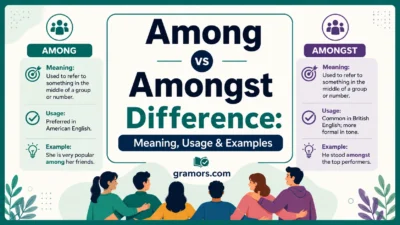
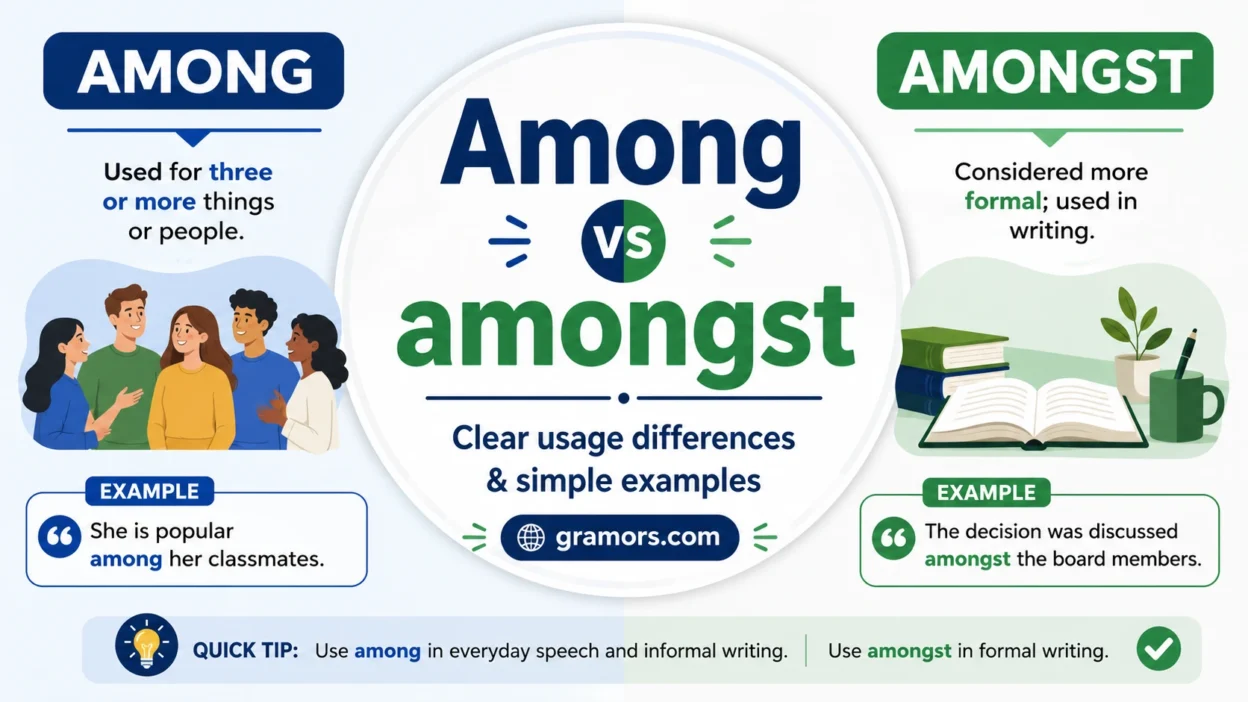
In modern American English, “among” is far more common, while “amongst” is often seen in British or more formal or literary writing.
2. Quick Answer
“Among” and “amongst” mean the same thing.
They both describe something being in the middle of or included in a group.
Examples:
- She stood among her friends.
- She stood amongst her friends.
The difference is not meaning, but style:
- Among = modern, standard, widely used
- Amongst = more traditional or stylistic
In American English, “among” is the safest and most natural choice.
3. Why People Confuse Them
People confuse these words because both are prepositions with identical meanings.
The confusion also comes from older English, where “amongst” was more common in both British and American writing.
Examples:
- Literary style: “He walked amongst the trees.”
- Modern style: “He walked among the trees.”
Today, British English may still use “amongst” more often in formal or poetic writing, while American English strongly favors “among.”
4. Key Differences At A Glance
Context | Best Choice | Why
Modern American English | among | most natural and common
British literary style | amongst | traditional tone
Formal academic writing | among | preferred clarity
Poetic or rhetorical tone | amongst | stylistic effect
General communication | among | neutral standard form
| Feature | Among | Amongst |
|---|---|---|
| Meaning | in or included within a group | same meaning |
| Usage frequency | very high | lower |
| Tone | neutral, modern | formal or stylistic |
| Region preference | global standard | more British usage |
5. Meaning and Usage Difference
Both “among” and “amongst” are prepositions meaning:
- surrounded by
- included in a group
- in the middle of
Examples:
- She was sitting among students.
- She was sitting amongst students.
There is no difference in meaning.
The choice depends entirely on style and preference rather than grammar rules.
In modern writing, “among” is generally preferred for clarity and simplicity.
6. Tone, Context, and Formality
“Among” has a neutral and modern tone, making it suitable for:
- academic writing
- business communication
- everyday conversation
Examples:
- The idea spread among employees.
- The report was shared among departments.
“Amongst” has a slightly formal or literary feel:
- The legend lives amongst the villagers.
- The castle stands amongst the hills.
It is not incorrect; it simply carries a more traditional tone.
7. Which One Should You Use?
A simple rule works in most situations:
Use among by default.
Use amongst only if:
- you want a formal or poetic tone
- you are writing in British English style
- stylistic variation is intentional
Examples:
- Essay: The decision was made among experts.
- Literary style: The secret was hidden amongst ancient ruins.
In American English writing, “among” is almost always the better choice.
8. When One Choice Sounds Wrong
Sometimes “amongst” can sound outdated in modern American writing.
Less natural:
- The policy was discussed amongst managers.
More natural:
- The policy was discussed among managers.
However, “amongst” may still sound appropriate in:
- historical writing
- poetry
- formal British contexts
“Among” almost never sounds wrong in any context.
9. Common Mistakes
Mistake → Fix
- Overusing “amongst” in American English → use “among”
- Assuming meaning changes → both mean the same thing
- Thinking “amongst” is incorrect → it is still valid English
Rewrite examples:
- amongst friends → among friends
- amongst employees → among employees
- amongst the trees → among the trees
10. Everyday Examples
Workplace:
- We shared the report among the team.
- The message spread amongst staff (more literary tone).
School:
- The teacher moved among the students.
- The idea circulated amongst classmates.
Conversation:
- She is popular among her friends.
- He felt lost amongst strangers.
Nature:
- The cabin sits among the mountains.
- The deer moved amongst the trees.
Media style:
- The news spread among citizens.
- The story is known amongst locals.
11. Dictionary-Style Word Details
Verb
• AMONG: Not used as a verb.
• AMONGST: Not used as a verb.
• Note: Both are prepositions only.
Noun
• AMONG: Not a noun.
• AMONGST: Not a noun.
• Note: Neither functions as a noun.
Synonyms
• AMONG: amid, within, in the middle of (contextual)
• AMONGST: same as among (no separate synonym set)
• Note: full meaning overlap.
Example Sentences
• AMONG:
- She was among friends.
- The secret was shared among leaders.
• AMONGST:
- She was amongst friends.
- The story lived amongst villagers.
Word History
• AMONG: Modern standardized English form widely used today.
• AMONGST: Older English variant that remains in British usage and stylistic writing.
• Note: meaning has remained the same over time.
Phrases Containing
• AMONG:
- among others
- among friends
- among the best
• AMONGST:
- amongst others
- amongst friends
- amongst the stars (literary style)
12. FAQs
Is “amongst” wrong in modern English?
No. It is grammatically correct. It is simply less common, especially in American English.
Can I use “among” and “amongst” interchangeably?
Yes in meaning. The difference is only style and tone, not grammar.
Which is better for academic writing?
“Among” is usually preferred in academic and formal American writing for clarity and consistency.
Why do some writers still use “amongst”?
Writers may choose it for tone, tradition, or British English style preferences.
Does “amongst” sound old-fashioned?
In American English, it can sound slightly old-fashioned, but in British or literary contexts it is still natural.
13. Conclusion
“Among” and “amongst” mean exactly the same thing and are both grammatically correct.
The only real difference in among vs amongst is style.
Examples:
- among friends
- amongst friends
In modern American English, “among” is the preferred standard because it sounds natural and clear, while “amongst” is used mainly for stylistic, British, or literary effect.
Choosing between them is not about correctness, but about tone and audience.