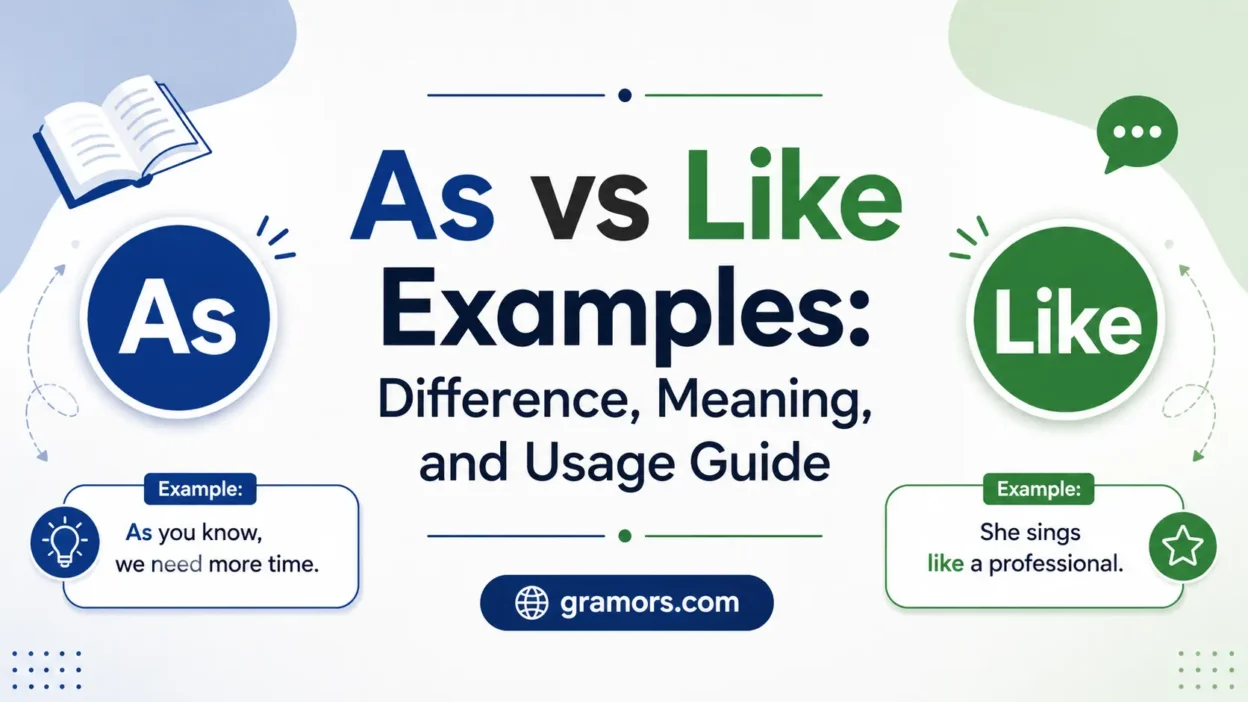
As vs like can be confusing because both words can compare people, things, actions, or situations. Still, they do not work the same way in every sentence.
Use like when you mean similar to before a noun or pronoun: “She looks like her sister.” Use as for roles, functions, clauses, and fixed patterns: “Do it as I showed you.”
The goal is not to ban one word. The goal is to choose the word that fits the sentence structure and tone.
Quick Answer
Use like before a noun or pronoun when you mean similar to.
Correct: “This smells like coffee.”
Use as for a role, function, clause, or fixed comparison pattern.
- Correct: “He works as a nurse.”
- Correct: “Write it as I explained.”
- Correct: “She is as tall as her brother.”
In conversation, like before a clause is common, but as is safer in formal writing.
Why People Confuse Them
People confuse as and like because both can express similarity.
Casual: “Like I said, we’re leaving early.”
More formal: “As I said, we’re leaving early.”
In speech, many Americans use like where formal writing often prefers as. That does not make every use of like a simple mistake. Sometimes the issue is tone, not basic meaning.
These two sentences are also close:
“Nobody knows her like I do.”
“Nobody knows her as I do.”
The first sounds more conversational. The second sounds more formal or polished.
Key Differences At A Glance
| Context | Best Choice | Why |
|---|---|---|
| Similarity before a noun | like | It means similar to. |
| Similarity before a pronoun | like | It fits phrases like “like me” or “like her.” |
| Job, role, or function | as | It means in the role of. |
| Before a full clause in formal writing | as | It connects to a subject-verb idea. |
| Fixed phrase with same | as | Standard form is “the same as.” |
| Fixed comparison pattern | as | Standard form is “as…as.” |
| Casual clause use | like | Common in conversation, but less formal. |
Meaning and Usage Difference
Like usually means similar to. It often comes before a noun, pronoun, or noun phrase.
- Correct: “She sings like an angel.”
- Correct: “He looks like his father.”
- Correct: “This tastes like lemon.”
As can mean in the role of, in the way that, or to the same degree.
- Correct: “She works as a singer.”
- Correct: “Sing it as I taught you.”
- Correct: “The update is as fast as the old version.”
The difference is clear in this pair:
“He acts like a leader.”
This means his behavior is similar to a leader’s behavior.
“He serves as a leader.”
This means he has the role or function of a leader.
So, like often compares appearance, sound, behavior, or feeling. As often names a role, explains a method, or completes a fixed comparison.
Compact comparison:
• Like: similar to.
• As: in the role of.
• Like: before a noun or pronoun.
• As: before a clause in careful writing.
• As: used in “as…as” and “the same as.”
• Like before a clause: common in speech, less formal in edited writing.
Tone, Context, and Formality
Like is natural in conversation and very common in American English.
Casual: “Like I said, we’re leaving early.”
Casual: “Do it like I showed you.”
These sentences are easy to understand and common in speech.
As is usually safer in formal writing before a clause.
More formal: “As I said, we’re leaving early.”
More formal: “Do it as I showed you.”
Do not treat conversational like as careless or unacceptable in every setting. In emails, essays, reports, and professional writing, though, as often sounds cleaner before a full clause.
Which One Should You Use?
- Choose like before a noun or pronoun when you mean similar to.
- Correct: “She sounds like her mom.”
- Correct: “He runs like my brother.”
- Correct: “This room feels like a hotel.”
- Choose as for a job, role, or function.
- Correct: “She works as a manager.”
- Correct: “Use this folder as a backup.”
- Correct: “He spoke as a parent, not as a lawyer.”
- Choose as before a full clause in formal writing.
Correct: “As we discussed, the deadline is Friday.”
Correct: “Please complete the form as I explained.”
Choose as in fixed comparison patterns.
Correct: “She is as tall as her cousin.”
Correct: “This is the same as mine.”
In casual speech, you may hear like before clauses. In careful writing, as is the better choice.
When One Choice Sounds Wrong
Sometimes the wrong choice changes the meaning.
“She works like a doctor” means she behaves in a way similar to a doctor. It does not clearly say her job is doctor.
“She works as a doctor” means doctor is her role.
Other sentences sound wrong in standard edited writing.
Wrong: “This tastes as lemon.”
Correct: “This tastes like lemon.”
Wrong for role: “He works like a chef.”
Correct for role: “He works as a chef.”
Wrong: “The same color like mine.”
Correct: “The same color as mine.”
Wrong: “It is not like good like the first one.”
Correct: “It is not as good as the first one.”
Some nonstandard forms may appear in speech, but the corrected forms are safer for school, work, and polished writing.
Common Mistakes
Mistake: Using as after sense verbs when like is needed.
Wrong: “She looks as her mother.”
Correct: “She looks like her mother.”
Mistake: Using like for a job or role.
Wrong: “He works like a teacher.”
Correct: “He works as a teacher.”
Mistake: Using same like instead of same as.
Wrong: “This is the same like mine.”
Correct: “This is the same as mine.”
Mistake: Breaking the as…as pattern.
Wrong: “It is not like good like the first one.”
Correct: “It is not as good as the first one.”
Mistake: Overcorrecting casual phrases without thinking about tone.
Casual: “Like I said, we’re leaving early.”
More formal: “As I said, we’re leaving early.”
Both are understandable. The second is better for formal writing.
Everyday Examples
“This app works like a calendar.”
“Use this folder as a backup.”
“She sounds like her mom.”
“As your manager, I need to review this.”
“The update is not as fast as the old version.”
“He handled it as we expected.”
“My little brother eats like a grown-up.”
“She works as a nurse at a local clinic.”
“This coffee tastes like chocolate.”
“Please reply as soon as you can.”
“That answer sounds like a guess.”
“As we agreed, the payment is due Friday.”
“The new screen is the same size as the old one.”
“He talked like he knew the answer.”
“She acted as the team lead during the project.”
Dictionary-Style Word Details
Verb
• As: Not commonly used as a verb in this comparison.
• Like: Fully applies as a verb meaning enjoy, approve, or prefer.
Example: “I like coffee.”
That verb meaning is different from comparison like in “It tastes like coffee.”
Noun
• As: Not commonly used as a noun in this comparison.
• Like: Applies partly as a noun, as in “likes and dislikes” or social media “likes.”
Example: “Her likes and dislikes changed over time.”
That noun use is separate from the comparison use.
Synonyms
• As: Closest plain alternatives depend on meaning. It can mean in the role of, in the way that, because, while, or to the same degree.
• Like: Closest plain alternatives include similar to, such as, as if, and in the manner of, depending on sentence structure.
These are not exact replacements in every sentence. The sentence pattern matters.
Example Sentences
• As: “She works as a nurse.”
• As: “Do it as I showed you.”
• As: “The answer is as clear as the example.”
• Like: “He looks like his father.”
• Like: “It smells like rain.”
• Like: “She sings like a professional.”
These examples show the main pattern: as often marks role, method, or fixed comparison; like often marks similarity.
Word History
• As: As is an old English function word with several uses, including comparison, manner, time, and reason.
• Like: Like has long been used for similarity. Its use before clauses is common in speech, but many careful writers still prefer as in formal prose.
History matters less than modern structure. Choose the word that fits the sentence.
Phrases Containing
• As: as I said, as you know, as if, as though, as…as, the same as, as in, as a result.
• Like: look like, sound like, feel like, act like, like I said, just like, nothing like, more like.
Some phrases are fixed. For example, write the same as, not the same like. Use as I said in formal writing, but like I said is common in conversation.
FAQs
Is “like I said” wrong?
“Like I said” is common in conversation. It sounds casual.
Casual: “Like I said, we’re leaving early.”
More formal: “As I said, we’re leaving early.”
Use as I said in polished writing.
Is “as I said” more formal?
Yes. As I said sounds more formal and polished than like I said.
Correct: “As I said in the meeting, the deadline is Friday.”
Is it “work as” or “work like”?
Use work as for a job or role.
Correct: “She works as a teacher.”
Use work like only when you mean someone or something works in a similar way.
Correct: “This app works like a timer.”
Is it “same as” or “same like”?
Use same as.
Wrong: “This is the same like mine.”
Correct: “This is the same as mine.”
Can like be a conjunction?
In everyday speech, like is often used before a clause.
Casual: “Do it like I showed you.”
In formal writing, as is usually preferred.
Formal: “Do it as I showed you.”
What is the easiest rule to remember?
Use like for similarity before nouns and pronouns.
Correct: “She looks like her sister.”
Use as for roles, clauses, and fixed comparison patterns.
- Correct: “She works as a nurse.”
- Correct: “Write it as I explained.”
- Correct: “She is as tall as her brother.”
Conclusion
For as vs like, do not treat the words as always interchangeable. Like is best for similarity before nouns and pronouns. As is safest for roles, clauses, and fixed comparison patterns.