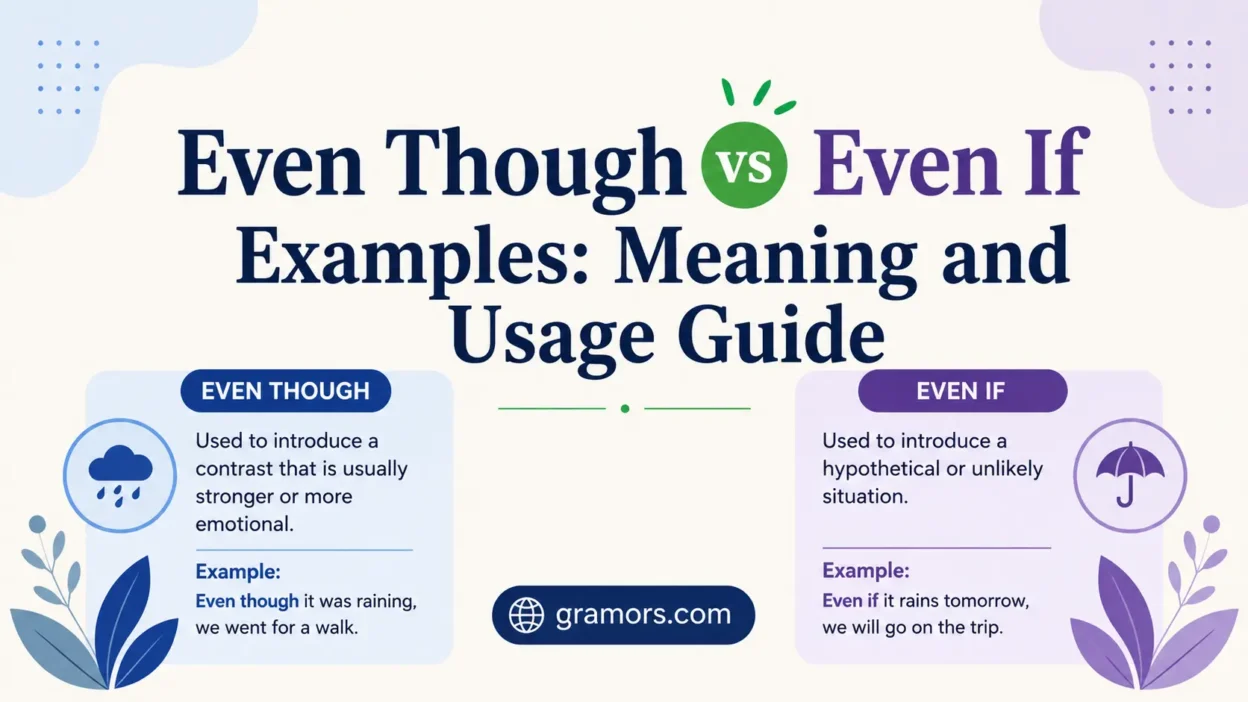
Even though vs even if can be confusing because both phrases add contrast. They show that one idea does not stop another idea from being true or happening.
Still, they do not mean the same thing. Even though points to a real fact. Even if points to a possible, uncertain, or imagined condition.
Correct: “Even though it is raining, we are going outside.”
Correct: “Even if it rains, we are going outside.”
Quick Answer
Use even though when the contrast is based on a real fact.
Correct: “Even though I was tired, I finished the work.”
Use even if when the contrast is based on a possible condition.
Correct: “Even if I get tired, I will finish the work.”
The difference is about truth and condition, not simply past and future.
Why People Confuse Them
People confuse even though and even if because both begin with even. Both also introduce dependent clauses, and both show that one idea does not stop another idea.
The meaning changes when though becomes if.
Fact: “Even though I was invited, I did not go.”
Condition: “Even if I am invited, I will not go.”
The first sentence says the invitation was real. The second says the invitation may or may not happen, but the result will stay the same.
Key Differences At A Glance
| Context | Best Choice | Why |
|---|---|---|
| A real fact | even though | It means although or despite the fact that. |
| A possible condition | even if | It means whether or not or no matter if. |
| Something already true | even though | The speaker accepts the situation as real. |
| Something uncertain | even if | The speaker treats the situation as possible. |
| Promise or determination | even if | It shows the result will not change. |
| Clear contrast with known information | even though | It contrasts one real fact with another idea. |
Meaning and Usage Difference
Even though introduces a fact, real situation, or accepted information.
Correct: “Even though she was nervous, she spoke clearly.”
This means she really was nervous, but she still spoke clearly.
Correct: “Even though the project was difficult, the team finished it.”
This means the project really was difficult.
Even if introduces a condition, possibility, unlikely event, or imagined situation.
Correct: “Even if she gets nervous, she will speak clearly.”
This means she may or may not get nervous, but she will speak clearly either way.
Correct: “Even if the project gets difficult, the team will finish it.”
This means difficulty is possible, but it will not change the result.
Both phrases can introduce contrast, but they do different work.
• Even though: real fact + surprising result.
• Even if: possible condition + unchanged result.
• Even though: “although this is true.”
• Even if: “whether or not this happens.”
• Even if can also use past-form verbs in unreal conditions: “Even if I won the lottery, I would keep working.”
Tone, Context, and Formality
Both even though and even if are standard in US English. They work in conversation, school writing, business emails, and formal explanations.
Even though sounds natural when you want to show strong contrast with a real fact.
Casual: “Even though I was tired, I still went to the gym.”
Professional: “Even though the deadline was tight, we completed the report.”
Academic-style: “Even though the results were limited, the study raised useful questions.”
Even if sounds natural when you want to stress determination, refusal, certainty, or an unchanged result.
Casual: “Even if it gets late, I’m finishing this episode.”
Professional: “Even if the schedule changes, we will send the update today.”
Academic-style: “Even if the sample size increases, the main limitation may remain.”
Neither phrase is incorrect or too informal. The best choice depends on meaning.
Which One Should You Use?
Ask this first: Is the situation already true?
Use even though.
Correct: “Even though the meeting was long, we covered everything.”
The meeting really was long.
Ask this next: Is the situation only possible or imagined?
Use even if.
Correct: “Even if the meeting runs late, we will cover everything.”
The late ending is only possible.
Ask one more question: Would “whether or not” fit?
Use even if.
Correct: “Even if it rains, the event will continue.”
Meaning: “Whether or not it rains, the event will continue.”
Quick choice guide:
• Real fact: “Even though I studied, the test was hard.”
• Possible condition: “Even if I study, the test may be hard.”
• Confirmed problem: “Even though it is expensive, I bought it.”
• Possible change: “Even if it gets cheaper, I may not buy it.”
When One Choice Sounds Wrong
The wrong phrase can change the meaning.
“Even though I was invited, I did not go.”
This means I was invited.
“Even if I was invited, I would not go.”
This means the invitation is uncertain or does not matter.
Use even though when the fact is already known.
Awkward: “Even if I was sick yesterday, I went to work.”
Better: “Even though I was sick yesterday, I went to work.”
The sickness happened, so even though fits better.
Use even if for uncertain future conditions.
Awkward: “Even though it rains tomorrow, we will leave early.”
Better: “Even if it rains tomorrow, we will leave early.”
Tomorrow’s rain is not yet a confirmed fact, so even if fits better.
Common Mistakes
Mistake: Using even though for an uncertain future condition.
Wrong: “Even though it snows tomorrow, school will open.”
Correct: “Even if it snows tomorrow, school will open.”
Reason: The snow is only possible.
Mistake: Using even if for a confirmed fact.
Wrong: “Even if I was tired last night, I finished the essay.”
Correct: “Even though I was tired last night, I finished the essay.”
Reason: The tiredness was real.
Mistake: Forgetting the comma after a fronted clause.
Correct: “Even though it was late, we kept working.”
Correct: “Even if it gets late, we will keep working.”
When the phrase comes at the end, the comma is often not needed.
Correct: “We kept working even though it was late.”
Correct: “We will keep working even if it gets late.”
Mistake: Treating even though as the same as even.
Wrong: “Even I was tired, I finished.”
Correct: “Even though I was tired, I finished.”
Everyday Examples
Work
“Even though the meeting was long, we made a decision.”
“Even if the meeting runs late, I’ll send the notes today.”
“Even though the client asked for changes, the project stayed on schedule.”
“Even if the client asks for changes, we can still meet the deadline.”
School
“Even though I studied all week, the quiz was difficult.”
“Even if I study all week, I may still feel nervous.”
“Even though the assignment was short, it took me an hour.”
“Even if the assignment is short, I will read the instructions carefully.”
Weather
“Even though it snowed, the roads were clear.”
“Even if it snows, we are still going.”
“Even though it was raining, the kids played outside.”
“Even if it rains, the game will continue.”
Money and Plans
“Even though the jacket was expensive, I bought it.”
“Even if the jacket gets cheaper, I may not buy it.”
“Even though we were busy, we made time for dinner.”
“Even if we get busy, we will make time for dinner.”
Dictionary-Style Word Details
Verb
• Even though: Not a verb. Even though introduces a dependent clause.
• Even if: Not a verb. Even if introduces a dependent clause.
Neither phrase is an action word.
Noun
• Even though: Not a noun. It is used to introduce contrast.
• Even if: Not a noun. The word if can be a noun in phrases like “too many ifs,” but even if is not a noun in this comparison.
Synonyms
• Even though: Closest plain alternatives include although, though, despite the fact that, and in spite of the fact that.
• Even if: Closest plain alternatives include whether or not, no matter if, and even in the case that.
These are not perfect one-for-one replacements. Tone and sentence structure can change.
Example Sentences
• Even though: “Even though she was nervous, she spoke clearly.”
• Even though: “Even though the store was crowded, the line moved fast.”
• Even though: “Even though I disagreed, I listened carefully.”
• Even if: “Even if she gets nervous, she will speak clearly.”
• Even if: “Even if the store gets crowded, we will wait.”
• Even if: “Even if I disagree, I will listen carefully.”
These pairs show the meaning shift: even though treats the situation as real, while even if treats it as possible or conditional.
Word History
• Even though: The phrase combines even, used as an intensifier, with though, a contrast connector.
• Even if: The phrase combines even, used as an intensifier, with if, a conditional connector.
That simple difference explains the modern meaning: though points to contrast with a fact, while if points to a condition.
Phrases Containing
• Even though: related phrases include although, though, even though, and despite the fact that.
• Even if: related phrases include if, even if, whether or not, no matter if, and even when.
Be careful with even when. It can describe repeated or expected situations, not just one possible condition.
FAQs
Are even though and even if the same?
No. They can look similar, but they do not mean the same thing.
Even though introduces a real fact.
Correct: “Even though I was tired, I finished.”
Even if introduces a possible condition.
Correct: “Even if I get tired, I will finish.”
Is even though formal?
Even though is standard in both speech and writing. It is not too casual or incorrect.
Correct: “Even though the report was short, it was useful.”
Can even if mean whether or not?
Yes. Even if often means whether or not or no matter if.
Correct: “Even if it rains, we will go.”
Meaning: “Whether or not it rains, we will go.”
Can I start a sentence with even though?
Yes. A sentence can start with even though.
Correct: “Even though it was late, we kept working.”
Use a comma after the opening clause in most cases.
Can I start a sentence with even if?
Yes. A sentence can start with even if.
Correct: “Even if it gets late, we will keep working.”
This structure is common when you want to stress that the result will not change.
Which phrase should I use for real facts?
Use even though for real facts.
Correct: “Even though I was busy, I replied.”
Use even if for possible conditions.
Correct: “Even if I get busy, I will reply.”
Conclusion
Use even though for real contrast. Use even if for a possible condition that does not change the result.
Final contrast:
Correct: “Even though it is raining, we are leaving.”
Correct: “Even if it rains, we are leaving.”
For even though vs even if examples, remember this simple test: real fact takes even though; possible condition takes even if.