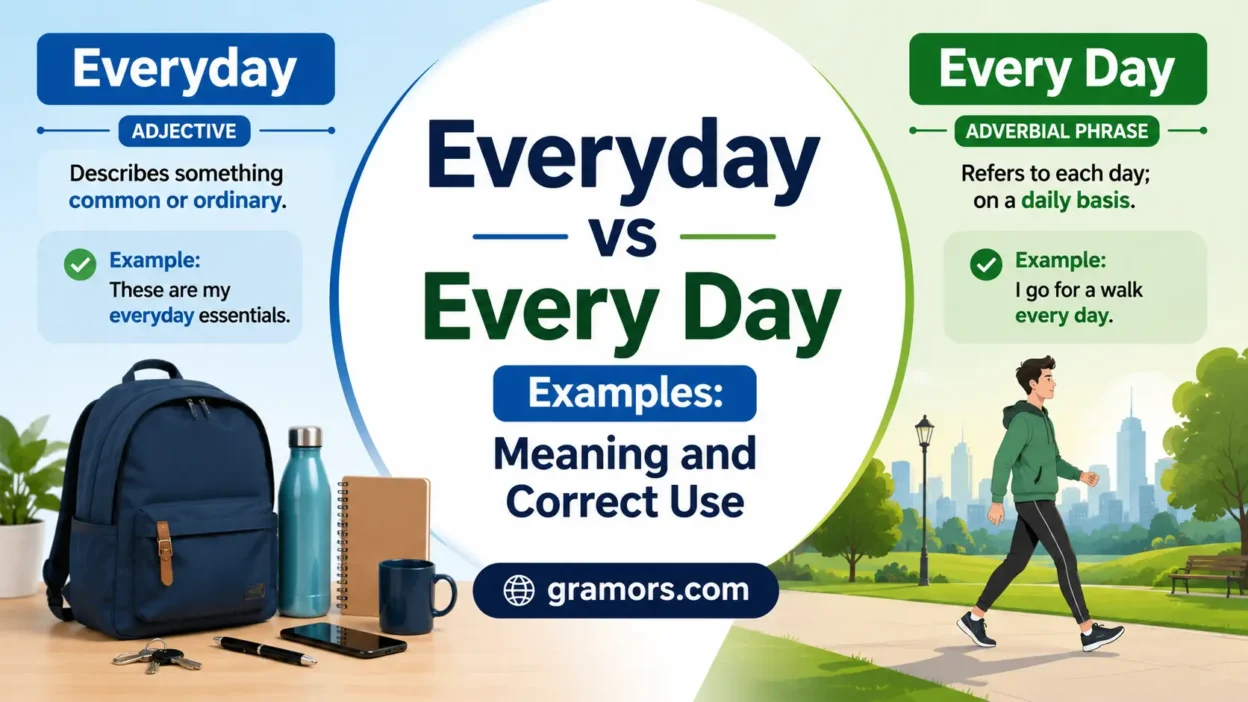
The confusion between everyday and every day happens because they sound the same but work differently in a sentence.
Use everyday before a noun:
These are my everyday clothes.
Use every day when you mean each day:
I wear them every day.
They are not interchangeable. One describes a thing. The other tells how often something happens.
Quick Answer
Use everyday as an adjective before a noun.
Example:
This is my everyday routine.
Use every day when you mean each day.
Example:
I practice every day.
A quick test helps: if you can replace the phrase with each day, use every day.
Why People Confuse Them
People confuse these forms because both relate to daily life.
They also sound identical when spoken.
Compare:
That is an everyday habit.
I do that every day.
In the first sentence, everyday describes the noun habit. In the second sentence, every day tells how often the action happens.
Key Differences At A Glance
| Context | Best Choice | Why |
|---|---|---|
| Before a noun | everyday | It describes the noun. |
| After an action verb | every day | It tells how often. |
| Meaning “ordinary” | everyday | It means common or routine. |
| Meaning “each day” | every day | It works as a time phrase. |
| School writing | depends on grammar | Choose based on sentence structure. |
| Work emails | depends on grammar | Both are standard when used correctly. |
Compact comparison:
• Everyday: one-word adjective meaning ordinary, common, or routine.
• Every day: two-word time phrase meaning each day.
Meaning and Usage Difference
Everyday describes nouns. It means ordinary, usual, common, or part of daily life.
Examples:
These are everyday tasks.
She wore everyday shoes.
That app helps with everyday problems.
Every day tells how often something happens. It means each day.
Examples:
She completes tasks every day.
I check my email every day.
They walk to school every day.
Do not use everyday as an adverb. Write every day when you are talking about frequency.
Tone, Context, and Formality
Both forms are standard in American English.
The choice is not about being formal or casual. It is about grammar.
Casual:
I drink coffee every day.
School:
Reading is part of my everyday routine.
Workplace:
Please check the shared folder every day.
Professional writing:
The policy affects everyday business operations.
In each case, the correct form depends on whether the phrase describes a noun or tells how often something happens.
Which One Should You Use?
Use this simple test: replace the phrase with each day or every single day.
If the sentence still makes sense, use every day.
Example:
I run every day.
I run every single day.
That works.
Now try it before a noun:
These are my every single day clothes.
That sounds wrong. So use:
These are my everyday clothes.
The test is helpful, but meaning still matters. If the word describes a noun, choose everyday.
When One Choice Sounds Wrong
Everyday usually sounds wrong after an action verb when you mean frequency.
Wrong:
I drink coffee everyday.
Correct:
I drink coffee every day.
Wrong:
She studies everyday.
Correct:
She studies every day.
Every day sounds wrong when it directly describes a noun.
Wrong:
These are my every day shoes.
Correct:
These are my everyday shoes.
Wrong:
That is an every day problem.
Correct:
That is an everyday problem.
Common Mistakes
Mistake:
I use this notebook everyday.
Fix:
I use this notebook every day.
Mistake:
This is my every day routine.
Fix:
This is my everyday routine.
Mistake:
He wears everyday clothes every day.
Fix:
This sentence is correct. Everyday describes clothes, and every day tells how often.
Mistake:
Everyday, I wake up at 6.
Fix:
Every day, I wake up at 6.
Mistake:
These are every day items.
Fix:
These are everyday items.
Everyday Examples
Correct:
These are my everyday shoes.
Correct:
I wear these shoes every day.
Correct:
She has an everyday routine before school.
Correct:
She studies every day after school.
Correct:
This is an everyday problem at work.
Correct:
We solve problems like this every day.
Incorrect:
I check my messages everyday.
Correct:
I check my messages every day.
Incorrect:
This is my every day lunch bag.
Correct:
This is my everyday lunch bag.
Incorrect:
He exercises everyday.
Correct:
He exercises every day.
Dictionary-Style Word Details
Verb
• Everyday: Not commonly used as a verb.
• Every day: Not a verb.
Noun
• Everyday: Mainly an adjective. The noun everydayness exists, but it is uncommon in normal writing.
• Every day: The word day is a noun inside the phrase, but every day works as a time phrase.
Synonyms
• Everyday: closest plain alternatives include ordinary, routine, common, usual, and daily.
• Every day: closest alternatives include daily and each day.
Context matters. Daily can replace either form in some sentences, but not all.
Example Sentences
• Everyday: These are my everyday shoes.
• Everyday: The guide explains everyday grammar mistakes.
• Every day: I wear those shoes every day.
• Every day: She writes in her journal every day.
Word History
• Everyday: A compound formed from every and day. In modern use, it works mainly as an adjective.
• Every day: The ordinary phrase every + day, used when talking about each day.
Phrases Containing
• Everyday: everyday life, everyday use, everyday clothes, everyday items, everyday routine
• Every day: every day, every single day, every day after school, every day at work
FAQs
Is everyday one word?
Yes, everyday is one word when it describes a noun.
Example:
These are everyday shoes.
Is every day correct?
Yes, every day is correct when it means each day.
Example:
I work every day.
Which is correct after verbs?
Use every day after verbs when you mean how often something happens.
Example:
She reads every day.
Is “I go to school everyday” correct?
No. Write:
I go to school every day.
Is “everyday routine” correct?
Yes. Everyday describes the noun routine.
Can daily replace both?
Sometimes. Daily can mean ordinary or each day, but it does not always sound natural in the same sentence.
Conclusion
The rule is simple: everyday describes a noun, while every day means each day.
Final pair:
These are my everyday clothes.
I wear them every day.
For everyday vs every day examples, check whether the phrase describes something or tells how often it happens.