
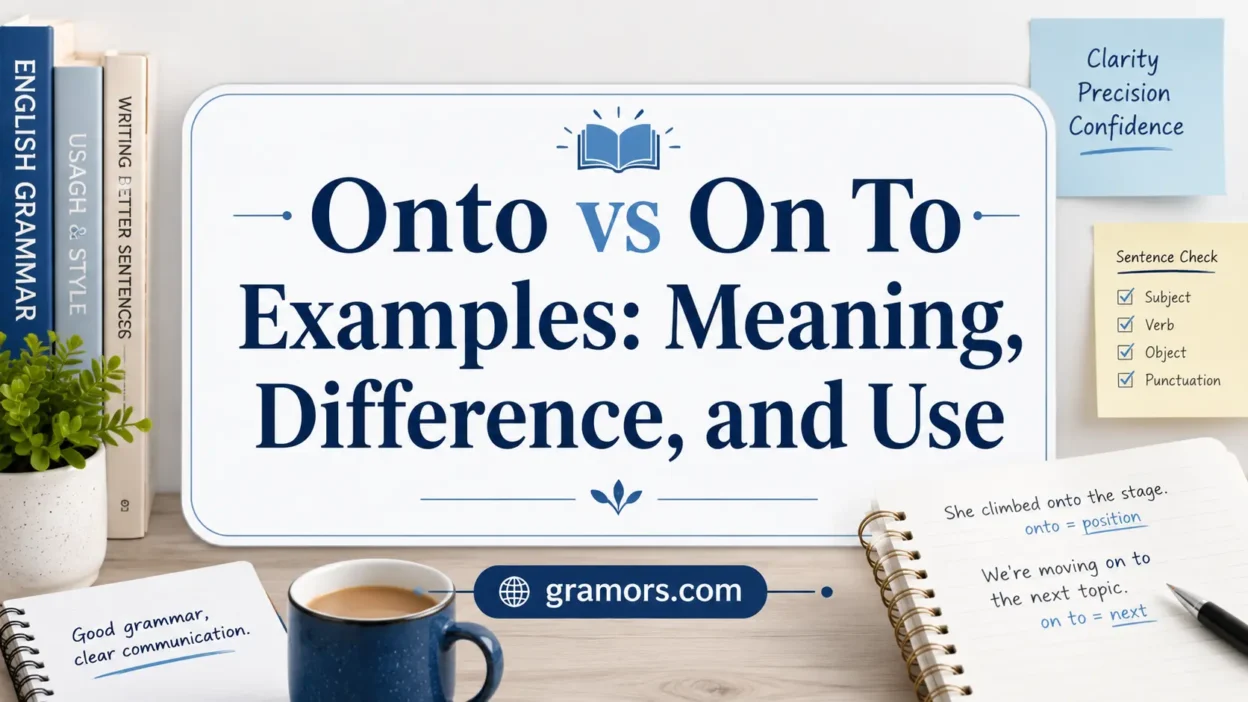
The difference between onto and on to can be tricky because both forms can appear in correct English.
Compare these sentences:
The child jumped onto the bed.
The class moved on to the next question.
In the first sentence, onto shows movement to a surface. In the second sentence, on to is part of a two-word structure after the verb moved.
One form is not always wrong. The right choice depends on meaning and sentence structure.
Quick Answer
Use onto when something moves to a position on a surface, place, or object.
Example:
The worker climbed onto the roof.
Use on to when on belongs with the verb before it, and to starts the next part of the sentence.
Example:
The team went on to win the game.
A helpful rule: onto often answers “where did it move?” On to often appears in phrases like move on to, go on to, hold on to, and log on to.
Why People Confuse Them
People confuse onto and on to because they look and sound almost the same.
Both can also follow action verbs.
Compare:
She got onto the bus.
She got on to the next topic.
The first sentence means she entered or moved to the bus. The second means she proceeded to another topic.
Small spacing changes the grammar, so context matters.
Key Differences At A Glance
| Context | Best Choice | Why |
|---|---|---|
| Movement to a surface | onto | Shows motion to a position on something. |
| Physical placement | onto | The object ends up on a surface. |
| Continuing to the next thing | on to | On belongs with the verb. |
| Phrasal-verb pattern | on to | The verb works with on. |
| Example with travel | onto | We got onto the bus. |
| Example with progress | on to | Let’s move on to chapter two. |
Compact comparison:
• Onto: one-word preposition meaning to a position on.
• On to: two separate words, often used when on belongs to the verb and to introduces the next object or action.
Meaning and Usage Difference
Onto is a preposition. It shows movement toward a surface, position, or place.
Examples:
The cat jumped onto the counter.
The papers fell onto the floor.
Turn onto Maple Street.
In these sentences, something moves to a position on something else.
On to is not one word. It is usually a combination of on plus to. The word on may belong to a verb phrase, while to points to the next thing.
Examples:
She carried on to the finish line.
Let’s move on to the next slide.
He went on to become a doctor.
In these sentences, on helps complete the action, and to introduces the next step, place, or result.
Tone, Context, and Formality
The choice between onto and on to is not about tone.
Both are standard.
The correct choice depends on grammar.
Everyday:
The dog jumped onto the couch.
School:
Let’s move on to the next problem.
Work:
Please log on to the company portal.
Formal:
The report went on to explain the findings.
In each case, spacing changes the structure, not the level of formality.
Which One Should You Use?
Ask this first: does the sentence mean to a position on?
If yes, use onto.
Examples:
Step onto the platform.
The ball rolled onto the field.
She placed the folder onto the desk.
Now ask: can the verb stand with on?
If yes, use on to.
Examples:
Move on to the next section.
Go on to explain your answer.
Hold on to the receipt.
These tests are helpful, but they are not perfect. Always check the meaning of the full sentence.
When One Choice Sounds Wrong
Onto can sound wrong when you mean “continue to the next thing.”
Less clear:
Let’s move onto the next topic.
Better:
Let’s move on to the next topic.
Here, move on means continue or proceed. The to introduces the next topic.
On to can sound wrong when physical movement to a surface is meant.
Wrong:
The cat jumped on to the counter.
Better:
The cat jumped onto the counter.
Some expressions vary. For example, many writers use hold onto to mean keep or retain. However, hold on to is often clearer when you want to show the phrasal verb hold on.
Example:
Hold on to your receipt.
Common Mistakes
Mistake:
Let’s move onto the next chapter.
Better:
Let’s move on to the next chapter.
Mistake:
The cat jumped on to the table.
Better:
The cat jumped onto the table.
Mistake:
Please log onto your account.
Better in many style settings:
Please log on to your account.
Mistake:
Hold onto the railing.
Also acceptable:
Hold on to the railing.
Use hold on to when you want the clearest two-word verb pattern.
Mistake:
Turn on to Oak Street.
Better:
Turn onto Oak Street.
Everyday Examples
Onto Examples
The baby climbed onto the chair.
She tossed the keys onto the table.
The rainwater flowed onto the sidewalk.
He stepped onto the stage.
The driver turned onto Pine Avenue.
The dog jumped onto the bed.
The books fell onto the floor.
We loaded the boxes onto the truck.
On To Examples
Let’s move on to the next question.
He went on to win the award.
Please log on to the website.
Hold on to your ticket.
The teacher moved on to chapter five.
She carried on to the finish line.
The speaker went on to explain the rule.
We can go on to the next example now.
Dictionary-Style Word Details
Verb
• Onto: Not a verb.
• On to: Not a verb by itself, but it often appears after verbs or phrasal verbs, such as move on to and go on to.
Noun
• Onto: Not commonly used as a noun.
• On to: Not a noun.
Synonyms
• Onto: closest plain alternatives include on, upon, and to a position on. These are only partial matches because the exact meaning depends on the sentence.
• On to: No exact synonym applies because it is two separate words working together.
Example Sentences
• Onto: The papers fell onto the floor.
• Onto: She stepped onto the porch.
• On to: Let’s go on to the next slide.
• On to: He went on to start his own business.
Word History
• Onto: This one-word form combines the ideas of on and to. In modern use, it works as a preposition.
• On to: This is not a separate historical term. It is simply the two ordinary words on and to used next to each other.
Phrases Containing
• Onto: onto something, onto the stage, onto the road, onto the floor
• On to: move on to, go on to, hold on to, log on to
FAQs
Is it onto or on to?
Use onto for movement to a surface or position.
Example:
She climbed onto the roof.
Use on to when on belongs with the verb.
Example:
Let’s move on to the next topic.
Is “move onto” correct?
It can be correct for physical movement.
Example:
The truck moved onto the bridge.
For “continue to the next thing,” use move on to.
Example:
Let’s move on to question two.
Is it hold onto or hold on to?
Both are common. Hold on to is often clearer when you mean keep your grip or keep possession.
Example:
Hold on to your ticket.
Is it log onto or log on to?
Many people use log onto, but log on to is clearer when log on is the verb phrase.
Example:
Log on to your account.
Is “go onto the next step” correct?
Usually, write:
Go on to the next step.
Use onto only if there is physical movement to a surface or place.
Is onto always about physical movement?
Usually it shows movement to a position on something, but it can also be used in some figurative meanings.
Example:
She is onto a good idea.
Conclusion
The rule is simple: onto means movement to a surface or position, while on to keeps on and to as separate parts of the sentence.
Final contrast:
The cat jumped onto the desk.
Let’s move on to the next lesson.
For onto vs on to examples, check whether the sentence shows movement onto something or a two-word structure after a verb.