If vs whether is a common English question because both words can introduce uncertainty. You might say, “I don’t know if he’s coming” or “I don’t know whether he’s coming,” and both can sound natural.
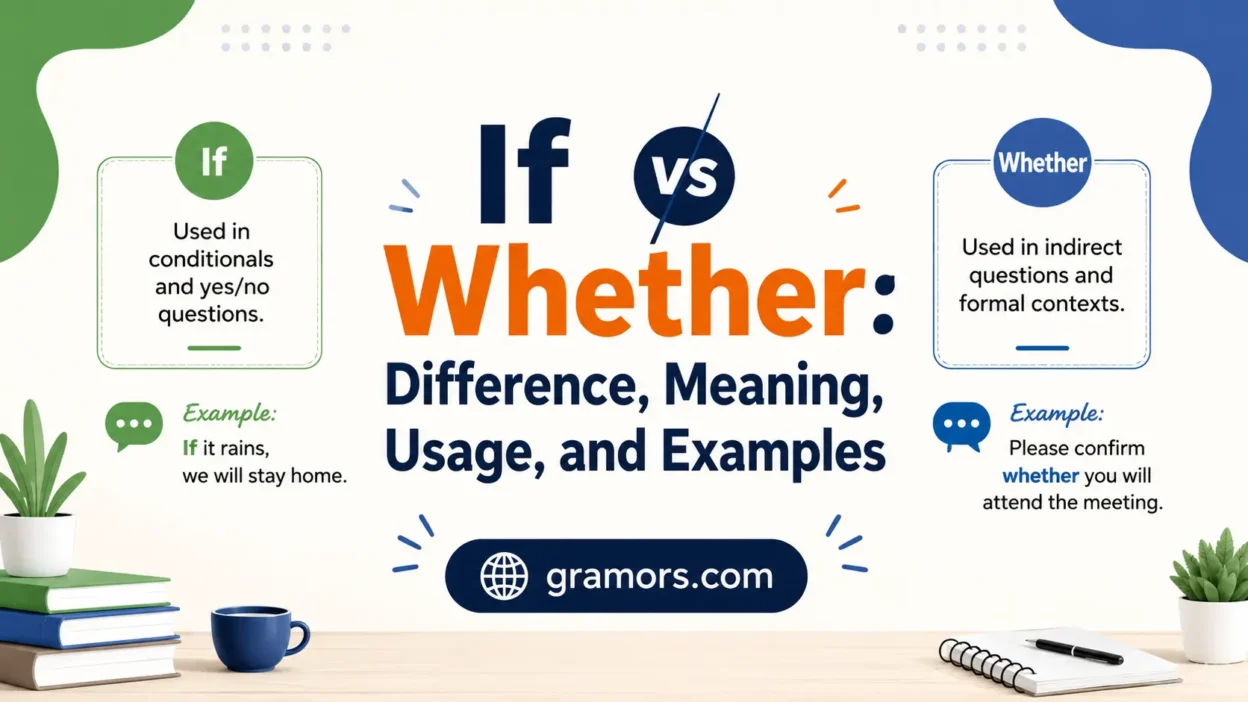
The difference depends on meaning and sentence structure. If is best for conditions. Whether is best for choices, alternatives, and certain fixed structures.
Quick Answer
Use if when one thing depends on another.
Correct: “If it rains, we’ll stay inside.”
Use whether for choices, alternatives, or not, formal writing, after prepositions, and before infinitives.
Correct: “I’m deciding whether to go.”
Both can work in many indirect yes-no questions.
Correct: “I don’t know if she called.”
Correct: “I don’t know whether she called.”
Why People Confuse Them
People confuse if and whether because both can mean “whether it is true that” in indirect questions.
Correct: “She asked if I was ready.”
Correct: “She asked whether I was ready.”
In these examples, both sentences ask about a yes-or-no possibility. That overlap makes the words seem fully interchangeable.
The problem is that if has limits. It does not work well before an infinitive, after a preposition, or in some clear either-or choices. Whether is often the safer choice in those structures.
Key Differences At A Glance
| Context | Best Choice | Why |
|---|---|---|
| Condition | if | It shows that one thing depends on another. |
| Choice between options | whether | It clearly introduces alternatives. |
| Indirect yes-no question | if / whether | Both often work after verbs like know, ask, and wonder. |
| Formal writing | whether | It often sounds more precise. |
| Directly before “or not” | whether | “Whether or not” is the standard structure. |
| After a preposition | whether | It fits after words like about, on, and over. |
| Before “to + verb” | whether | “Whether to go” is standard. |
Meaning and Usage Difference
If introduces a condition or possible situation.
Correct: “If you finish early, text me.”
Correct: “If the price drops, I’ll buy it.”
Correct: “If traffic gets bad, we’ll leave later.”
In these sentences, one action depends on another condition.
Whether introduces a choice, alternative, or indirect yes-no question.
Correct: “I wonder whether she finished early.”
Correct: “We discussed whether the office should open.”
Correct: “I can’t decide whether to buy it.”
Both words can introduce indirect yes-no questions after verbs such as know, ask, wonder, doubt, and be sure.
Correct: “I don’t know if the store is open.”
Correct: “I don’t know whether the store is open.”
Compact comparison:
• If: best for conditions.
• Whether: best for choices and alternatives.
• If or whether: both can work in many indirect yes-no questions.
• Whether: required or strongly preferred before “to + verb.”
• Whether: preferred after prepositions.
• Whether or not: standard phrase for “regardless of the answer.”
Tone, Context, and Formality
If is common in casual speech and everyday writing. It sounds natural in many indirect questions.
Casual: “I’m not sure if he replied.”
Natural: “Ask her if she wants coffee.”
Whether often sounds more formal, careful, and precise. It is especially useful when the sentence involves a choice or decision.
Formal: “The committee will determine whether the policy applies.”
Clear: “Please confirm whether you want the PDF or the Word version.”
Do not treat if as wrong in every indirect question. It is standard in many normal sentences. Use whether when structure, clarity, or formality makes it the better fit.
Which One Should You Use?
Use if when one thing depends on another.
Correct: “If the price drops, I’ll buy it.”
Correct: “If you need help, call me.”
Correct: “If the meeting ends early, I’ll stop by.”
Use whether when choosing between options.
Correct: “I can’t decide whether to buy it.”
Correct: “Let me know whether you want coffee or tea.”
Correct: “We need to decide whether the plan is realistic.”
Use whether before to + verb.
Wrong: “I don’t know if to apply.”
Correct: “I don’t know whether to apply.”
Use whether after prepositions.
Wrong: “It depends on if the price drops.”
Correct: “It depends on whether the price drops.”
Use whether directly before or not.
Wrong: “Tell me if or not you agree.”
Correct: “Tell me whether or not you agree.”
When One Choice Sounds Wrong
Some sentences need whether because if does not fit the structure.
Wrong: “I don’t know if to apply.”
Right: “I don’t know whether to apply.”
Wrong: “She asked if to bring snacks.”
Right: “She asked whether to bring snacks.”
Wrong: “We talked about if it was fair.”
Right: “We talked about whether it was fair.”
Wrong: “The decision depends on if they approve it.”
Right: “The decision depends on whether they approve it.”
Wrong: “Tell me if or not you agree.”
Right: “Tell me whether or not you agree.”
Wrong: “I’m choosing if to stay or leave.”
Right: “I’m choosing whether to stay or leave.”
In some sentences, if is not impossible, but it changes the meaning.
Conditional: “Call me if you need help.”
Choice: “Tell me whether you need help.”
The first means call only under that condition. The second asks for an answer.
Common Mistakes
Mistake: Using if before an infinitive.
Wrong: “I’m deciding if to leave.”
Correct: “I’m deciding whether to leave.”
Mistake: Using if after a preposition.
Wrong: “It depends on if she agrees.”
Correct: “It depends on whether she agrees.”
Mistake: Writing if or not.
Wrong: “Tell me if or not you can come.”
Correct: “Tell me whether or not you can come.”
Mistake: Using if when a clear either-or choice is meant.
Less clear: “Let me know if you want tea or coffee.”
Clearer: “Let me know whether you want tea or coffee.”
Mistake: Thinking whether or not is always needed.
Wordy: “I don’t know whether or not he called.”
Shorter: “I don’t know whether he called.”
Use whether or not when you mean “regardless of the answer.”
Correct: “We’re leaving whether or not he is ready.”
Everyday Examples
“Let me know if you need the file.”
“Let me know whether you want the PDF or the Word version.”
“We’ll leave early if traffic gets bad.”
“I’m not sure whether to book the morning flight.”
“If you finish the homework, you can watch TV.”
“The teacher asked whether everyone understood the lesson.”
“Text me if your plans change.”
“Please confirm whether you can attend the meeting.”
“If the store is open, I’ll stop by.”
“I don’t know whether the store is open today.”
“Ask him if he needs a ride.”
“Ask him whether he wants a ride or plans to drive.”
“If it gets cold, bring a jacket.”
“We discussed whether to cancel the trip.”
Dictionary-Style Word Details
Verb
• If: Not commonly used as a verb. In this comparison, if mainly works as a conjunction.
• Whether: Not commonly used as a verb. In this comparison, whether mainly works as a conjunction.
Noun
• If: Can be a noun in phrases like too many ifs or a big if. It means a condition, uncertainty, or possibility.
Example: “That plan has too many ifs.”
• Whether: Not commonly used as a noun in everyday modern English.
Synonyms
• If: Closest plain alternatives include in case, provided that, on condition that, and assuming that.
• Whether: Closest plain alternatives include if, whether or not, regardless of whether, and which of the two.
These are not exact replacements in every sentence. The best choice depends on grammar and meaning.
Example Sentences
• If: “If you call before noon, I’ll answer.”
• If: “I don’t know if the office is open.”
• If: “If the weather improves, we’ll go outside.”
• Whether: “I’m deciding whether to call.”
• Whether: “We discussed whether the office should open.”
• Whether: “Tell me whether you want lunch now or later.”
Word History
• If: If is an old English word used for conditions and uncertainty.
• Whether: Whether is also an old English word and has long been connected with choice between alternatives.
The history is less important than the modern rule: if is strongest for conditions, while whether is strongest for choices and fixed structures.
Phrases Containing
• If: if so, if not, even if, only if, what if, as if, if anything, too many ifs.
• Whether: whether or not, whether to, whether by accident or design, whether we like it or not.
These phrases show the main difference. If often points to a condition. Whether often points to a choice or possible outcome.
FAQs
What is the difference between if and whether?
Use if for conditions. Use whether for choices, alternatives, and certain structures.
Correct: “If it rains, we’ll stay home.”
Correct: “I don’t know whether to go.”
Can I use if instead of whether?
Sometimes, yes. In many indirect yes-no questions, both work.
Correct: “I don’t know if she called.”
Correct: “I don’t know whether she called.”
Use whether when the sentence involves a clear choice, a preposition, or not, or to + verb.
Is whether more formal than if?
Often, yes. Whether can sound more formal and precise.
Casual: “I’m not sure if he replied.”
Formal: “Please confirm whether he replied.”
Still, if is not wrong in many normal indirect questions.
Is whether or not always correct?
Whether or not is correct, but it is not always needed.
Correct: “I don’t know whether he called.”
Also correct: “I don’t know whether or not he called.”
Use whether or not when you mean “regardless of the answer.”
Correct: “We’re going whether or not it rains.”
Why is if to go wrong?
If does not work before to + verb in standard English.
Wrong: “I don’t know if to go.”
Correct: “I don’t know whether to go.”
Should I write depends on if or depends on whether?
Use depends on whether.
Wrong: “It depends on if she agrees.”
Correct: “It depends on whether she agrees.”
Whether is the better choice after a preposition like on.
Is if better for conditions?
Yes. Use if when one thing depends on another.
Correct: “If you need help, call me.”
That sentence gives a condition.
What is the easiest rule to remember?
Use if for conditions. Use whether for choices, especially in formal writing or fixed structures.
Correct: “If the price drops, I’ll buy it.”
Correct: “I’m deciding whether to buy it.”
Conclusion
The main difference between if and whether comes down to sentence meaning and structure. Use if for conditions, especially when one thing depends on another. For example, “If it rains, we will stay home” shows a condition.
Use whether when you are talking about a choice, doubt, question, or alternative. It is often better before or not, after prepositions, and before infinitives. For example, “I am deciding whether to go” sounds more natural than “I am deciding if to go.”
In everyday English, if and whether can sometimes overlap, especially after verbs like know, ask, and wonder. Still, whether is usually clearer when two options are involved. For careful writing, choose if for conditions and whether for choices