Another and the other can both point to something additional or different, but they do not identify that thing in the same way.
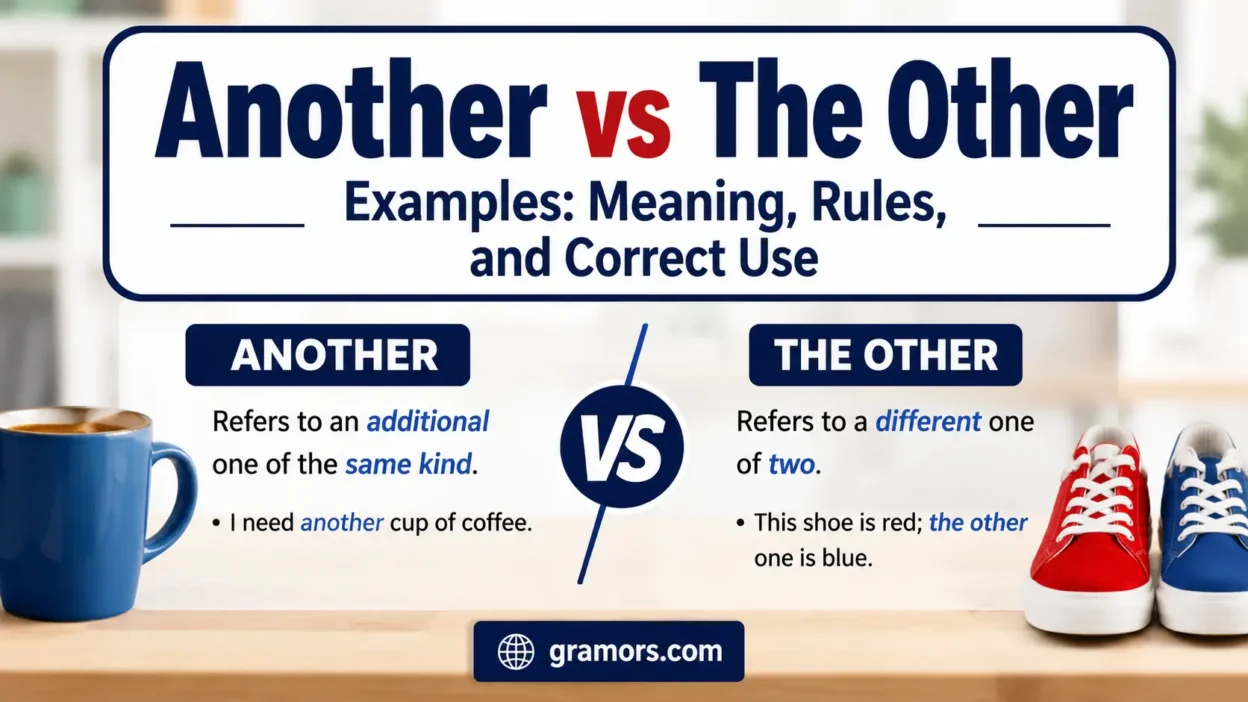
“Can I have another cup?” asks for one more cup without identifying a particular one.
“Where is the other cup?” refers to a specific cup that the listener can identify, often the remaining cup from a known pair or group.
The central difference is usually nonspecific versus specific reference. Another introduces an additional or alternative choice. The other points to a known, remaining, or previously established choice.
These another vs the other examples show how the distinction works in ordinary conversations, workplace messages, shopping, travel, and other modern American English contexts.
Quick Answer
Use another for one more or a different nonspecific person or thing.
Use the other for the particular remaining, contrasting, or contextually known person or thing.
“Let’s try another restaurant” means any suitable additional restaurant.
“The first restaurant is closed, but the other restaurant is open” identifies a particular alternative already known to both speakers.
Both expressions are standard, but they are not normally interchangeable.
Why People Confuse Them
The expressions are easy to confuse because they share the word other and can both direct attention away from something already mentioned.
“I need another charger.”
“I need the other charger.”
The first sentence asks for an additional or different charger without identifying one specific charger. The second assumes that the listener knows which charger is meant.
Historically, another developed from an + other, but modern speakers use it as one word. Do not write “an other” in ordinary uses.
The articles also help explain the contrast:
- An- introduces an indefinite or nonspecific choice.
- The points to an identifiable choice.
The same distinction remains when the noun is omitted:
“Choose another.”
“Choose the other.”
Key Differences At A Glance
| Context | Best Choice | Why |
|---|---|---|
| One additional nonspecific item | another | The exact item has not been identified. |
| A different alternative from an open group | another | Any suitable alternative may be chosen. |
| The remaining member of a known pair | the other | Only one identifiable choice remains. |
| A known contrasting item | the other | The listener knows which item is meant. |
| An added numbered amount | another | Use “another three days.” |
| A known remaining numbered group | the other | Use “the other three days.” |
| The noun is understood and omitted | either form | Reference determines the choice. |
Compact comparison:
- Another book: one more or a different nonspecific book
- The other book: the identifiable remaining or contrasting book
- Another: one additional or alternative item
- The other: the particular known item
- Another three books: three additional books
- The other three books: the known remaining three books
Meaning and Usage Difference
How Another Works
Another has two central meanings.
First, it can mean one additional item:
“She ordered another drink.”
“We need another chair.”
Second, it can mean a different or alternative item:
“This route is blocked. Let’s choose another route.”
“That password failed. Try another.”
Another normally appears before a singular countable noun:
“another applicant”
“another idea”
“another opportunity”
It can also stand alone when the missing noun is understood:
“This copy is damaged. Please bring another.”
Another may appear before a number and a plural noun:
“We need another four chairs.”
“The project will take another three weeks.”
Here, another applies to the complete numbered amount. This does not make forms such as “another chairs” correct without a number.
Another can also appear in an of construction:
“Another of the candidates withdrew.”
“One solution failed, and another of our ideas proved too expensive.”
How The Other Works
The other often identifies the second or remaining member of a pair:
“I have two phones. One is personal, and the other is for work.”
“She wore one glove but could not find the other.”
It can also identify the known remainder of a larger set:
“Ten applicants arrived early. The other four arrived after noon.”
“We completed the first two sections yesterday. The other sections will be reviewed today.”
The other may come before an expressed noun:
“the other proposal”
“the other entrance”
“the other three files”
It may also stand independently:
“One option is expensive; the other is unreliable.”
“Would you like this chair or the other?”
The same noun can accept either expression when the intended reference changes:
“Send me another report” means send one additional or different report.
“Send me the other report” means send the particular report already known from context.
Tone, Context, and Formality
Both expressions are neutral and standard. They work in conversation, professional communication, instructions, academic prose, and formal writing.
The choice is controlled by reference, not social tone.
In conversation:
“Could I get another napkin?”
At work:
“Please review the other proposal.”
In instructions:
“Repeat the process on the other side.”
While planning:
“We may need another week.”
Another often introduces a new possibility. The other assumes shared knowledge, a previous mention, or an established set.
Stress may make the contrast stronger in speech, but pronunciation does not determine which form is grammatically appropriate.
Which One Should You Use?
Ask whether the person or thing is already identifiable.
Use another when you need one additional or alternative item:
“Try another password.”
“Let’s visit another store.”
Use the other when the listener knows which item you mean:
“Use the other password I sent you.”
“The other store closes at 8 p.m.”
Use the other for the uniquely remaining member of a pair:
“One key opens the front door. The other opens the garage.”
Use another + number + plural noun for an added amount:
“We need another two volunteers.”
Use the other + number + plural noun for a known remaining group:
“The other two volunteers have arrived.”
Specificity must come from the complete conversation. An isolated noun does not always reveal whether another or the other is correct.
When One Choice Sounds Wrong
Another creates the wrong meaning when the speaker intends the uniquely identifiable remainder.
Unclear for the intended meaning:
“I have two phones. One is personal; another is for work.”
Better:
“I have two phones. One is personal; the other is for work.”
The original sentence is not impossible in every context. It becomes unsuitable when exactly two phones are being divided into a known pair.
The other sounds unnatural when no particular alternative has been established:
Awkward without prior context:
“Can I have the other glass of water?”
Natural request:
“Can I have another glass of water?”
Numbered plural constructions are valid:
“We stayed another three nights.”
“The other three nights were spent in Boston.”
The first adds three nights. The second identifies three known nights from a larger period.
Common Mistakes
Writing an other
Incorrect: “Can I have an other chance?”
Correct: “Can I have another chance?”
Another is written as one word.
Using another for a known remaining item
Unclear: “One file is complete, and another is missing a page.”
Clear when there are exactly two: “One file is complete, and the other is missing a page.”
Using the other without an identifiable reference
Awkward: “I need the other mechanic” when no mechanics have been discussed.
Natural: “I need another mechanic.”
Assuming the other must be singular
Correct: “The other three files are in the archive.”
The phrase can identify a known remaining plural group.
Rejecting another before a numbered plural noun
Correct: “Give me another three minutes.”
Another can introduce an additional numbered amount.
Using one when it adds no value
Natural: “This cup is cracked. Bring another.”
Also correct: “Bring another one.”
The version with one may add clarity or emphasis, but it is not always required.
Confusing another with one another
Another means one more or a different one.
One another expresses a reciprocal relationship:
“The teammates supported one another.”
Everyday Examples
Food and Drinks
“I’ll have another slice.”
“The other slice is for Maya.”
“Could we order another pitcher of water?”
“The other pitcher is already on the table.”
Shopping
“This jacket is too large. Do you have another?”
“I tried two jackets. The other jacket fit better.”
“Show me another color.”
“The other color is unavailable online.”
Work and School
“We need another person to review the document.”
“The other reviewer will send comments tomorrow.”
“Another student joined the group.”
“One student presented first; the other presented after lunch.”
Travel and Directions
“Let’s take another route.”
“The other route is shorter, but it has a toll.”
“Use the other entrance.”
“We may need another hotel if this one is full.”
Technology
“Open another tab.”
“Close the other tab before restarting the browser.”
“This charger does not work. Please send another.”
“The other charger is in my backpack.”
Time and Quantities
“We need another five minutes.”
“The other five minutes were spent answering questions.”
“The repair may take another two days.”
“The other two days are reserved for testing.”
People and Standalone Uses
“One applicant arrived early; the other arrived at noon.”
“This size is too small. Do you have another?”
“Which document should I sign?”
“The other.”
Dictionary-Style Word Details
Reference works may describe these forms as determiners, adjectives, pronouns, or complete noun phrases. The useful point is how they behave in sentences.
Verb
Another: Another is not commonly used as a verb.
The other: The complete phrase is not a verb. Bare other has a separate specialized verb use, but that meaning falls outside this comparison.
Noun
Another: It can replace an understood noun: “This one is damaged; choose another.” This use is commonly described as a pronoun rather than an ordinary noun.
The other: It can stand as a complete noun phrase: “One stayed; the other left.” Terminology varies, but the expression functions independently.
Synonyms
Another: Closest alternatives include one more, an additional, a different one, and an alternative.
The other: Closest alternatives include the remaining one, the second one, the remaining ones, and, in limited contexts, the opposite side.
These are context-based alternatives, not exact replacements in every sentence.
Example Sentences
Another: “She ordered another drink.” “This route is blocked; choose another.” “We need another solution.” “Another of the candidates withdrew.” “The repair requires another three days.”
The other: “One key is silver; the other is gold.” “Use the other entrance.” “The other four employees work remotely.” “Turn the package over and label the other side.”
Word History
Another: The word developed from the Middle English combination an other and became established as one written word.
The other: This phrase combines the definite article the with the much older word other, which comes from Old English and has related forms in other Germanic languages.
Phrases Containing
Another: another day, another time, one after another, one way or another, another matter, another story.
The other: on the other hand, the other day, one or the other, the other way around, from one side to the other, the other end.
One another is a reciprocal expression similar to each other. It does not carry the ordinary “one more” meaning of another.
FAQ
What Is the Simplest Difference Between Another and The Other?
Another means one more or a different nonspecific choice. The other identifies a particular remaining or contrasting choice.
“Choose another seat.”
“Choose the other seat beside me.”
Can Another Be Followed by a Plural Noun?
Yes, when a number appears between another and the plural noun:
“another three weeks”
Without a number, use a singular noun: “another week.”
Is The Other Used Only for Two People or Things?
No. It often identifies the remaining member of a pair, but it can also refer to the known remainder of a larger group:
“The other three employees work remotely.”
Can Both Expressions Be Used Without a Noun?
Yes.
“I’ll take another” means an additional or different one.
“I’ll take the other” means the identifiable remaining or contrasting one.
What Is the Difference Between Another One and The Other One?
Another one means one more or a different nonspecific item. The other one means the known remaining or contrasting item.
“This pen is dry. Give me another one.”
“Give me the other one on the desk.”
Is Another the Same as One Another?
No. Another refers to an additional or different item. One another expresses a reciprocal relationship.
“They gave one another advice” means each person gave advice to the other person or people.
Use another for an additional or alternative nonspecific choice. Use the other for the identifiable remaining or contrasted choice. Before choosing, ask whether the listener already knows exactly which person or thing you mean.
Conclusion
Another and the other are both correct, but they express different ideas. Use another when you mean one more or a different person or thing that is not specifically identified. Use the other when you mean a particular remaining, known, or previously mentioned person or thing. For example, “Can I have another cup?” asks for one more cup, while “Where is the other cup?” refers to a specific cup. Remembering the difference between nonspecific and specific reference will help you choose the correct expression naturally and confidently.