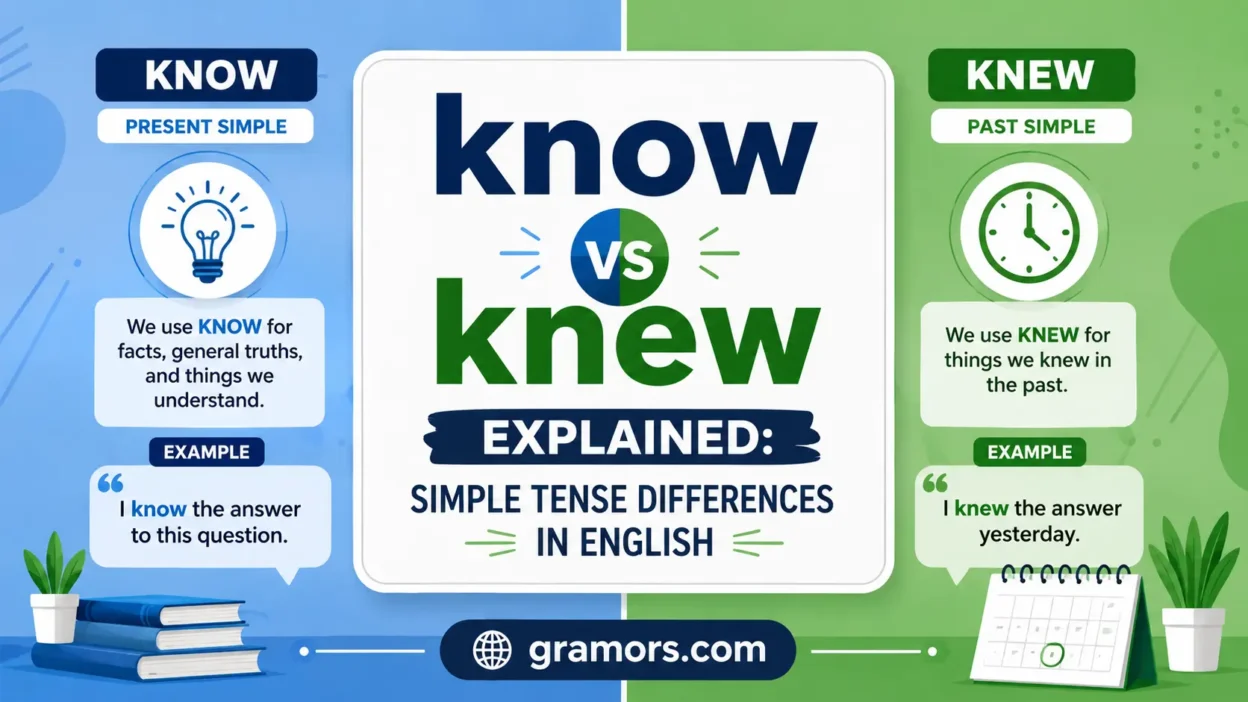
Many English learners confuse know vs knew because both words come from the same verb and share the same core meaning. The real difference is time.
“Know” talks about present knowledge or awareness, while “knew” talks about knowledge that existed in the past.
For example:
- I know her.
- I knew her years ago.
They are related, but they are not interchangeable in the same sentence.
2. Quick Answer
“Know” is the present-tense or base form of the verb.
“Knew” is the simple past tense form.
Examples:
- I know the truth.
- I knew the truth yesterday.
The meaning stays similar, but the time reference changes completely.
3. Why People Confuse Them
The confusion usually comes from irregular verb patterns. English learners expect past tense forms to end in “-ed,” but “know” changes to “knew” instead.
Pronunciation also causes problems:
- know → sounds like “noh”
- knew → sounds like “noo”
Another issue is tense switching in conversation.
Incorrect:
- Yesterday I know the answer.
Correct:
- Yesterday I knew the answer.
Some learners also confuse “knew” with “known,” which is a different verb form.
4. Key Differences At A Glance
| Context | Best Choice | Why |
|---|---|---|
| Talking about present knowledge | know | present-time awareness |
| Talking about past knowledge | knew | completed past awareness |
| After helper verbs like “do” or “will” | know | base form required |
| Describing a past realization | knew | simple past tense needed |
Extra Comparison Block
- know → present tense or base verb
- knew → simple past tense
- know works after helper verbs like “do,” “does,” and “will”
- knew does not follow helper verbs in standard grammar
- neither word is the past participle form (“known” is)
5. Meaning and Usage Difference
The core meaning of both words is awareness, familiarity, or understanding. The difference is when that knowledge exists.
“Know” describes current or ongoing knowledge.
Examples:
- I know what she means.
- We know the rules.
“Knew” describes knowledge that existed in the past.
Examples:
- I knew what she meant.
- They knew the answer already.
Time markers often help:
- now, today, usually → know
- yesterday, last year, before → knew
6. Tone, Context, and Formality
Both words are neutral and common in everyday English.
“Know” appears more in present conversations and ongoing situations.
“Knew” often appears in storytelling, memories, or emotional reactions.
Example:
- I knew this would happen!
That sentence can sound emotional because it expresses expectation or realization from the past.
There is no major formal or informal difference between the two.
7. Which One Should You Use?
Choose based on time reference.
Use know when:
- the information is current
- the situation is ongoing
- the sentence includes helper verbs
Examples:
- I know your name.
- Do you know the answer?
- You will know soon.
Use knew when:
- the action happened in the past
- the sentence describes past understanding or familiarity
Examples:
- I knew him in college.
- She knew the story already.
8. When One Choice Sounds Wrong
Some sentences sound unnatural because the tense does not match the timeline.
Incorrect:
- Yesterday I know the answer.
Correct:
- Yesterday I knew the answer.
Another example:
Incorrect:
- I will knew tomorrow.
Correct:
- I will know tomorrow.
The surrounding grammar decides which form fits.
9. Common Mistakes (and Quick Fixes)
- Mistake 1: Mixing up “knew” and “known”
- ❌ I have knew him for years.
- ✔️ I have known him for years.
- Mistake 2: Using “knew” after helper verbs
- ❌ Do you knew him?
- ✔️ Do you know him?
- Mistake 3: Wrong tense with time markers
- ❌ Last year I know the answer.
- ✔️ Last year I knew the answer.
Quick memory tip:
- know = now
- knew = before now
10. Everyday Examples
Conversation:
- I know what you mean.
- I knew you were joking.
School:
- We know the homework rules.
- We knew the test would be difficult.
Work:
- I know the client personally.
- She knew the project details already.
Storytelling:
- He knew something was wrong.
- They knew the meeting would be delayed.
11. Dictionary-Style Word Details
Verb
- know: present-tense and base form used for awareness, familiarity, or understanding
- knew: simple past tense form used for past awareness or familiarity
Noun
- know: appears in limited expressions like “in the know”
- knew: not commonly used as a noun
Synonyms
- know: understand, recognize, be aware of
- knew: understood, recognized, was aware of
Example Sentences
- know: “I know the answer now.”
- knew: “I knew the answer yesterday.”
Word History
- know: comes from Old English and Germanic roots related to understanding and recognition
- knew: developed historically as the irregular past-tense form of “know”
Phrases Containing
- know: know better, know by heart, in the know
- knew: knew better, never knew why
12. FAQ
Is “knew” the past tense of “know”?
Yes. “Knew” is the simple past tense form of “know.”
What is the difference between “knew” and “known”?
“Knew” is simple past tense. “Known” is the past participle used with helper verbs.
Examples:
- I knew him years ago.
- I have known him for years.
Can I say “I knew him”?
Yes. It means you were familiar with him in the past.
Why does “I knew it!” sound emotional?
It often expresses strong expectation, prediction, or realization after something happens.
13. Conclusion
The difference between know vs knew comes down to time. “Know” describes present or ongoing understanding, while “knew” describes past understanding or familiarity.
A simple comparison makes it clear:
- I know the answer now.
- I knew the answer yesterday.
Once you match the verb to the correct timeline, choosing between them becomes much easier.