Nonetheless and none the less sound almost identical, so writers often wonder whether both forms mean the same thing. In modern English, nonetheless is the standard one-word adverb. It means “despite that,” “even so,” or “however.”
The three-word phrase none the less can still appear, but it usually has a more literal meaning related to quantity or degree. Because the two forms serve different purposes, they are not always interchangeable. This guide explains the difference, shows when each form is correct, and provides clear examples to help you choose confidently.
Quick Answer
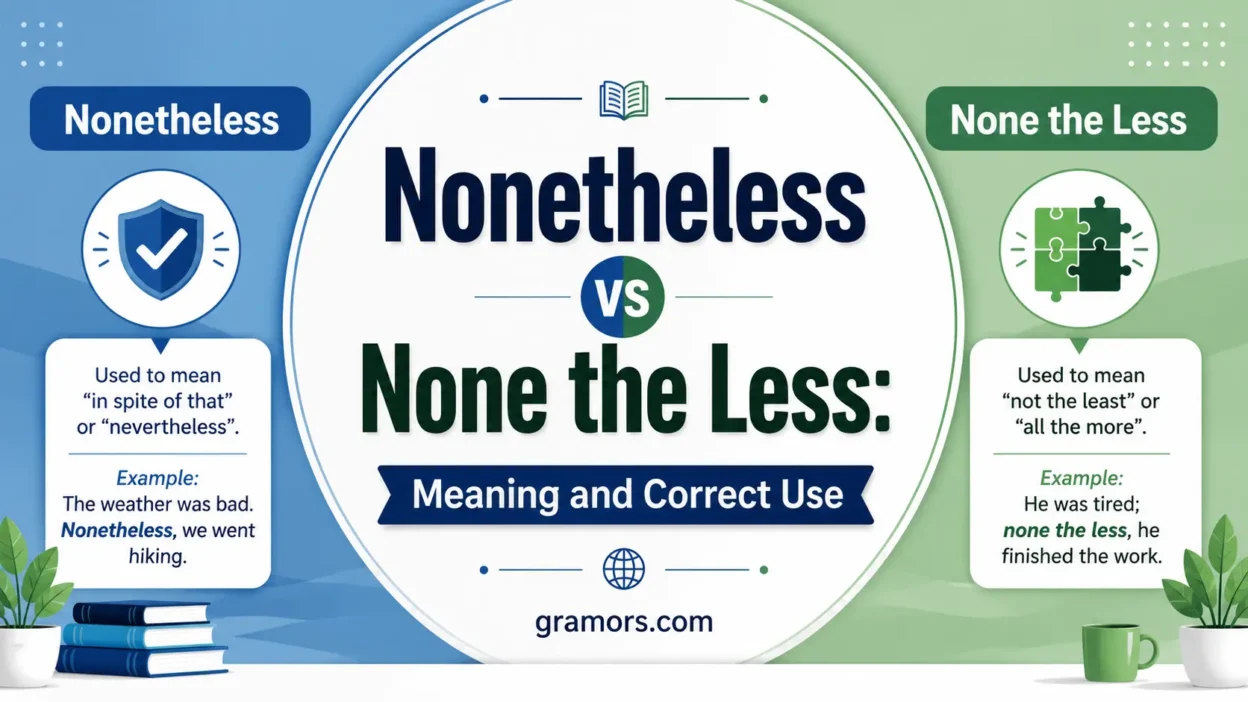
Use nonetheless when you mean “however,” “even so,” or “in spite of that.” It is the standard modern spelling and works as an adverb.
None the less is a rare phrase used when less keeps its literal meaning, usually in expressions such as “none the less important.”
Example: The task was difficult; nonetheless, she completed it on time.
Why People Confuse Them

The confusion comes from the one-word and three-word forms.
Nonetheless developed from the phrase:
none + the + less
Over time, those words joined into the standard compound nonetheless.
Because the parts are still easy to see, some writers separate them again. In modern use, though, the one-word form is normally expected.
Key Differences At A Glance

| Context | Best Choice | Why |
|---|---|---|
| Standard transition | nonetheless | It is the modern adverb form. |
| Meaning “despite that” | nonetheless | It clearly shows contrast. |
| Formal writing | nonetheless | It sounds polished and accepted. |
| Literal comparison | none the less | The words may keep separate roles. |
| General writing | nonetheless | It is the safer default. |
| Older or rare style | none the less | It may appear, but it can look unusual. |
Compact comparison:
• Nonetheless: one-word adverb meaning despite that, even so, or nevertheless.
• None the less: rare three-word form or literal construction, not the usual modern spelling.
Meaning and Usage Difference
Nonetheless means despite that, even so, or nevertheless.
It connects two ideas that seem to contrast.
Example:
She was tired; nonetheless, she kept working.
This means she kept working despite being tired.
You can place nonetheless at the beginning, middle, or end of a sentence.
Examples:
Nonetheless, we agreed to help.
The plan, nonetheless, had some value.
It was costly but useful nonetheless.
None the less can sometimes carry the same idea, but it is uncommon as a simple transition. It may also appear in a more literal structure.
Example:
The medicine was none the less effective because it was inexpensive.
Here, the words are working more literally: the medicine was not less effective.
Tone, Context, and Formality
Nonetheless sounds polished and somewhat formal. It fits well in academic writing, reports, business messages, and serious explanations.
Academic:
The evidence is limited; nonetheless, it is useful.
Business:
The launch was delayed; nonetheless, the team stayed on schedule.
Everyday writing:
It rained all morning. Nonetheless, we had a good trip.
None the less can look old-fashioned or unusual. It may distract readers if you use it as a normal transition.
Because of that, avoid it in most modern school, work, and professional writing.
Which One Should You Use?
Choose nonetheless for essays, articles, emails, reports, and exams.
Examples:
The answer was incomplete; nonetheless, it showed effort.
The project was expensive; nonetheless, it delivered results.
The weather was bad; nonetheless, the event continued.
Use none the less carefully. It may be acceptable in older style, quoted material, or literal structures like:
The result was none the less impressive because it came late.
Even there, many modern readers may still prefer a clearer rewrite.
When One Choice Sounds Wrong
As a simple transition, none the less often sounds strange today.
Less natural:
The delay was frustrating; none the less, we continued.
Better:
The delay was frustrating; nonetheless, we continued.
However, nonetheless may not work when the phrase is literal.
Less natural:
The medicine was nonetheless effective because it was cheap.
Clearer:
The medicine was none the less effective because it was cheap.
In most sentences, though, readers expect nonetheless.
Common Mistakes
Mistake:
None the less, we finished the assignment.
Fix:
Nonetheless, we finished the assignment.
Mistake:
The report was short, nonetheless it was helpful.
Fix:
The report was short; nonetheless, it was helpful.
Mistake:
The report was short but nonetheless it was helpful.
Fix:
The report was short but helpful nonetheless.
Note: But nonetheless is not always grammatically wrong, but it can be wordy.
Mistake:
Confusing nonetheless with no less.
Fix:
Use nonetheless for contrast. Use no less for emphasis.
Example:
It was difficult; nonetheless, she tried.
Example:
She won three awards, no less.
Everyday Examples
Nonetheless, we agreed to help.
The test was hard; nonetheless, she passed.
It was costly but useful nonetheless.
The store was crowded; nonetheless, we found what we needed.
He was nervous; nonetheless, he gave a strong speech.
The instructions were confusing; nonetheless, the class finished on time.
The road was icy; nonetheless, traffic kept moving.
The idea was unusual but interesting nonetheless.
The meeting ran late; nonetheless, everyone stayed calm.
The result was none the less impressive because the team had little time.
Dictionary-Style Word Details
Verb
• Nonetheless: Not a verb.
• None the less: Not a verb.
Noun
• Nonetheless: Not a noun.
• None the less: Not commonly a noun phrase in this usage.
Synonyms
• Nonetheless: closest alternatives include nevertheless, however, still, yet, and even so.
• None the less: the same alternatives apply only when it is used as an adverbial variant. This use is rare, so the synonym match is only partial.
Example Sentences
• Nonetheless: The weather was bad; nonetheless, we went outside.
• Nonetheless: The plan was risky; nonetheless, it worked.
• Nonetheless: She disagreed but listened nonetheless.
• Nonetheless: The app has flaws; nonetheless, it is useful.
• Nonetheless: The task took longer than expected; nonetheless, we finished.
• Nonetheless: His answer was brief but correct nonetheless.
• None the less: The result was none the less valuable because it came late.
• None the less: Her effort was none the less impressive because she had little help.
• None the less: None the less, they continued. This is understandable, but it looks unusual in modern writing.
Word History
• Nonetheless: This word comes from the phrase none the less. The separate words became a compound used to show contrast.
• None the less: This is the older phrase behind the compound and may still appear as an occasional variant or literal construction.
Phrases Containing
• Nonetheless: No major everyday phrase set is built around this word beyond normal sentence use.
• None the less: Literal patterns include none the worse and none the less effective, where none keeps a separate role.
FAQs
Nonetheless is normally written as one word. It is a standard adverb meaning “in spite of that” or “even so.” For example: “The road was icy; nonetheless, they continued carefully.”
Yes, none the less can be grammatically correct, but it is much less common. Writers usually use it when less has a literal meaning, such as “not any less.” In most contrast sentences, nonetheless is the better choice.
Nonetheless introduces a contrast with the previous statement. It means “despite what was just mentioned.” For example: “The task was difficult. Nonetheless, she completed it on time.”
Not in every sentence. Nonetheless works as a linking adverb, while none the less may emphasize that something is not reduced in degree, value, or importance. Therefore, writers should not treat them as automatically interchangeable.
Both words are correct and have almost the same meaning. They introduce an unexpected result or contrast. Nevertheless can sound slightly more formal, while nonetheless often feels smoother in everyday writing.
A comma usually follows nonetheless when it begins a sentence: “Nonetheless, the event continued.” When it appears in the middle, punctuation depends on the sentence structure: “The plan was risky but nonetheless effective.”
No. None-the-less is not the standard spelling. Use nonetheless as one word for the common adverb, or write none the less as three separate words when the literal phrase is required.
Use nonetheless in formal, academic, professional, and everyday writing. It is the established and widely accepted form for showing contrast. Use none the less only when the sentence specifically means “not any less.”
Conclusion
The safest rule is simple: use nonetheless as the standard modern choice.
Use none the less only when the words are working literally or when you are preserving an older style.
Memory sentence:
The task was difficult; nonetheless, we finished it.