
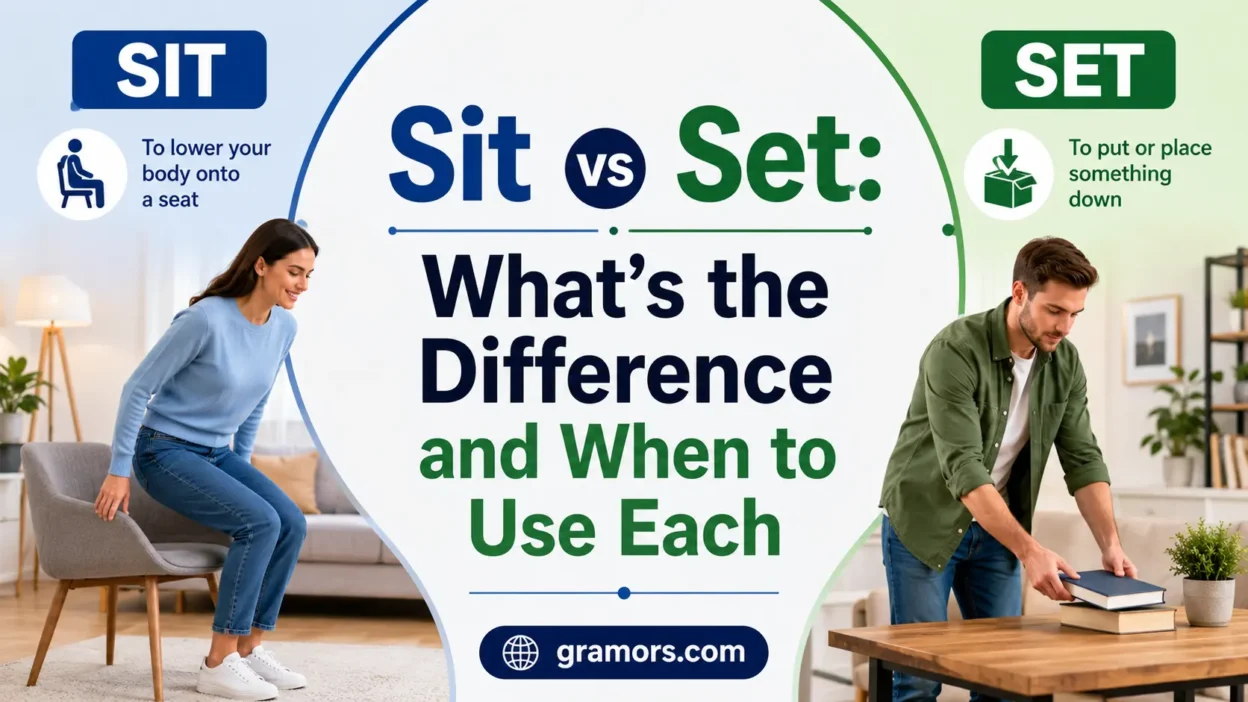
Many English learners — and plenty of native speakers — mix up “sit” and “set.” The confusion makes sense because both words relate to position and placement, and they sound somewhat similar in fast conversation.
Still, they are not interchangeable in standard American English. The difference usually depends on sentence structure and whether the verb acts on an object.
For example:
- “Sit on the chair.”
- “Set the book on the desk.”
In the first sentence, the subject moves into a seated position. In the second, someone places an object somewhere.
This guide will make the sit vs set difference clear with practical examples, quick corrections, and natural everyday usage.
Quick Answer
“Sit” usually means to rest in a seated position or remain somewhere. It normally does not take a direct object.
- “Please sit here.”
- “The dog sat by the door.”
“Set” usually means to place or put something somewhere. It normally takes a direct object.
- “Please set the bag on the floor.”
- “She set the keys on the counter.”
Incorrect:
- “Sit the book on the desk.”
Correct:
- “Set the book on the desk.”
A quick shortcut:
- If something is being placed, “set” is usually correct.
- If someone or something is resting somewhere, “sit” is usually correct.
Some exceptions and regional uses exist, but this rule works in most modern American English situations.
Why People Confuse Them
The confusion comes from a few different things.
First, the meanings are related. Both words involve position or movement.
Second, spoken English sometimes blurs the distinction. In some regions, people casually say things like:
- “Sit the baby down.”
- “Sit your drink over there.”
Those forms appear in conversation, but edited American English usually prefers “set” when an object is involved.
Past tense forms also cause problems:
- sit → sat
- set → set
Because “set” stays the same in present and past tense, many learners second-guess themselves.
Another issue is that native speakers often rely on instinct instead of grammar rules. That works until they have to explain why one version sounds natural and another does not.
Key Differences At A Glance
| Context | Best Choice | Why |
|---|---|---|
| Resting in a chair | sit | No direct object |
| Placing keys on a table | set | Object is being placed |
| Remaining in one location | sit | Subject stays positioned |
| Putting a bag down | set | Action affects an object |
| “The cat ___ by the window.” | sits | The cat positions itself |
| “She ___ the keys down.” | set | Keys are the object |
| Feature | sit | set |
|---|---|---|
| Main meaning | Rest or remain positioned | Place something somewhere |
| Usual grammar type | Intransitive | Transitive |
| Direct object | Usually no | Usually yes |
| Past tense | sat | set |
| Common pattern | sit here | set it down |
Meaning and Usage Difference
The main difference is simple once you focus on the sentence structure.
“Sit” usually describes the subject’s own position.
- “The cat sits in the sun.”
- “We sat near the stage.”
- “The village sits beside the river.”
Notice that nothing is being acted upon directly.
“Set” usually describes placing something somewhere.
- “She set the cup on the table.”
- “He set his backpack by the door.”
- “Please set the groceries inside.”
Here, the object receives the action.
A direct object is the thing being placed:
- set the cup
- set the backpack
- set the groceries
“Sit” also appears in figurative uses:
- “The issue sits unresolved.”
- “The cabin sits on a hill.”
These still follow the same pattern: the subject remains in a position or state.
One important detail: “set” has many unrelated meanings outside this comparison.
Examples include:
- “set a record”
- “set a timer”
- “TV set”
But in this guide, the focus stays on the placement meaning.
Tone, Context, and Formality
In casual speech, many Americans blur the line between these verbs.
You may hear:
- “Sit your bag over there.”
- “I’m gonna sit this down for a second.”
These forms exist in regional and conversational speech, especially in informal settings.
In formal or edited writing, though, standard usage usually prefers:
- “Set your bag over there.”
- “I’m going to set this down for a second.”
That does not mean casual speech is “bad” English. It simply follows different spoken habits.
Native speakers often notice the difference more in writing than in conversation.
At work, in school, or in professional emails, using the standard distinction sounds clearer and more polished.
Which One Should You Use?
A fast way to decide is to check whether the verb acts on something.
Ask:
“Is someone placing an object?”
If yes, “set” is usually correct.
- “Set the laptop on my desk.”
- “Can you set the plates out?”
- “She set the file beside the printer.”
If no object exists, “sit” is usually correct.
- “Please sit here.”
- “The kids sat quietly.”
- “The cat sits near the fireplace.”
A useful memory trick:
- “Set” usually sets something somewhere.
- “Sit” usually describes position without moving another object.
This shortcut will help in most real-world situations, though idioms and regional speech may vary.
When One Choice Sounds Wrong
Some sentence combinations sound unnatural because the grammar structure does not match the verb.
Incorrect:
- “Sit the glass here.”
Standard version:
- “Set the glass here.”
Why? Because “glass” is the object being placed.
Incorrect:
- “Set here quietly.”
Standard version:
- “Sit here quietly.”
Why? Nothing is being placed.
Another common example:
Incorrect:
- “The teacher told us to set down.”
Standard version:
- “The teacher told us to sit down.”
Using the wrong verb can change the meaning or make the sentence sound awkward to native speakers.
At the same time, some regional speech patterns use these forms casually, so readers may still hear them in everyday conversation.
Common Mistakes
Many errors happen because people use one verb for every situation.
Incorrect:
- “Please sit the groceries on the counter.”
Correct:
- “Please set the groceries on the counter.”
Incorrect:
- “Set next to me.”
Correct:
- “Sit next to me.”
Incorrect:
- “He sat the phone down.”
Standard edited version:
- “He set the phone down.”
Incorrect:
- “The backpack set on the chair all day.”
Correct:
- “The backpack sat on the chair all day.”
Quick editing checklist:
- Is there an object being placed? → use “set”
- Is the subject resting or staying somewhere? → use “sit”
Everyday Examples
- “Please sit near the window.”
- “She set her coffee on the desk.”
- “The dog sat by the fireplace.”
- “Can you set these boxes in the garage?”
- “He sat quietly during the meeting.”
- “The nurse set the clipboard on the counter.”
- “Our cabin sits above the lake.”
- “She set her phone face down.”
- “The students sat in the front row.”
- “Dad set the groceries on the kitchen table.”
- “The town sits along the river.”
- “Please set the keys beside the lamp.”
- “The baby sat on the floor playing with blocks.”
- “The server set our drinks on the table.”
- “He sat outside after dinner.”
- “She carefully set the birthday cake in the fridge.”
Dictionary-Style Word Details
Verb
• sit:
Usually means to rest in a seated position or remain somewhere.
Main forms:
- sit
- sat
- sitting
Examples:
- “Please sit down.”
- “They sat near the stage.”
• set:
Usually means to place or put something somewhere.
Main forms:
- set
- set
- setting
Examples:
- “Set the tray on the counter.”
- “She set the alarm.”
Noun
• sit:
Limited noun use in modern English. It appears mainly in specialized expressions such as “a photo sit” in creative industries.
• set:
Common noun meanings include a collection or group.
Examples:
- “a set of tools”
- “a TV set”
These noun meanings are separate from the verb comparison.
Synonyms
• sit:
Closest plain alternatives:
- rest
- remain seated
- stay positioned
• set:
Closest plain alternatives:
- place
- put
- position
These are not perfect replacements in every sentence.
Example Sentences
• sit:
- “I usually sit near the back.”
- “The restaurant sits across from the park.”
- “We sat there for an hour.”
• set:
- “Please set the dishes on the table.”
- “He set the package by the door.”
- “She set the timer for twenty minutes.”
Word History
• sit:
Comes from Old English roots connected to being seated or occupying a position.
• set:
Also comes from older Germanic language roots and gradually developed many meanings related to placing, arranging, and establishing things.
Historically, the meanings sometimes overlapped more than they do today.
Phrases Containing
• sit:
- sit down
- sit tight
- sit still
• set:
- set aside
- set up
- set down
These phrases are very common in modern American English.
Conclusion
The main sit vs set difference comes down to sentence structure.
Use “sit” when someone or something rests in a position:
- “The kids sat quietly.”
Use “set” when placing something somewhere:
- “She set the bag on the chair.”
A quick object check usually solves the problem. If the verb acts on something, “set” is probably the better choice. If not, “sit” is usually right.
With enough real-world examples, the distinction starts to feel natural in both speaking and writing.