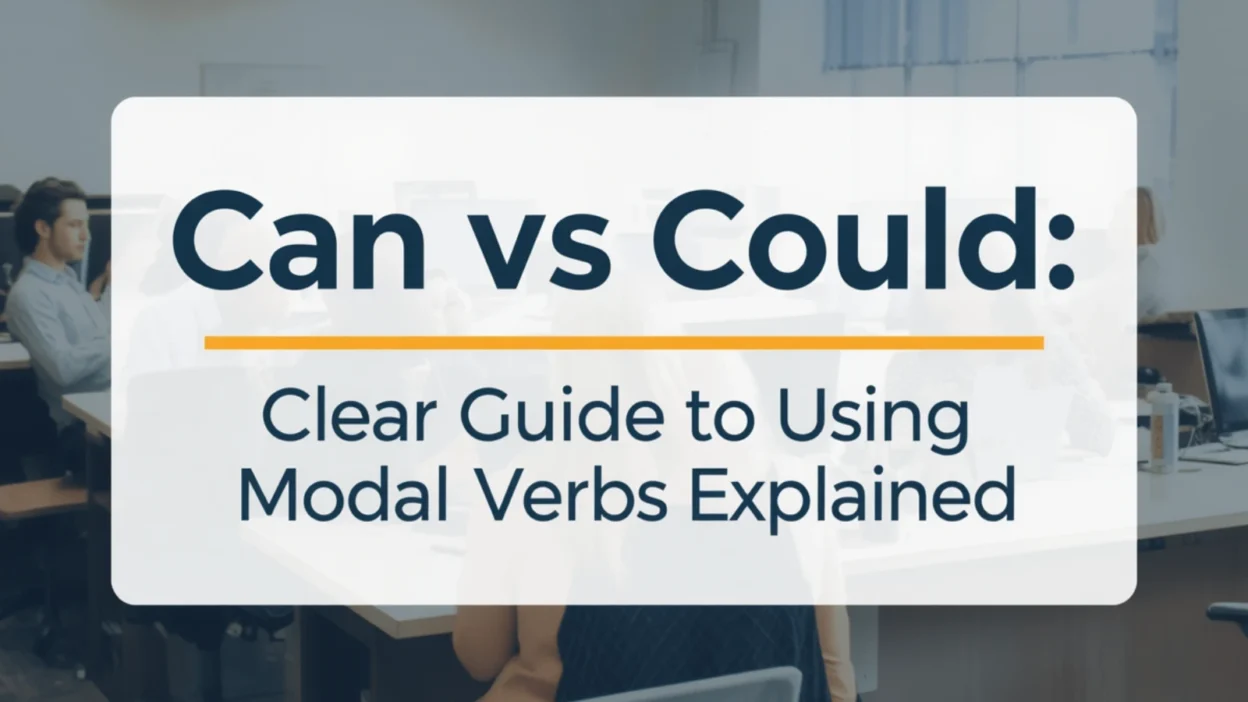
People often mix up can vs could because both words talk about ability, permission, and possibility. They look similar, sound related, and appear in everyday speech all the time.
The confusion usually comes from context. One small change in wording can shift meaning, tone, or time.
This guide breaks everything down in a simple way so you can use both words with confidence in real conversations.
2. Quick Answer
- can = present ability, general truth, or direct permission
- could = past ability, polite request, or uncertain/hypothetical situation
They are not always interchangeable.
Example:
- I can drive now.
- I could drive when I was 16.
3. Why People Confuse Them
Both words are modal verbs and behave in similar sentence structures. That alone makes them easy to mix up.
Another reason is meaning overlap. Both can talk about ability or possibility, depending on context.
Finally, everyday speech doesn’t always follow strict grammar rules, so learners hear flexible usage in real life.
4. Key Differences At A Glance
| Context | Best Choice | Why |
|---|---|---|
| Present ability | can | talks about now |
| Past ability | could | refers to earlier time |
| Polite request | could | sounds softer |
| Direct request | can | sounds straightforward |
| Hypothetical idea | could | shows uncertainty |
Extra Comparison
| Feature | can | could |
|---|---|---|
| Tone | direct | softer / indirect |
| Time reference | present | past or conditional |
5. Meaning and Usage Difference
can is used for ability or permission in the present.
- She can speak Spanish.
- You can leave early today.
could is used for past ability or imagined situations.
- He could run fast when he was younger.
- I could help if I had more time.
The key idea is that “could” often moves away from reality into time, politeness, or possibility.
6. Tone, Context, and Formality
Tone plays a big role.
can feels direct and simple:
- Can you help me?
could feels more polite or careful:
- Could you help me?
In workplaces or formal situations, “could” is often preferred because it sounds less forceful. In casual talk, “can” is very common.
7. Which One Should You Use?
Choose based on three things:
- Time: now → can, past/hypothetical → could
- Tone: direct → can, polite → could
- Reality: real ability → can, imagined situation → could
Examples:
- At school: You can submit it today.
- Asking politely: Could you explain this again?
- Hypothetical: I could travel if I had money.
8. When One Choice Sounds Wrong
Some sentences feel unnatural when the wrong modal is used.
- Wrong:
- I could go to the gym now every day.
Right: - I can go to the gym every day.
- Wrong:
- Can you passed the book?
Right: - Can you pass the book?
- Wrong structure or mismatched time makes sentences sound off.
9. Common Mistakes (and Quick Fixes)
- Mistake 1: Using “could” for everything
- Fix: Use “can” for present facts.
- Mistake 2: Confusing past vs present
- Fix: Ask yourself “Did this happen before or now?”
- Mistake 3: Wrong grammar after modal
- Wrong: could goes
- Right: could go
- Mistake 4: Overusing “could” in daily speech
- Fix: Mix both naturally depending on context.
10. Everyday Examples
- At home:
- I can clean my room now.
- I could clean it yesterday before I was busy.
- At school:
- You can use a calculator.
- Could you help me with this question?
- At work:
- We can finish this today.
- We could finish early if we work together.
Travel:
- I can take the morning bus.
- I could visit next year if I save money.
11. Dictionary-Style Word Details
Verb
- can: present modal verb showing ability or permission
- could: past form and conditional modal showing ability or possibility
Noun
- Not used as nouns for either term (they function as modal verbs only)
Synonyms
- can: be able to, have the ability to
- could: might be able to, would be able to (context-based alternatives)
Example Sentences
- can: I can finish this task today.
- could: I could finish it if I had more time.
Word History
- can comes from old English usage tied to ability and knowledge of doing something.
- could developed as a past form of “can,” later gaining additional uses like politeness and hypothetical meaning.
Phrases Containing
- can: can do, can’t wait, can help
- could: could have, could be, could go
FAQ
What is the main difference between can and could?
“Can” usually talks about present ability, permission, or possibility, while “could” often refers to past ability, polite requests, or hypothetical situations.
Examples:
- I can swim.
- I could swim when I was younger.
Is could the past tense of can?
Yes, in many situations.
Example:
- Present: I can run fast.
- Past: I could run fast as a child.
However, “could” also has other uses, such as polite requests and hypothetical ideas.
Which sounds more polite: can or could?
“Could” usually sounds more polite and less direct.
Examples:
- Can you help me? → direct
- Could you help me? → softer and more polite
Can can and could be interchangeable?
Sometimes, but not always.
Examples:
- Can I borrow your pen?
- Could I borrow your pen?
Both are correct, but “could” sounds more polite.
However, you cannot always swap them:
❌ I could drive now every day.
✔ I can drive now every day.
When should I use can?
Use “can” for:
- present ability
- permission
- real possibility
Examples:
- She can speak English.
- You can leave now.
- This can happen sometimes.
When should I use could?
Use “could” for:
- past ability
- polite requests
- hypothetical situations
- uncertain possibilities
Examples:
- I could read at age four.
- Could you open the window?
- We could travel next year.
Is “could” always past tense?
No. “Could” can also describe imagined or possible situations in the present or future.
Example:
- I could help tomorrow if needed.
Here, “could” is not past tense.
What grammar comes after can and could?
Use the base form of the verb.
Correct:
- can go
- could help
Incorrect:
- can goes
- could helped
Why do learners confuse can and could?
People confuse them because both words talk about ability and possibility, and both use similar sentence structures. Everyday English also uses them flexibly depending on tone and context.
What is the easiest way to remember can vs could?
Use this quick memory trick:
- can = present or direct
- could = past, polite, or imagined
Examples:
- I can do it now.
- I could do it if I had time.
12. Conclusion
The difference between can vs could comes down to time, tone, and reality. One describes what is possible now, while the other shifts into the past, politeness, or imagination.
Once you focus on context instead of memorizing rules, choosing the right word becomes much easier.