People often get confused about meet vs know because both words are connected to people and relationships. But they do very different jobs in English.
The confusion usually happens when learners try to use “know” for first meetings or “meet” for long-term familiarity. That leads to incorrect sentences like “I know him yesterday” or “I meet him for years.”
This guide makes the difference clear so you always know which word fits the situation.
2. Quick Answer
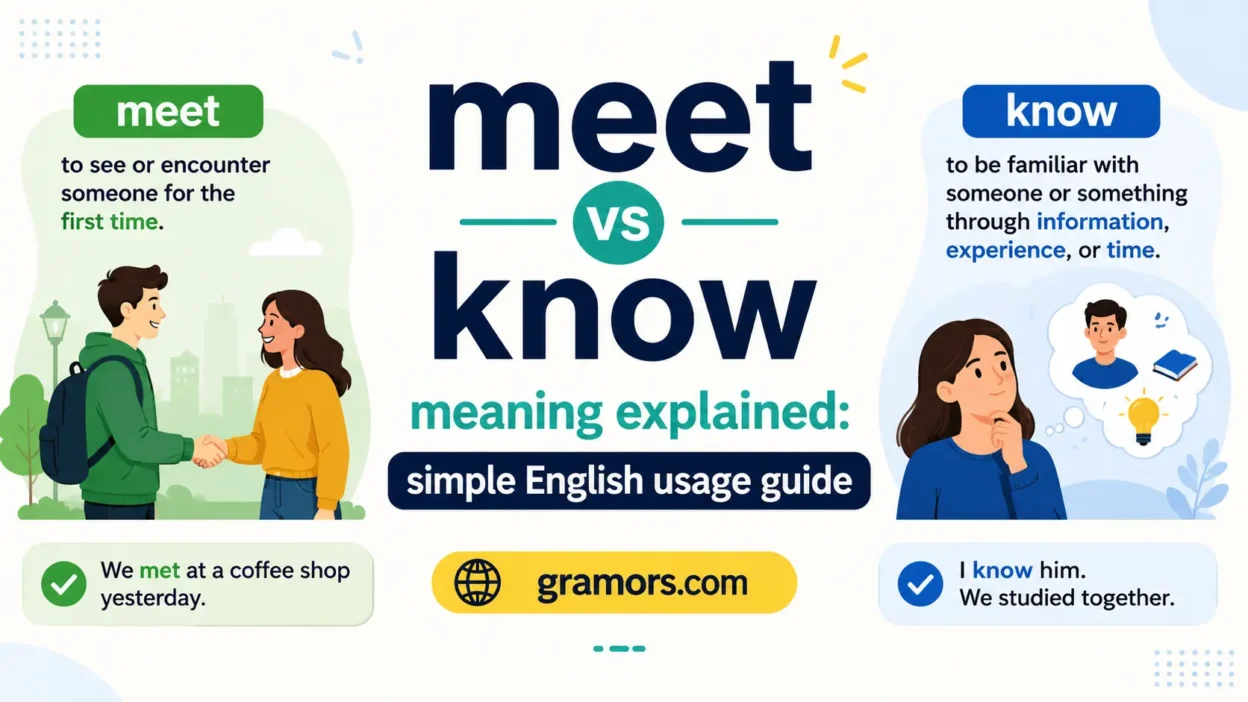
“Meet” means the first time you come into contact with someone or arrange to see them.
“Know” means you already have familiarity, experience, or information about someone or something.
Examples:
- Nice to meet you. (first introduction)
- I know her very well. (existing familiarity)
They are not interchangeable.
3. Why People Confuse Them
The confusion happens because both words often translate into the same idea in other languages, especially “conocer.”
Another reason is the natural relationship progression: you meet someone first, and later you get to know them, and finally you know them well.
This overlap makes learners mix the stages and use the wrong verb in the wrong moment.
4. Key Differences At A Glance
| Context | Best Choice | Why |
|---|---|---|
| First introduction | meet | first contact or encounter |
| Existing familiarity | know | established relationship or knowledge |
| Greetings | meet | fixed expression “Nice to meet you” |
| Facts or information | know | awareness or understanding |
Extra Comparison Block
- meet → first encounter, introduction, arranged contact
- know → familiarity, understanding, or long-term awareness
- “meet” is about starting contact
- “know” is about existing knowledge
- they often appear in a natural progression, not at the same stage
5. Meaning and Usage Difference
“Meet” refers to the moment when you first come into contact with someone, whether planned or by chance.
“Know” refers to a state of familiarity or awareness after that contact.
Examples:
- I meet new students every semester.
- I know my classmates very well now.
Important note: “know” has multiple uses. It can apply to people, facts, or skills, while “meet” mainly refers to people or arranged interactions.
6. Tone, Context, and Formality
Both words are neutral and used in everyday English. Neither is more formal than the other.
However, their context differs:
- “meet” is common in introductions and greetings
- “know” is used when describing familiarity or knowledge
Examples:
- Nice to meet you. (standard greeting)
- I know your brother. (existing relationship)
7. Which One Should You Use?
Use meet when talking about:
- first-time introductions
- arranged meetings
- chance encounters
Use know when talking about:
- existing relationships
- information or awareness
- familiarity over time
Examples:
- I meet my manager today for the first time.
- I know my manager well after two years.
8. When One Choice Sounds Wrong
Some sentences sound wrong because they mix stages of relationship.
Wrong:
- Nice to know you.
- I know him yesterday.
Correct:
- Nice to meet you.
- I met him yesterday.
Another mistake:
- Wrong: I know her last week
- Correct: I met her last week
The key issue is using “know” for first encounters, which sounds unnatural.
9. Common Mistakes
- Mistake 1: Using “know” for first meeting
- ❌ Nice to know you
- ✔️ Nice to meet you
- Mistake 2: Using “meet” for long-term familiarity
- ❌ I meet him for five years
- ✔️ I have known him for five years
- Mistake 3: Forgetting progression
- ❌ I know him yesterday
- ✔️ I met him yesterday
Quick fix: think meet = start, know = already established
10. Everyday Examples
School:
- I meet new classmates every year.
- I know many classmates from last year.
Work:
- I meet clients during onboarding.
- I know my team well now.
Social life:
- I met her at a party.
- I know her through school.
Travel:
- I meet new people when I travel.
- I know some locals in that city.
11. Dictionary-Style Word Details
Verb
- meet: to come into contact for the first time or arranged interaction
- know: to have familiarity, awareness, or understanding of someone or something
Noun
- meet: used as an event (sports meet, school meet)
- know: no equivalent noun in this sense
Synonyms
- meet: encounter, come across, introduce
- know: understand, recognize, be familiar with
Example Sentences
- meet: “I met my teacher yesterday.”
- know: “I know my teacher very well.”
Word History
- meet: Old English origin meaning “come together”
- know: Old English origin meaning “perceive or understand”
- both evolved into modern relationship-based meanings
Phrases Containing
- meet: meet up, meet with, nice to meet you
- know: get to know, know about, know how
12. FAQ
Can “meet” mean you already know someone?
No. “Meet” is mainly for first contact or arranged meetings.
Can “know” be used for first introductions?
No. It sounds incorrect in greetings.
What is “get to know”?
It is the middle stage between meeting someone and fully knowing them.
Is “know” only for people?
No. It is also used for facts, skills, and information.
13. Conclusion
The difference between meet vs know is based on relationship stage. “Meet” is the beginning of contact, while “know” is established familiarity or understanding.
Use “meet” for introductions and first encounters, and use “know” for ongoing relationships or knowledge. Once you follow this rule, your English becomes much clearer and more natural.