
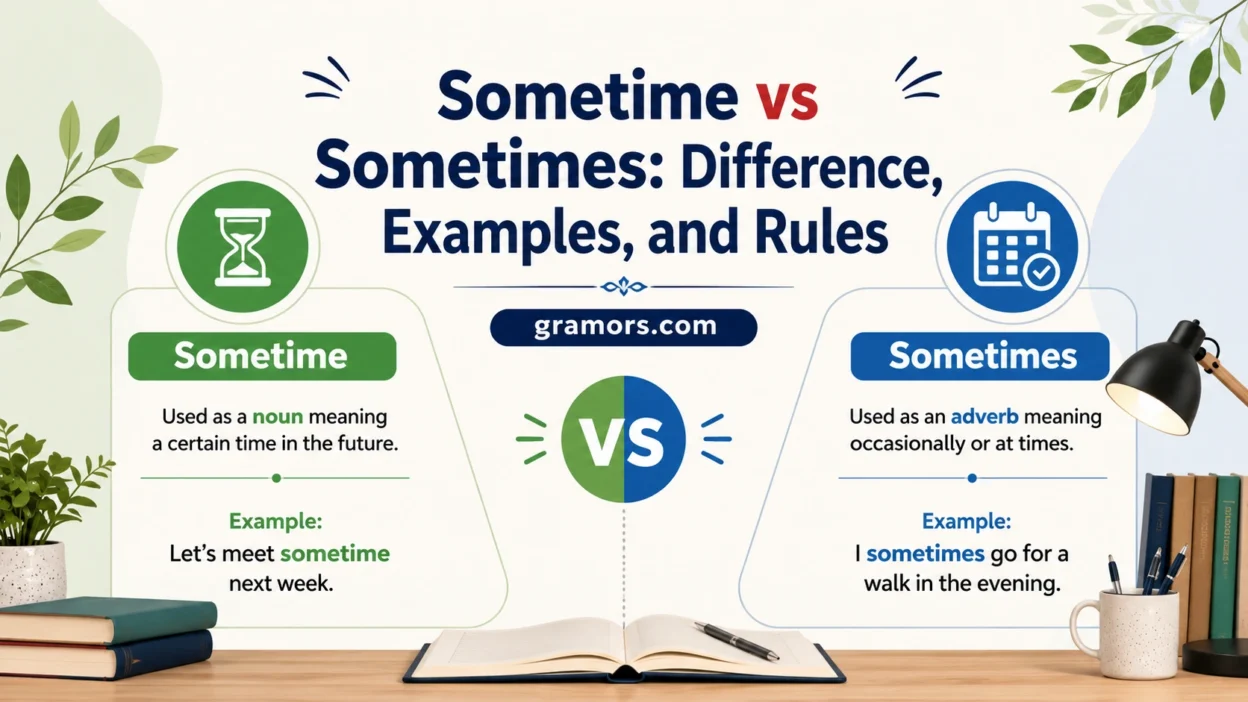
The confusion between sometime vs sometimes is common because the words look and sound similar. Both are correct, but they do not mean the same thing.
The final s changes the meaning and the grammar role.
Sometime means at an unspecified time.
Call me sometime.
Sometimes means occasionally.
I sometimes call him.
Do not treat sometimes as a plural form of sometime. It is a different word with a different job.
Quick Answer
Use sometime when you mean at some point or at an unspecified time.
Let’s meet sometime.
I’ll email you sometime next week.
Use sometimes when you mean occasionally or now and then.
We sometimes meet after work.
She sometimes walks to school.
They are not interchangeable. Sometime answers when?. Sometimes answers how often?.
Why People Confuse Them
People confuse these words because they have similar spelling and related time meanings. They also sound close in normal speech.
Compare:
I’ll visit sometime.
I sometimes visit.
The first sentence means the visit will happen at an unspecified time. The second means the visit happens occasionally.
The choice depends on what the sentence is trying to say, not just how the word sounds.
Key Differences At A Glance
| Context | Best Choice | Why |
|---|---|---|
| Meaning “at some point” | sometime | It answers “when?” |
| Meaning “occasionally” | sometimes | It answers “how often?” |
| Talking about a future plan | sometime | The exact time is not stated. |
| Talking about a repeated habit | sometimes | The action happens now and then. |
| Before a time phrase like “next week” | sometime | It means an unspecified point within that time. |
| Describing frequency | sometimes | It shows how often something happens. |
Compact comparison:
- Sometime = at an unspecified time.
- Sometimes = occasionally.
- Sometime usually answers when?
- Sometimes usually answers how often?
- Sometime is not the same as some time.
- Sometimes is not a plural form of sometime.
Meaning and Usage Difference
Sometime is mainly an adverb that points to an unspecified point in time.
She arrived sometime after noon.
Let’s talk sometime next week.
I saw him sometime last year.
In each sentence, sometime tells when something happened or may happen, but the exact time is unclear.
Sometimes is an adverb of frequency. It tells how often something happens.
She sometimes arrives after noon.
I sometimes forget to reply.
They sometimes work from home.
In these sentences, the action happens occasionally.
There is also a less common adjective use of sometime.
The sometime mayor spoke at the event.
Here, sometime means former. This use is more formal or literary and is not the main everyday rule.
Tone, Context, and Formality
Both sometime and sometimes are standard in casual, school, and professional writing.
Casual:
Text me sometime.
I sometimes miss that old neighborhood.
Work email:
Let’s schedule a call sometime next week.
I sometimes work late on Thursdays.
School writing:
The event happened sometime in the early 1900s.
The author sometimes uses humor to make a serious point.
The adjective use of sometime can sound more formal or literary.
A sometime professor joined the panel.
In everyday writing, most readers use sometime for an unspecified time and sometimes for occasional frequency.
Which One Should You Use?
Ask what question the word answers.
If it answers when?, use sometime.
Email me sometime.
Let’s meet sometime after lunch.
The package should arrive sometime tomorrow.
If it answers how often?, use sometimes.
I sometimes forget to reply.
We sometimes eat dinner early.
He sometimes rides his bike to work.
Use this quick test:
Sometime = at some point.
Sometimes = occasionally.
Call me sometime.
I sometimes call my cousins on weekends.
When One Choice Sounds Wrong
The wrong word can change the meaning.
Wrong: I’ll call you sometimes.
Better: I’ll call you sometime.
Why: The speaker means at an unspecified future time, not occasionally.
Wrong: I sometime call my mom after work.
Correct: I sometimes call my mom after work.
Why: The sentence describes how often the action happens.
Both sentences below are correct, but they mean different things:
I sometimes call you.
I’ll call you sometime.
The first means I call you occasionally. The second means I will call you at an unspecified time.
Do not mark rare adjective uses of sometime as wrong.
Correct: The sometime editor returned for a guest column.
Common Mistakes
Mistake: Using sometime for frequency.
Wrong: I sometime go to the gym.
Right: I sometimes go to the gym.
Fix: If occasionally fits, use sometimes.
Mistake: Using sometimes for a future point.
Wrong: Let’s meet sometimes next week.
Right: Let’s meet sometime next week.
Fix: If at some point fits, use sometime.
Mistake: Using sometime for duration.
Wrong: Take sometime to think.
Right: Take some time to think.
Fix: For an amount of time, use some time as two words.
Mistake: Mixing all three forms.
Sometime = at an unspecified time.
Sometimes = occasionally.
Some time = an amount of time.
Keep the focus simple: sometime is about when, and sometimes is about how often.
Everyday Examples
Messages:
Call me sometime.
I sometimes forget to check my messages.
Work emails:
Let’s talk sometime tomorrow.
I sometimes work late on Fridays.
Plans:
We should grab coffee sometime.
We sometimes grab coffee after work.
Habits:
I’ll start the project sometime soon.
I sometimes start work before 8 a.m.
School writing:
The test will happen sometime next month.
The teacher sometimes gives short quizzes.
Travel:
We arrived sometime after midnight.
Flights sometimes arrive early.
Casual speech:
Come over sometime.
I sometimes cook dinner for my friends.
Each sentence shows the same rule. Sometime tells when. Sometimes tells how often.
Dictionary-Style Word Details
Verb
• sometime: Not commonly a verb. It does not name an action.
• sometimes: Not commonly a verb. It does not name an action.
Noun
• sometime: Not commonly a noun.
• sometimes: Not commonly a noun.
For an amount of time, use some time, not sometime.
Synonyms
• sometime: Closest plain alternatives include at some point, one day, and at an unspecified time. The best choice depends on context.
• sometimes: Synonyms include occasionally, now and then, and at times.
These alternatives are useful, but they are not perfect replacements in every sentence.
Example Sentences
• sometime: Let’s talk sometime next week.
• sometime: The sometime mayor spoke at the event.
• sometimes: Sometimes I walk to work.
• sometimes: She is sometimes late.
Word History
• sometime: Dictionary sources support long-established adverb and adjective uses. Keep the modern rule in mind: it usually means at an unspecified time.
• sometimes: A major dictionary records adverb use of sometimes from the 14th century.
The history is less important than the current meaning: sometime points to when, while sometimes points to frequency.
Phrases Containing
• sometime: sometime next week, sometime soon, sometime later.
• sometimes: sometimes I wonder, sometimes called, sometimes used.
These phrase patterns show the difference clearly. Sometime often pairs with a time period. Sometimes often describes repeated or occasional action.
FAQs
Is it sometime or sometimes?
Use sometime for an unspecified time. Use sometimes for occasionally.
Let’s meet sometime.
We sometimes meet after work.
Are sometime and sometimes interchangeable?
No. They mean different things.
I’ll visit sometime.
I sometimes visit.
Is sometime formal?
The normal adverb sometime is not especially formal.
Call me sometime.
The adjective use meaning former can sound more formal.
A sometime professor spoke at the event.
Is sometimes an adverb?
Yes. Sometimes is an adverb of frequency.
She sometimes works late.
Does sometime mean occasionally?
No. Sometimes means occasionally.
Wrong: I sometime walk to work.
Correct: I sometimes walk to work.
What is the easiest test?
Ask the question.
When? Use sometime.
How often? Use sometimes.
Conclusion
The rule for sometime vs sometimes is simple.
Sometime means at an unspecified time. Sometimes means occasionally.
Use sometime for when and sometimes for how often.
Let’s meet sometime.
We sometimes meet after work.