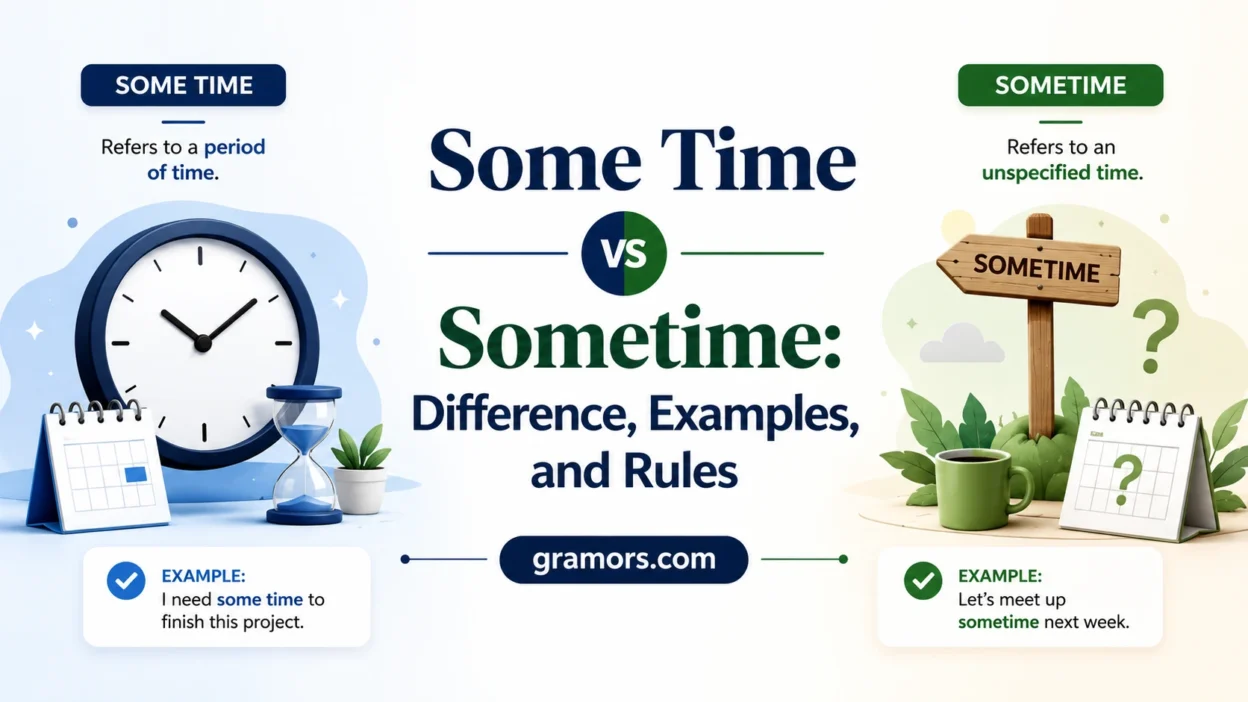
Sometime vs some time is a common English confusion because both expressions relate to time, but they do not mean the same thing. The difference is small in appearance but important in meaning.
Sometime refers to an unknown or unspecified point in time.
Some time refers to a period or amount of time.
For example:
- “Let’s meet sometime.”
- “I need some time.”
In the first sentence, the speaker means an unknown future moment. In the second sentence, the speaker means a certain amount of time is needed.
The space between the words changes their function and meaning. Understanding this difference helps you write more clearly and naturally.
Quick Answer
- Sometime = an unknown point in time.
- Example: “Come visit sometime.”
- Some time = a period or duration of time.
- Example: “Wait for some time.”
Use sometime when you mean “at an unspecified time.”
Use some time when you mean “a while” or “a period of time.”
The correct choice depends on the meaning of the sentence.
Why People Confuse Them
People often confuse sometime and some time because they look almost identical and both relate to time.
They are also pronounced the same in many situations, which makes the difference harder to notice when speaking.
Compare:
- “I’ll call you sometime.”
- “I’ll need some time.”
The first sentence refers to a future moment that is not decided.
The second sentence refers to a duration that is needed.
The space between some and time changes the grammatical function:
- Sometime works mainly as an adverb.
- Some time works as a phrase containing the noun time.
Key Differences At A Glance
| Context | Best Choice | Why |
|---|---|---|
| Unknown moment | Sometime | Refers to a time that is not specific |
| Duration or period | Some time | Refers to an amount of time |
| Future plans without a date | Sometime | Means at an unspecified point |
| Need for a period to complete something | Some time | Means a while or a length of time |
| Feature | Sometime | Some Time |
|---|---|---|
| Spelling | One word | Two words |
| Meaning | An unknown moment | A duration |
| Grammar role | Adverb | Determiner + noun phrase |
| Example | “Call me sometime.” | “I need some time.” |
Meaning and Usage Difference
Sometime
Sometime is an adverb that refers to an unspecified time.
It means:
- at an unknown time
- at some point
- someday
Examples:
- “I saw him sometime last month.”
- “We should meet sometime.”
- “She will visit sometime in the future.”
The exact time is not given or not important.
You can use sometime when discussing:
- future plans
- unknown dates
- past events with unclear timing
Examples:
- “I’ll finish the project sometime.”
- “He moved here sometime in 2024.”
Some Time
Some time is a phrase made of:
- some (a certain amount)
- time (a period or duration)
It refers to a length of time.
Examples:
- “I stayed there for some time.”
- “The project will take some time.”
- “Give me some time to think.”
Here, the speaker means a period, not a specific moment.
A useful replacement test:
If you can replace it with a while, use some time.
Example:
- “I need some time.”
- “I need a while.”
Both have the same meaning.
Tone, Context, and Formality
Both sometime and some time are common in everyday and formal English.
Neither expression is more formal than the other. The difference comes from meaning, not tone.
Conversation examples:
- “Let’s grab coffee sometime.”
- “I need some time before I decide.”
Professional examples:
- “The update will be completed sometime next week.”
- “The team needs some time to review the report.”
Choosing the correct form helps readers understand whether you mean a specific moment or a duration.
Which One Should You Use?
Ask yourself one question:
Am I talking about a moment or a duration?
If you mean an unknown moment:
Use sometime.
Example:
- “I’ll call you sometime.”
Meaning:
- I will call you at an unknown time.
If you mean a period of time:
Use some time.
Example:
- “I need some time.”
Meaning:
- I need a certain amount of time.
Another helpful test:
Replace the phrase.
- If “at an unknown time” works → sometime
- If “a period of time” or “a while” works → some time
Examples:
- “Visit me sometime.”
- “Visit me at an unknown time.” ✅
- “Stay here some time.”
- “Stay here for a while.” ✅
When One Choice Sounds Wrong
Using the wrong form can change the meaning.
Wrong:
- “I need sometime to relax.” ❌
Correct:
- “I need some time to relax.” ✅
Why?
The speaker needs a duration, not an unknown moment.
Wrong:
- “I’ll call you some time tomorrow.” ❌ (when meaning an unspecified moment)
Better:
- “I’ll call you sometime tomorrow.” ✅
Here, the speaker means an unknown point during tomorrow.
Wrong:
- “We spent sometime together.” ❌
Correct:
- “We spent some time together.” ✅
The sentence describes a period spent together.
Common Mistakes
Mistake 1: Confusing sometime with some time
Wrong:
- “I need sometime to finish this.”
Correct:
- “I need some time to finish this.”
Quick fix:
Ask whether you mean a moment or a duration.
Mistake 2: Confusing sometime with sometimes
These words have different meanings.
Sometime:
- an unknown time
Example:
- “Visit me sometime.”
Sometimes:
- occasionally
Example:
- “I sometimes visit my grandparents.”
Mistake 3: Using sometime ago
Wrong:
- “I saw her sometime ago.”
Correct:
- “I saw her some time ago.”
“Some time ago” means a period before now.
Example:
- “I moved here some time ago.”
Mistake 4: Using some time for future plans
Wrong:
- “Let’s meet some time.”
Better:
- “Let’s meet sometime.”
The first usually suggests a period of time, while the second suggests an unknown future moment.
Everyday Examples
Conversations
- “Let’s talk sometime this week.”
- “I need some time to think.”
Plans
- “We should travel together sometime.”
- “The trip will take some time.”
Work
- “The manager will respond sometime tomorrow.”
- “The team needs some time to finish the project.”
Travel
- “I visited that city sometime last year.”
- “It took some time to reach the hotel.”
Memories
- “I met her sometime during college.”
- “We spent some time together after graduation.”
Daily Life
- “Call me sometime.”
- “Give me some time to prepare.”
Dictionary-Style Word Details
Verb
Sometime:
- Does not apply.
- Sometime is not a verb.
Some time:
- Does not apply.
- Some time is a noun phrase, not a verb.
Noun
Sometime:
- Does not commonly apply.
- It functions mainly as an adverb.
Some time:
- Applies fully.
- The word time functions as the noun referring to a duration.
Example:
- “I need some time.”
Here, time is the noun describing a period.
Synonyms
Sometime:
Closest alternatives:
- someday
- at some point
- at an unspecified time
Examples:
- “I’ll visit sometime.”
- “I’ll visit at some point.”
Some time:
Closest alternatives:
- a while
- a period of time
- a duration
Examples:
- “Wait some time.”
- “Wait a while.”
The replacement depends on the meaning of the sentence.
Example Sentences
Sometime:
Unknown points in time:
- “I’ll call you sometime.”
- “She arrived sometime last night.”
- “We should meet sometime soon.”
Some Time:
Periods of time:
- “I need some time.”
- “He stayed there for some time.”
- “The repair will take some time.”
Word History
Sometime:
Sometime developed from the combination of some and time used together as an adverb meaning an unspecified point in time.
Some Time:
Some time developed as a phrase describing an amount or period of time.
The difference between the one-word and two-word forms comes from how the expression functions in a sentence.
Phrases Containing
Sometime:
Common phrases include:
- sometime soon
- sometime later
- sometime in the future
- sometime tomorrow
Some Time:
Common phrases include:
- some time ago
- take some time
- spend some time
- need some time
FAQs
Is sometime one word?
Yes. Sometime is one word when it means an unknown point in time.
Example:
- “Let’s meet sometime.”
Is some time always two words?
Usually, yes, when it means a period or duration.
Example:
- “I need some time.”
What is the difference between sometime and sometimes?
Sometime means an unknown time.
Example:
- “Call me sometime.”
Sometimes means occasionally.
Example:
- “I sometimes call my friends.”
Is “some time ago” correct?
Yes.
Example:
- “I moved here some time ago.”
It means a period before now.
Can I say “sometime in the future”?
Yes.
Example:
- “We will meet sometime in the future.”
It means an unspecified future moment.
How do I remember the difference?
Use this simple rule:
- Sometime = when? (unknown moment)
- Some time = how long? (duration)
Conclusion
The difference between sometime vs some time depends on whether you mean a moment or a duration.
Sometime refers to an unknown point in time:
- “Let’s meet sometime.”
Some time refers to a period of time:
- “I need some time.”
A simple memory rule makes the choice easier:
- If you mean when, use sometime.
- If you mean how long, use some time.
Understanding the meaning behind the words will help you choose the correct form naturally.