The confusion between maybe vs may be is common because one space changes the grammar.
Both forms are correct, but they fit different sentences.
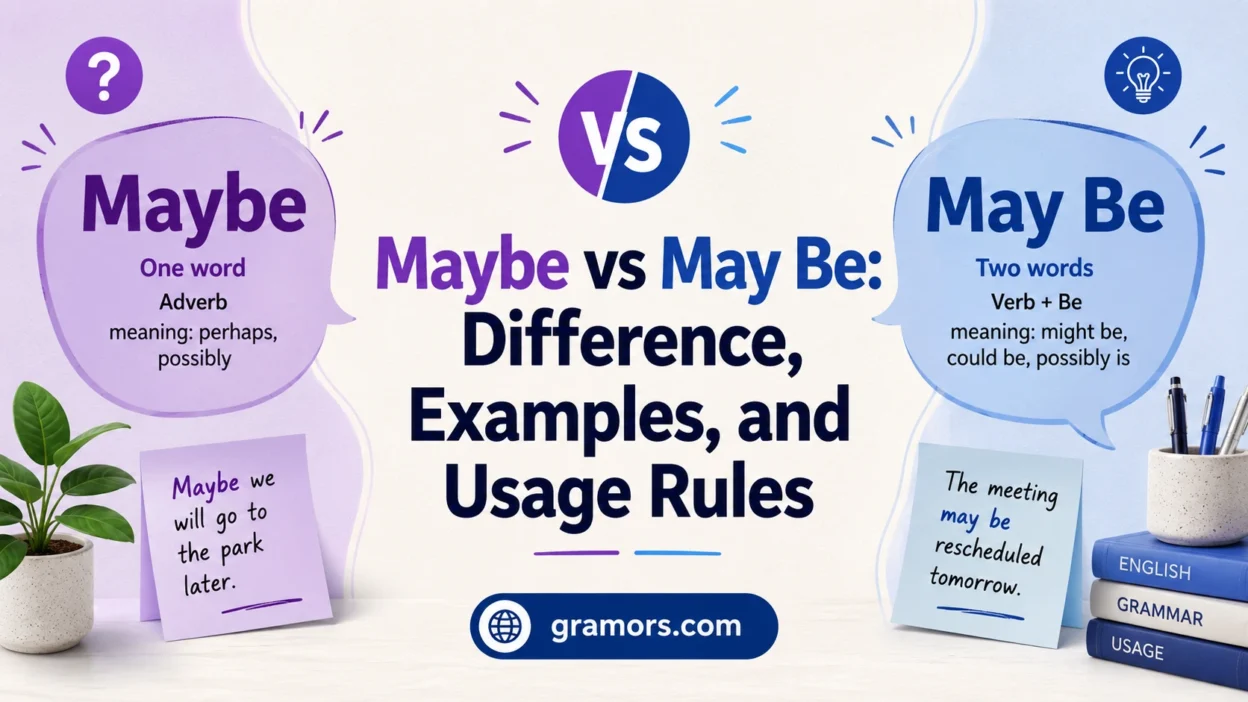
Maybe means perhaps.
Maybe I’ll go.
May be means might be.
I may be late.
Do not treat may be as a misspelling of maybe. The two forms express possibility, but they do it in different ways.
Quick Answer
Use maybe when you mean perhaps.
Maybe she forgot.
Maybe we should wait.
Use may be when you mean might be.
She may be tired.
This may be the answer.
They are not the same in grammar. Maybe is usually an adverb. May be is a verb phrase made from may plus be.
Why People Confuse Them
People confuse maybe and may be because they sound alike and both suggest uncertainty.
Compare:
Maybe he is home.
He may be home.
Both sentences express possibility. But the structure is different.
In the first sentence, maybe comments on the whole idea. In the second, may be is part of the verb.
Pronunciation does not decide the spelling. Sentence role does.
Key Differences At A Glance
| Context | Best Choice | Why |
|---|---|---|
| Meaning “perhaps” | maybe | It modifies the whole idea. |
| Meaning “might be” | may be | It is part of the verb structure. |
| Before a full sentence | maybe | It often starts a sentence. |
| After a subject | may be | It often follows the subject. |
| Replacement test | depends | Use “perhaps” for maybe and “might be” for may be. |
| Formal or precise tone | may be | It can sound slightly more measured. |
Compact comparison:
- Maybe is one word.
- May be is two words.
- Maybe means perhaps.
- May be means might be.
- Maybe can appear at the start, middle, or end of a sentence.
- May be usually follows a subject.
Meaning and Usage Difference
Maybe modifies the whole idea in a sentence. It tells the reader the statement is possible, not certain.
Maybe the meeting is canceled.
Maybe we should try again tomorrow.
The answer is, maybe, not as simple as it looks.
In these examples, maybe works like perhaps.
May be is part of the verb structure. The word may shows possibility, and be is the main verb.
The meeting may be canceled.
This may be the right address.
She may be waiting outside.
Both forms express possibility, but not through the same grammar.
Maybe the meeting is canceled.
The meeting may be canceled.
Both sentences are correct. The first uses an adverb. The second uses a verb phrase.
Tone, Context, and Formality
Both maybe and may be work in standard English.
- Maybe often sounds more conversational.
- Maybe I’ll text you later.
- Maybe we can meet after lunch.
It also works in school and workplace writing when the tone is natural.
Maybe the source needs more support.
May be can sound slightly more formal or precise because it fits neatly into a subject-verb structure.
The shipment may be delayed.
This may be a better option.
The results may be incomplete.
There is no strict US or UK split here. The choice depends on sentence structure and tone.
Which One Should You Use?
Use maybe if you can replace it with perhaps.
Maybe this is true.
Perhaps this is true.
Maybe we should leave early.
Perhaps we should leave early.
Use may be if you can replace it with might be.
This may be true.
This might be true.
She may be sick.
She might be sick.
Both versions can be correct in similar situations, but the structure changes.
Maybe this is the answer.
This may be the answer.
The meaning is close, but the grammar is not the same.
When One Choice Sounds Wrong
Some mistakes are easy to fix once you know the structure.
Wrong: He maybe right.
Correct: He may be right.
Why: After the subject he, the sentence needs a verb phrase.
Wrong: May be we should leave.
Correct: Maybe we should leave.
Why: At the start of this sentence, the meaning is perhaps.
Wrong: The answer maybe simple.
Correct: The answer may be simple.
Why: The subject the answer needs the verb phrase may be.
Wrong: I may be can help.
Correct: Maybe I can help.
Why: May be cannot be placed before another main verb like that.
Do not overcorrect valid noun uses of maybe.
Correct: Put me down as a maybe.
Here, maybe means an undecided answer or uncertain person.
Common Mistakes
Mistake: Using maybe after a subject when the sentence needs a verb.
Wrong: She maybe sick.
Right: She may be sick.
Fix: If might be fits, use may be.
Mistake: Splitting maybe when the meaning is perhaps.
Wrong: May be we should wait.
Right: Maybe we should wait.
Fix: If perhaps fits, use maybe.
Mistake: Thinking maybe can appear only at the start.
Correct: We could, maybe, try again.
Correct: I’ll go, maybe.
Fix: Maybe often starts a sentence, but it can appear in other positions too.
Mistake: Treating may be as one word.
Wrong: The road maybe closed.
Right: The road may be closed.
Fix: After a subject, check whether the sentence needs may be as the verb phrase.
Everyday Examples
Conversation:
Maybe I’ll call you tonight.
You may be right.
Texting:
Maybe later.
I may be busy after work.
Email:
Maybe we can move the meeting to Friday.
The file may be too large to send.
School:
Maybe the answer is on page 12.
The answer may be on page 12.
Workplace:
Maybe we should review the numbers again.
The numbers may be incorrect.
Plans:
Maybe we’ll leave early.
The flight may be delayed.
Advice:
Maybe you should ask your teacher.
That may be the safest choice.
Uncertainty:
Maybe.
It may be possible.
Dictionary-Style Word Details
Verb
• maybe: Not commonly a verb. It does not name an action.
• may be: A verb phrase using the modal verb may plus the verb be.
Examples:
She may be tired.
This may be true.
Noun
• maybe: Can be a noun meaning uncertainty or an undecided answer.
• may be: Not commonly a noun.
Example:
His answer was a maybe.
Put me down as a maybe.
Synonyms
• maybe: Close alternatives include perhaps, possibly, and conceivably.
• may be: Close alternatives include might be and could be.
The best replacement depends on the sentence.
Example Sentences
• maybe: Maybe we can try again tomorrow.
• maybe: Maybe she already left.
• may be: Tomorrow may be better.
• may be: The package may be outside.
Word History
• maybe: A major dictionary traces the adverb use of maybe to the 15th century.
• may be: This is best understood as a use of the modal may plus be, not as one fixed headword.
For modern writing, the key point is structure: maybe is one word meaning perhaps, while may be is two words meaning might be.
Phrases Containing
• maybe: maybe later, a definite maybe, put me down as a maybe.
• may be: may be able to, may be true, may be possible.
These forms belong to different patterns, so do not swap them automatically.
FAQs
Is it maybe or may be?
Use maybe for perhaps. Use may be for might be.
Maybe we should wait.
This may be the answer.
Is maybe one word?
Yes, when it means perhaps.
Maybe she forgot.
Is may be two words?
Yes, when it means might be.
She may be tired.
Are maybe and may be interchangeable?
No. They can express similar uncertainty, but their grammar is different.
Maybe he is home.
He may be home.
Is “maybe later” correct?
Yes. Maybe means perhaps.
Maybe later.
Is “it may be later” correct?
Yes. Here may be means might be.
The meeting may be later than planned.
What is the easiest test?
Replace maybe with perhaps and may be with might be.
Maybe this is true.
Perhaps this is true.
This may be true.
This might be true.
Conclusion
The rule for maybe vs may be is simple.
Maybe means perhaps. May be means might be.
Maybe we should wait.
This may be the answer.