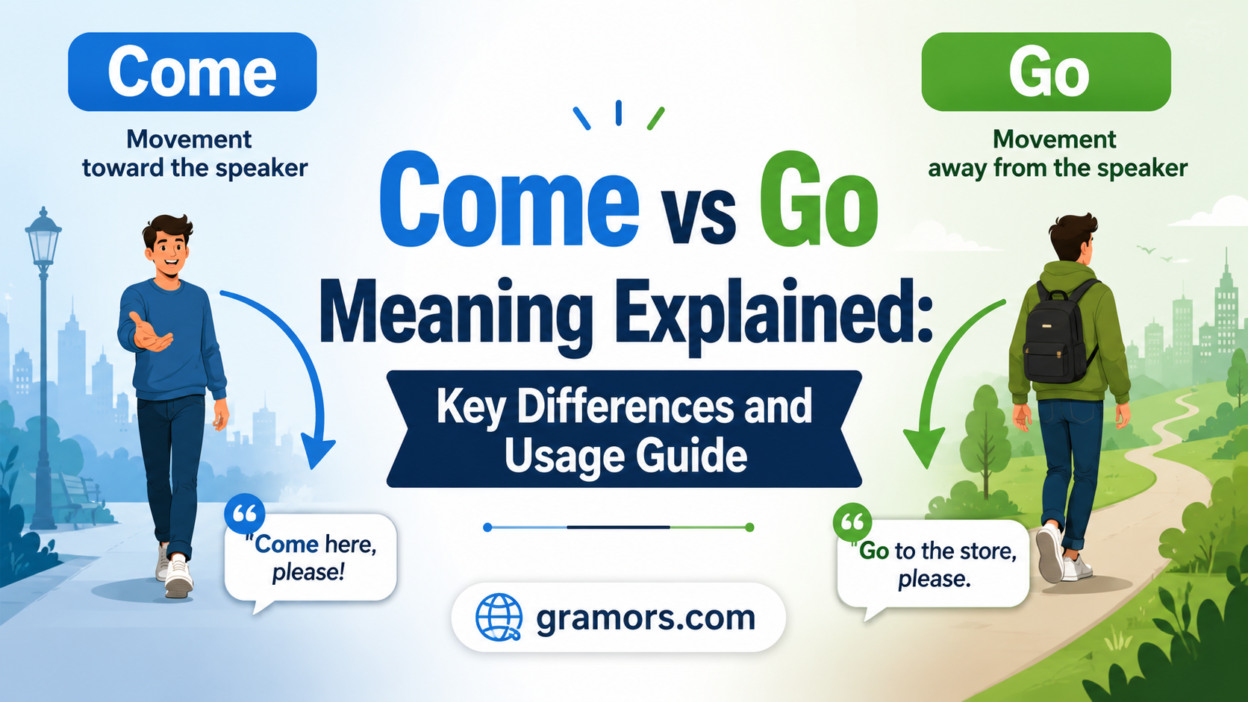
The confusion between come vs go is one of the most common issues in everyday English. Both words describe movement, but the direction depends on perspective.
The key idea is simple: it’s not just about movement—it’s about where the speaker is mentally or physically located in the situation.
For example:
- “Come here.”
- “Go there.”
Both are correct, but they point in opposite directions based on viewpoint. That’s why learners often mix them up in real conversation.
2. Quick Answer
“Come” means movement toward the speaker or the reference point being discussed.
“Go” means movement away from the speaker or toward another place.
They are not interchangeable because direction changes the meaning.
Examples:
- “Come to me.”
- “Go to school.”
However, in conversation, the reference point can shift depending on who is speaking or being addressed.
3. Why People Confuse Them
People confuse come and go because both describe movement and can appear in similar sentences.
The real difficulty comes from perspective changes. In a conversation, the “center point” may shift depending on who is speaking.
For example:
- Invitation: “Come to my party.”
- Instruction: “Go to the store.”
Confusion increases in spoken English because speakers often switch viewpoint naturally without noticing.
4. Key Differences At A Glance
| Context | Best Choice | Why |
|---|---|---|
| Movement toward speaker | Come | Direction is toward reference point |
| Movement away from speaker | Go | Direction is away from reference point |
| Invitation | Come | Listener is expected to arrive |
| Instruction/dispatch | Go | Person moves to another location |
Extra Comparison
| Feature | Come | Go |
|---|---|---|
| Direction | Toward reference point | Away from reference point |
| Perspective | Arrival-focused | Departure-focused |
5. Meaning and Usage Difference
Come is used when something moves toward the speaker, listener, or shared point of focus.
Example: “Come to my house.”
Go is used when something moves away from that point or toward another location.
Example: “Go home after school.”
Both can also be used figuratively:
- “Ideas come to me easily.”
- “Problems go away with time.”
In real conversation, perspective may shift depending on who controls the “reference point.”
6. Tone, Context, and Formality
Both come and go are neutral in tone and used in everyday American English across casual and formal situations.
Common patterns:
- “Please come in.” (invitation)
- “Go ahead.” (permission or encouragement)
- “Come back later.” (return request)
- “Go take a look.” (instruction)
Sometimes tone matters more than strict direction, especially in polite speech.
7. Which One Should You Use?
Decide by asking one question: Where is the reference point?
Use come when movement is toward that point.
Use go when movement is away from it.
Examples:
- “Come here right now.”
- “Go to your room.”
In conversation, the reference point can change depending on who is speaking or being addressed.
8. When One Choice Sounds Wrong
Some sentences sound incorrect because the direction does not match the reference point.
Wrong: “Go here.”
Correct: “Come here.”
Wrong: “Come away from me.”
Correct: “Go away from me.”
The issue is not grammar style—it’s directional mismatch.
9. Common Mistakes (and Quick Fixes)
Mistake → Correction:
- “Go to me.” → “Come to me.”
- “Come to school (when leaving school).” → “Go to school.”
- Mixing perspective: “Come there tomorrow.” → “Go there tomorrow.”
Most mistakes happen when learners forget to set the correct viewpoint first.
10. Everyday Examples
- “Come here for a second.”
- “Go to the store and buy milk.”
- “Come to my birthday party.”
- “Go home after practice.”
- “Come inside before it rains.”
- “Go outside and check the mail.”
- “Come with me to the office.”
- “Go back to your seat.”
- “Come over tonight.”
- “Go take a look at this.”
- “Come early tomorrow.”
- “Go pick up your sister.”
- “Come closer so I can hear you.”
- “Go ahead without me.”
Each sentence depends on direction and reference point.
11. Dictionary-Style Word Details
Verb
- TERM_A (come): Movement toward the speaker, listener, or shared reference point.
- TERM_B (go): Movement away from the speaker or toward another destination.
Noun
- TERM_A: Rare noun use in modern English; generally not used as a noun.
- TERM_B: Some informal noun-like uses exist (such as “a go” in expressions), but not central in standard usage.
Synonyms
- TERM_A: approach, arrive (closest plain alternatives)
- TERM_B: leave, depart (closest plain alternatives)
Example Sentences
- TERM_A: “Come here right now.” / “She will come to the meeting.”
- TERM_B: “He went home early.” / “Go to the doctor.”
Word History
- TERM_A: From Old English roots linked to movement toward a place or person.
- TERM_B: From Old English origins connected to movement away or departure.
Phrases Containing
- TERM_A: come in, come back, come over
- TERM_B: go out, go away, go back
12. FAQ
Is it come or go here?
It depends on direction. Toward the reference point = come; away = go.
Can they be interchangeable?
No, changing them changes meaning.
Why do native speakers switch them?
Because they often shift perspective naturally in conversation.
Can both be figurative?
Yes, both are used in idiomatic and abstract meanings.
Is one more common?
Both are extremely common in everyday speech.
13. Conclusion
The difference between come vs go comes down to one simple idea: perspective. “Come” moves toward a reference point, while “go” moves away from it.
Once you lock in that direction rule, choosing the right word becomes much easier.
Example:
- “Come here and sit.”
- “Go there and wait.”
That’s the core distinction you can rely on in real English communication.