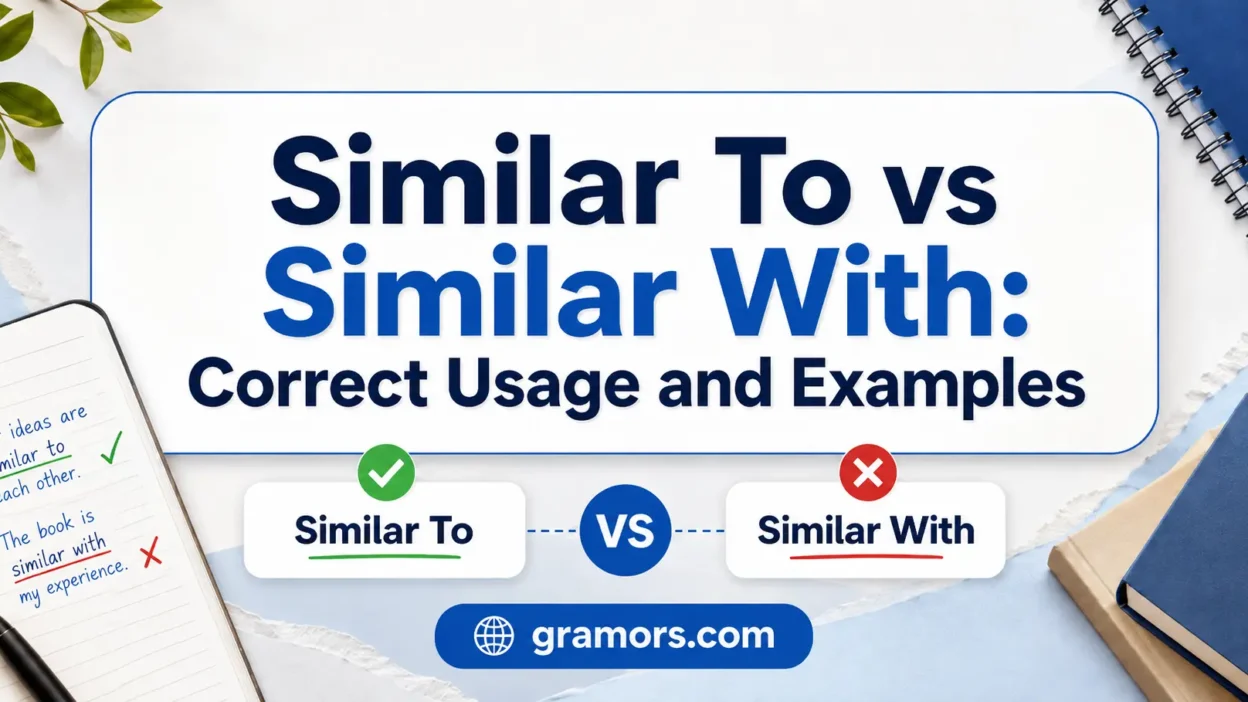
Similar to” and “similar with” may look interchangeable, but they are not used in the same way in standard English. In most situations, similar to is the correct and natural expression when comparing two people, objects, ideas, or situations. Similar with is much less common and usually appears only in specific sentence structures. Understanding the difference will help you make clearer comparisons and avoid an awkward word choice in both speaking and writing.
Quick Answer
Use similar to when comparing two people, things, ideas, or situations. It is the standard and most natural expression in English. For example, “This phone is similar to mine.” Similar with is uncommon and usually incorrect in direct comparisons, although it may appear in specialized contexts when describing shared features.
Why People Confuse Them
The preposition with appears in many expressions connected with comparison and relationships.
For example:
“Compare this version with the original.”
Writers may transfer that pattern and produce:
“This version is similar with the original.”
However, compare with and similar to are separate established constructions.
Other familiar expressions may also create confusion:
- agree with someone
- match with something
- work with someone
- the same with another group
The basic idea of two things being considered together can make with feel logical, but English conventionally uses to after similar when naming the comparison target.
Authentic sentences may still place the words close together:
“We saw similar behavior with the second group.”
“The materials are similar with respect to weight.”
In these examples, with does not introduce the thing being compared directly.
Key Differences At A Glance
| Feature | Similar to | Similar with |
|---|---|---|
| Standard direct-comparison construction | Yes | No |
| Introduces the comparison target | Yes | Normally no |
| Suitable in edited American English | Yes | Not in the same role |
| Main meaning | Resembling another person or thing | Depends on a separate with phrase |
| Natural example | “The house is similar to ours.” | “We found similar defects with both products.” |
| Correction pattern | Usually needs no change | Change to similar to if with introduces the comparison target |
| Can appear in a grammatical sentence | Yes | Yes, when with belongs elsewhere |
Compare these structures:
“The two houses are similar.”
“The first house is similar to ours.”
“The houses are similar in size.”
“We found similar defects with both products.”
Meaning and Usage Difference
In similar to, similar functions as an adjective. The preposition to introduces the person, object, idea, situation, or possessive pronoun used as the comparison target.
“Her accent is similar to her mother’s.”
“The new policy seems similar to the old one.”
“They introduced a design similar to ours.”
The expression means that two things resemble each other but are not necessarily exactly the same.
It can follow linking verbs such as:
- be
- look
- seem
- feel
- appear
Examples include:
“This fabric feels similar to silk.”
“The two applications look similar to each other.”
Bare similar with is nonstandard when with directly introduces the comparison target.
Incorrect:
“Her accent is similar with her mother’s.”
Correct:
“Her accent is similar to her mother’s.”
Related structures use different prepositions for different jobs.
Use similar in to identify the shared feature:
“Their accents are similar in rhythm.”
Use both in and to when naming the feature and comparison target:
“Her accent is similar in rhythm to her mother’s.”
No preposition is needed when both compared items already form the subject:
“Their accents are similar.”
A sentence containing similar with can still be correct when with belongs to another construction:
“The results were similar with both testing methods.”
Here, with both testing methods explains the circumstances in which the similar results appeared.
Tone, Context, and Formality
Similar to is neutral and natural in conversation, business communication, academic work, technical documents, and formal prose.
Conversation:
“Your phone is similar to mine.”
Business:
“The proposed policy is similar to our current policy.”
Academic:
“The findings were similar to those reported in earlier studies.”
Technical writing commonly uses several related patterns:
“The measurements were similar in magnitude.”
“The results were similar for both groups.”
“Similar results were obtained with both procedures.”
Technical sentences may also contain similar with respect to:
“The models were similar with respect to processing speed.”
This sentence is correct because with respect to is a complete expression meaning regarding or in relation to. It does not make bare similar with a standard direct-comparison phrase.
Which One Should You Use?
First, identify the two things being compared.
When the word after the preposition names the comparison target, use similar to:
“My schedule is similar to yours.”
“This product is similar to the older model.”
When both items form the subject, no preposition may be necessary:
“Our schedules are similar.”
“The two products are similar.”
Use similar in when you want to identify the shared feature:
“Our schedules are similar in structure.”
“The apartments are similar in size.”
Keep with when it explains a method, circumstance, accompanying detail, or relevant aspect:
“We obtained similar results with Method B.”
“I created something similar with another program.”
In the second sentence, with another program explains how the item was created. It does not identify the object being compared with something similar.
Do not mechanically replace every with located near similar. First determine which word or idea the preposition modifies.
When One Choice Sounds Wrong
Similar with sounds unnatural when it directly introduces a noun, pronoun, person, idea, or situation used as the comparison target.
Incorrect:
“His personality is similar with his father’s.”
Correct:
“His personality is similar to his father’s.”
A casual alternative is:
“He is like his father.”
Incorrect:
“The new version is very similar with ours.”
Correct:
“The new version is very similar to ours.”
Incorrect:
“Her situation is similar with the previous case.”
Correct:
“Her situation is similar to the previous case.”
Sometimes the comparison complement is unnecessary.
Wordy but grammatical:
“The two personalities are similar to each other.”
More concise:
“The two personalities are similar.”
However, similar to each other remains correct when the writer wants to emphasize the mutual comparison.
Common Mistakes
Mistake: Using “with” before the comparison target
Incorrect: “The new logo is similar with the old one.”
Correct: “The new logo is similar to the old one.”
Mistake: Using “similar like”
Incorrect: “The new logo is similar like the old one.”
Correct: “The new logo is similar to the old one.”
Also correct: “The new logo is like the old one.”
Mistake: Confusing “similar” with “the same”
Inaccurate: “The two files are the same” when small differences remain.
Better: “The two files are similar.”
Mistake: Confusing “similar” and “similarly”
Correct adjective: “The two systems are similar.”
Correct adverb: “The two systems operate similarly.”
Mistake: Misreading a separate “with” phrase
“We got similar results with the revised test” is correct.
The revised test produced the results. It is not the comparison target of similar.
Mistake: Leaving the comparison unclear
Possible but unclear: “The new plan is similar.”
Clearer when context requires a target: “The new plan is similar to the original.”
Everyday Examples
People and Appearance
“Maya looks similar to her aunt.”
“The brothers have similar voices.”
“His writing style is similar to his father’s.”
Clothing and Possessions
“Your backpack is similar to mine.”
“We bought similar backpacks.”
“This jacket looks similar to the one you wore yesterday.”
School and Work
“This proposal is similar to the one we reviewed yesterday.”
“Both teams faced similar problems.”
“The student produced an answer similar to mine.”
Technology and Products
“The interface is similar to the previous version.”
“The two phones are similar in size.”
“We reproduced similar behavior with an older device.”
Experiences and Situations
“Her experience was similar to mine.”
“We had similar experiences in college.”
“The current situation is similar to what happened last year.”
Research and Data
“The apartments are similar in size.”
“This apartment is similar in size to ours.”
“The researchers obtained similar results with both samples.”
“The plans are similar with respect to cost.”
In the final two examples, with belongs to a method or a complete with respect to phrase. It does not replace to before a direct comparison target.
Dictionary-Style Word Details
Verb
Similar to: The expression is not a verb. Similar functions as an adjective, while to functions as a preposition.
Linking verbs may appear before it:
- is similar to
- looks similar to
- seems similar to
- feels similar to
Similar with: This is also not a verb. When with is grammatical, it may connect with an earlier verb:
“We tested something similar with a smaller group.”
Do not confuse similar with the verb resemble:
“This design resembles ours.”
Noun
Neither target phrase normally functions as a noun.
The related noun is similarity:
“There is a clear similarity between the two designs.”
The expression something similar uses the adjective substantively, but that does not turn similar to into an ordinary noun phrase.
In a sentence such as “We had similar problems with the software,” the phrase with the software provides information about the problems.
Synonyms
Closest plain alternatives for similar to include:
- like
- comparable to
- resembling
- much like
- akin to
The best choice depends on sentence structure and the degree of resemblance.
Possible contrasting expressions include:
- different from
- dissimilar to
- unlike
Bare similar with does not need a separate synonym list. Replace it with similar to when with introduces the comparison target.
Do not treat identical to as an exact synonym. Identical normally suggests complete sameness, while similar allows differences.
Example Sentences
Similar To
“The painting is similar to the original.”
“Her response was similar to mine.”
“The process looks similar to the one we used before.”
“They introduced a policy similar to ours.”
Similar With
Incorrect direct comparison:
“The painting is similar with the original.”
Correct:
“The painting is similar to the original.”
Grammatical separate structures:
“We created a similar painting with different materials.”
“The paintings are similar with respect to color.”
Word History
The relevant history belongs mainly to the adjective similar, not to the complete phrase.
The word entered English in the late sixteenth century through French or Medieval Latin. Its deeper source is the Latin similis, meaning like or resembling.
The preposition to became established in the ordinary comparison pattern. Bare similar with does not have a supported history as an equal standard alternative.
Modern or historical appearances of the words together may involve nonstandard usage or a separate with phrase.
Phrases Containing
Common patterns with similar to include:
- similar to mine
- similar to each other
- very similar to
- strikingly similar to
- something similar to
- similar in size to
- similar in appearance to
Complete constructions containing nearby similar and with include:
- similar with respect to cost
- similar results with both methods
- a similar problem with the printer
- something similar with the new data
- similar, with a few exceptions
These expressions do not make similar with interchangeable with similar to.
FAQs
Is it “similar to” or “similar with”?
Similar to is the standard and correct phrase when comparing two people, objects, places, or ideas.
Correct: “This phone is similar to mine.”
Incorrect: “This phone is similar with mine.”
Why do we use “similar to”?
The adjective similar normally takes the preposition to when it introduces the person or thing being compared.
Example: “Her writing style is similar to her sister’s.”
Here, to her sister’s identifies the style used for comparison.
Is “similar with” grammatically correct?
Similar with is generally considered incorrect in standard American English when making a direct comparison.
Incorrect: “My experience was similar with yours.”
Correct: “My experience was similar to yours.”
However, with can appear in related expressions such as similarities with.
Example: “The new design has several similarities with the original.”
Can I say “similar as”?
Usually, no. Use similar to for a direct comparison.
Incorrect: “This dress is similar as mine.”
Correct: “This dress is similar to mine.”
The structure as…as can be used with other adjectives:
Correct: “This dress is as expensive as mine.”
What is the difference between “similar to” and “similar in”?
Use similar to to name the person or thing being compared. Use similar in to identify the specific feature that is alike.
“Your car is similar to mine.”
“The two cars are similar in size and color.”
Both prepositions may appear in the same sentence:
“The building is similar to ours in design.”
Is “similar to each other” correct?
Yes. Similar to each other is grammatically correct when two or more things share common features.
Example: “The twins are similar to each other in appearance.”
You may also write:
“The twins look similar.”
Should I use “similar to me” or “similar with me”?
Use similar to me.
Correct: “His personality is similar to mine.”
Incorrect: “His personality is similar with mine.”
When comparing possession, mine often sounds more natural than me.
Can “similar” and “same” be used interchangeably?
No. Similar means that two things share some qualities but are not completely identical. Same means they are identical or refer to one thing.
“The two shirts are similar, but they are not the same.”
“The same shirt is available in three sizes.”
What is a common mistake with “similar to”?
A common mistake is using with instead of to after similar.
Incorrect: “The result is similar with last year’s result.”
Correct: “The result is similar to last year’s result.”
Remember the basic pattern:
Something + is similar to + something else.
Conclusion
Use similar to when comparing one person, object, idea, or situation with another. It is the standard and natural construction in English.
Do not use similar with as a direct replacement for similar to. However, the words may appear together when with introduces a separate detail, method, or accompanying element.
For example, write “This design is similar to the original,” but you can say “We achieved similar results with fewer resources.” Remembering this sentence structure will help you make clear, accurate, and natural comparisons.