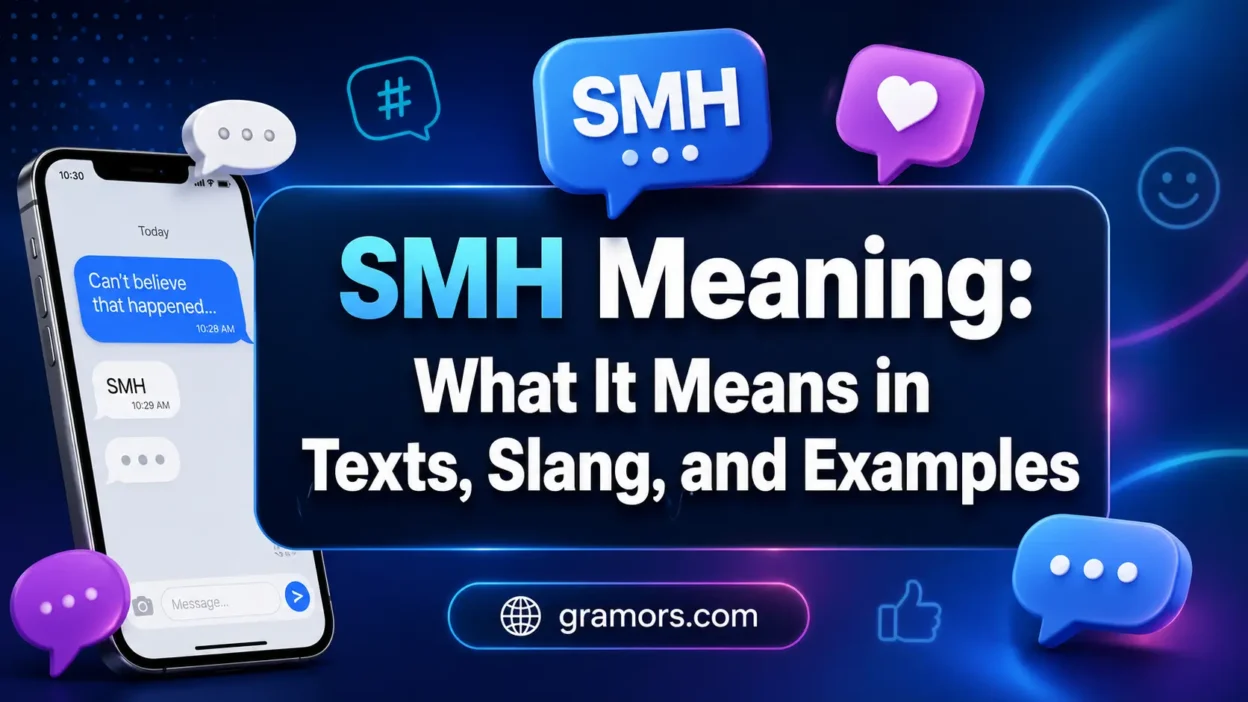
You may see SMH in a text, group chat, comment, meme, or social media post. It is a common shorthand reaction in informal online conversations.
Understanding SMH matters because the letters communicate more than their basic definition. They can show disappointment, disbelief, frustration, or playful annoyance.
Tone also depends on the conversation and your relationship with the other person. A friend may use it jokingly after a harmless mistake. Someone else may use it to criticize a decision.
This guide explains the SMH meaning, its tone, pronunciation, history, and common uses. You will also learn when it may sound rude. Realistic examples will make each use easier to recognize.
Quick Answer
SMH meaning is “shaking my head.” People use it to show disbelief, disappointment, frustration, or disapproval.
It is most common in texts, social posts, comments, and other informal conversations.
TL;DR
• SMH usually means “shaking my head.”
• It is informal texting and internet slang.
• It often shows disbelief, frustration, or disappointment.
• It can also sound playful or sarcastic.
• SMH and smh are both common forms.
• Avoid it when a respectful formal tone matters.
What Does SMH Mean?
SMH stands for “shaking my head.” It represents the familiar gesture of moving your head from side to side.
In messages, the writer usually does not mean the action literally. Instead, SMH communicates a reaction.
For example:
“He forgot his wallet again. SMH.”
The writer is expressing frustration or disbelief.
Another example is:
“You watched the whole movie without me? smh.”
Here, the reaction may be teasing rather than serious.
The main meanings usually include:
• Disbelief — “I cannot believe that happened.”
• Disappointment — “That was a poor choice.”
• Frustration — “This is annoying.”
• Disapproval — “I do not agree with that.”
• Dismay — “That situation is unfortunate.”
Major dictionaries consistently connect SMH with these reactions.
SMH Meaning in Texting and Social Media
In texting, SMH works like a quick emotional reaction. It often replaces a longer statement about frustration or disbelief.
You may see it in:
• Text messages
• Group chats
• Social media comments
• Captions
• Direct messages
• Online discussions
• Memes
Its basic meaning does not normally change between platforms.
For example:
Text: “I left my charger at home again. smh.”
Instagram comment: “He really posted that? SMH.”
Group chat: “Nobody remembered to make the reservation. smh.”
Social post: “Another delay at the airport. SMH.”
The surrounding message tells you how strong the reaction is.
Tone and Context: What SMH Can Express
SMH does not carry exactly the same emotion every time. Context can make it serious, playful, sarcastic, or judgmental.
Disappointment
“You skipped practice again? SMH.”
The writer thinks the other person made a poor choice.
Frustration
“The printer stopped working five minutes before class. smh.”
Here, the reaction is aimed at an annoying situation.
Disbelief
“He drove two hours before noticing his suitcase was missing. SMH.”
The writer finds the situation difficult to believe.
Playful annoyance
“You ate the last slice without asking me? smh 😂”
The emoji makes the reaction feel lighter.
Sarcasm
SMH can also strengthen a sarcastic comment.
“Great. Another Monday meeting at 7 a.m. SMH.”
The writer clearly is not celebrating the meeting.
Criticism
“He blamed everyone else for his mistake. SMH.”
This version sounds more judgmental.
Because of that range, you should always read the whole conversation.
How to Use SMH Naturally
SMH usually appears before or after the situation causing the reaction. Both positions can sound natural in casual writing.
At the end
“I forgot my lunch on the kitchen counter. smh.”
This pattern is very common.
At the beginning
“SMH, they canceled the event again.”
Here, the reaction comes first.
By itself
Friend: “I locked my keys inside my car again.”
You: “SMH 😂”
A short answer can communicate your whole reaction.
About yourself
SMH does not always criticize someone else.
“I studied the wrong chapter. smh.”
This sounds self-deprecating rather than insulting.
About another person
“He ignored the instructions again. SMH.”
This can sound critical because you are judging someone’s behavior.
Use it carefully when the person may take your response personally.
When Not to Use SMH
SMH belongs mainly in informal communication. Dictionaries classify it as informal and closely connect it with messaging.
Avoid it when your message needs to sound formal or especially respectful.
For example, avoid:
“SMH, the quarterly report contains errors.”
A clearer workplace version is:
“I noticed several errors in the quarterly report.”
You should also be careful during serious events.
A short slang reaction can seem insensitive when someone describes grief, illness, danger, or another crisis.
SMH can also sound dismissive during an argument.
Compare:
“SMH. You never listen.”
with:
“I feel like my point was misunderstood.”
The second version encourages a calmer conversation.
| Context | Best Choice | Why |
| Casual chat with friends | SMH | Natural and brief |
| Funny personal mistake | SMH | Often lighthearted |
| Formal email | Full sentence | Clearer and more professional |
| Serious personal news | Thoughtful words | Shows greater care |
| Heated disagreement | Explain your concern | Less dismissive |
Is SMH an Acronym? Form, Pronunciation, and Capitalization
SMH is an abbreviation formed from the first letters of shaking my head. More precisely, it is commonly described as an initialism.
An initialism uses the first letters of several words.
If spoken letter by letter, SMH sounds like:
ess-em-aitch
However, SMH is much more common in written digital conversation.
In a message, both forms are normal:
SMH
smh
Lowercase smh can look slightly more casual. Uppercase SMH may look more noticeable.
You do not need periods between the letters.
Write:
SMH
Not:
S.M.H.
In digital writing, the abbreviation can also function like an interjection or reaction.
Example:
“SMH. I cannot believe he did that.”
Where SMH Came From
The exact inventor of SMH is not known. That is common with expressions that spread through informal online communication.
Merriam-Webster reports evidence of the abbreviation from at least the early 1990s.
Dictionary.com documents its growth through online communication during the following years. It records an online dictionary entry from 2004.
Its structure is simple.
S = shaking
M = my
H = head
Instead of describing an emotion directly, SMH represents a physical reaction.
That makes it similar to written reactions such as facepalm or an eye-roll emoji.
SMH, SMDH, and Related Reactions
Several reactions express emotions similar to SMH. However, their tone can differ.
SMDH
SMDH usually means “shaking my damn head.” It is a stronger and more emphatic version of SMH.
Example:
“They canceled my flight after six hours of delays. SMDH.”
Because it contains a mild swear word, it sounds stronger.
Facepalm
Facepalm suggests embarrassment, frustration, or disbelief.
Example:
“I sent the document to the wrong person. Facepalm.”
Eye roll
An eye-roll reaction often signals annoyance or disbelief.
Example:
“He is telling that same story again. 🙄”
These are not exact synonyms. Each reaction carries slightly different emotional coloring.
SMH has no perfect antonym because it expresses a reaction rather than one fixed emotion.
A positive reaction such as “nice!” may create the opposite mood. Still, it is not a true antonym.
Common Mistakes and Misunderstandings
A few misunderstandings appear often around SMH.
Mistake 1: Writing SHM
The standard abbreviation is:
SMH = shaking my head
Not:
SHM
The letters follow the original word order.
Mistake 2: Assuming it always means “so much hate”
“Shaking my head” is the established default meaning in modern digital communication.
Other expansions sometimes appear online. They should not be your first interpretation without clear context.
Mistake 3: Thinking SMH always means anger
SMH can show frustration, but it can also be humorous.
“I wore two different socks to work. smh 😂”
That example is self-directed and playful.
Mistake 4: Writing “SMH my head” accidentally
Because SMH already means “shaking my head,” this phrase becomes repetitive.
Literally:
“SMH my head” = “shaking my head my head.”
However, people sometimes use that repetition intentionally as a joke.
Mistake 5: Giving it a special meaning on every platform
SMH usually keeps the same core meaning across texts and social networks.
The conversation changes its tone more than the platform does.
SMH Examples by Context
Examples make the emotional difference easier to understand.
Mild frustration
“The coffee shop closed right before I arrived. SMH.”
Meaning: That is annoying.
Disbelief
“He forgot his passport on the way to the airport. smh.”
Meaning: I cannot believe he did that.
Disappointment
“They promised to help, then never showed up. SMH.”
Meaning: That was disappointing.
Playful teasing
“You put pineapple on my pizza again? smh 😂”
Meaning: I am teasing you about this.
Self-directed humor
“I searched for my phone while holding it. SMH.”
Meaning: I cannot believe I did that.
Sarcasm
“Another software update right before my presentation. Great. SMH.”
Meaning: This timing is frustrating.
Strong criticism
“He knew the rule and ignored it anyway. SMH.”
Meaning: I strongly disapprove of that choice.
Mini Quiz
1. What does SMH usually stand for?
A. Send me help
B. Shaking my head
C. So many headaches
2. Which situation fits SMH best?
A. A formal legal document
B. A casual reaction to a silly mistake
C. A professional job application
3. What does SMDH usually express?
A. A stronger version of SMH
B. Happiness
C. Agreement
4. Is “SMH my head” literally repetitive?
A. Yes
B. No
Answer Key: 1-B, 2-B, 3-A, 4-A.
FAQs About SMH
What does SMH mean in text?
SMH means “shaking my head.” It usually expresses disbelief, frustration, disappointment, or disapproval.
The exact tone depends on the message around it.
What does SMH stand for?
SMH stands for “shaking my head.” Major dictionaries classify it as an informal abbreviation used in digital communication.
It represents the reaction of shaking your head at something surprising or disappointing.
Is SMH disrespectful?
It can be disrespectful when directed at someone’s behavior. It may suggest that you are judging their decision.
Among close friends, the same abbreviation may simply be playful teasing.
Can SMH be sarcastic?
Yes. SMH can support sarcasm when the surrounding sentence clearly signals that tone.
For example: “Perfect. My bus left early today. SMH.”
Is it SHM or SMH?
The standard form is SMH because it represents shaking my head.
SHM puts the letters in the wrong order.
What does SMDH mean?
SMDH means “shaking my damn head.” It usually adds stronger frustration or disapproval.
It is more intense than ordinary SMH.
What does SMH mean on Snapchat, Instagram, or TikTok?
It normally means “shaking my head” on those platforms too.
The surrounding conversation determines whether it sounds funny, annoyed, disappointed, or critical.
Conclusion
The SMH meaning is usually “shaking my head.” It is a quick way to express disbelief, frustration, disappointment, or disapproval.
Use it naturally in casual conversations, but pay attention to tone. When respect or clarity matters more, write your reaction in full.