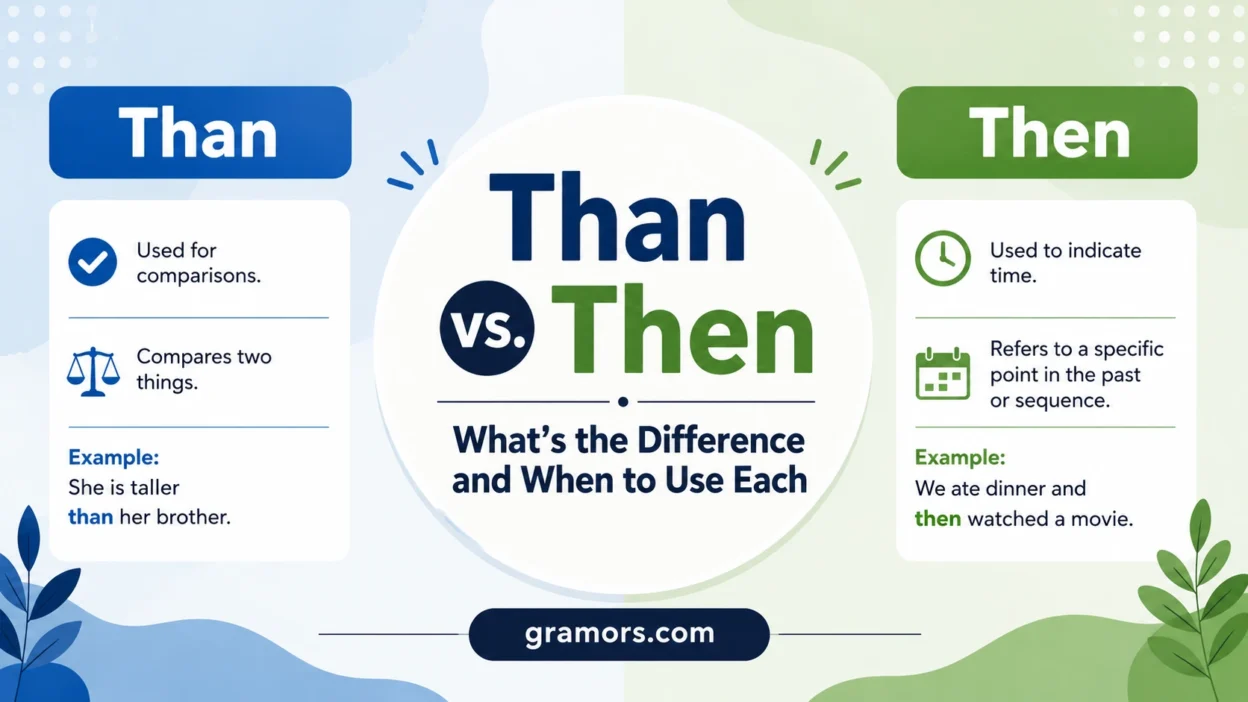
Many people mix up “than” and “then” because the words look similar and often sound alike in everyday American English. Still, they have very different meanings and grammar roles.
“Than” is mainly used for comparisons. “Then” usually relates to time, sequence, or results.
For example:
- “She is taller than me.”
- “We ate dinner, then watched a movie.”
Using the wrong word can make a sentence look careless or confusing. Once you understand the job each word performs, the difference becomes much easier to remember.
Quick Answer
Use “than” for comparisons.
Examples:
- “Better than”
- “More than”
- “Rather than”
Use “then” for time, order, next steps, or results.
Examples:
- “Finish homework, then relax.”
- “We went shopping, then got coffee.”
“Then” can also mean “in that case.”
Example:
- “If you’re tired, then go home.”
The two words are not interchangeable in standard written English.
Why People Confuse Them
One reason for the confusion is spelling. The words differ by only one letter.
Pronunciation also plays a role. In many American accents, “than” and “then” can sound very similar during fast speech.
Typing quickly creates even more mistakes online. Many people accidentally write:
- “more then”
- “better then”
instead of:
- “more than”
- “better than”
Autocorrect and casual texting habits also contribute to the problem.
Another issue is that both words appear in very common sentence patterns, so writers sometimes choose the wrong spelling without noticing.
Key Differences At A Glance
| Context | Best Choice | Why |
|---|---|---|
| Comparing two things | than | Signals comparison |
| Showing time order | then | Refers to sequence |
| Giving a next step | then | Means “next” or “afterward” |
| Using “more,” “better,” or “less” | than | Standard comparison structure |
| Showing a result | then | Means “in that case” |
| Comparing preferences | than | Used after comparative expressions |
Compact Comparison Block
- Than → comparison
- Then → time, order, or result
- Than → “She is faster than me.”
- Then → “We finished dinner, then left.”
Meaning and Usage Difference
“Than” is mainly used in comparisons. It commonly works as a conjunction or preposition.
Examples:
- “I’d rather walk than drive.”
- “This movie is better than the first one.”
- “He is taller than his brother.”
When you compare people, actions, amounts, or qualities, “than” is usually the correct choice.
“Then” usually functions as an adverb. It relates to time, sequence, consequence, or logical next steps.
Examples:
- “Back then, phones looked different.”
- “We studied, then went outside.”
- “If it rains, then stay inside.”
“Then” can also point to a specific time:
- “I was living in Texas then.”
A quick clue:
- If the sentence compares things, use “than.”
- If the sentence refers to “next,” “afterward,” or “in that case,” use “then.”
Although many Americans pronounce the words similarly in casual speech, their grammar functions remain completely different.
Tone, Context, and Formality
Both words are standard in formal and informal English.
The difference is grammatical, not stylistic.
In professional writing, using the correct word matters because mistakes are easy to spot.
One area where tone and formality appear is comparison structure:
- “She runs faster than I do.”
- “She runs faster than me.”
Both are common in American English. The first sounds more formal, while the second is more conversational.
Spoken English also increases confusion because the words may sound nearly identical during fast speech.
Still, standard written English keeps their meanings separate.
Which One Should You Use?
Use “than” when comparing things.
Quick comparison test:
- Can you replace the word with “compared to”?
- If yes, “than” is probably correct.
Example:
- “This laptop is cheaper than that one.”
Use “then” when talking about:
- time
- sequence
- next actions
- results
Quick sequence test:
- Can you replace the word with “next” or “afterward”?
- If yes, use “then.”
Example:
- “We cleaned the kitchen, then watched TV.”
Memory tricks can help, but they are only shortcuts. Grammar and sentence meaning matter most.
When One Choice Sounds Wrong
Some mistakes immediately sound unnatural in written English.
Incorrect:
- “She is smarter then me.”
Correct:
- “She is smarter than me.”
Why? The sentence compares two people.
Incorrect:
- “We went home than slept.”
Correct:
- “We went home then slept.”
Why? The sentence describes sequence.
Incorrect:
- “If you finish early, than call me.”
Correct:
- “If you finish early, then call me.”
Why? The sentence shows a result or next step.
These mistakes usually happen because writers choose words based on sound instead of meaning.
Common Mistakes
One of the most common errors online is:
- Incorrect: “better then”
- Correct: “better than”
Another frequent mistake:
- Incorrect: “more then”
- Correct: “more than”
Comparison phrases almost always require “than.”
Writers also confuse:
- Incorrect: “rather then”
- Correct: “rather than”
And:
- Incorrect: “other then”
- Correct: “other than”
Quick editing tip:
If the sentence compares things, check carefully for “than.”
Rarely, both words may appear close together:
- “If this option costs more than expected, then we’ll wait.”
In that sentence, both words are correct because they perform different jobs.
Everyday Examples
School:
- “Math is harder than history.”
- “We finished class, then went to lunch.”
Work:
- “This report is longer than the last one.”
- “First send the email, then schedule the meeting.”
Conversation:
- “I’d rather stay home than go out.”
- “We talked for a while, then left.”
Texting:
- Incorrect: “You’re better then that.”
- Correct: “You’re better than that.”
Social media:
- “Back then, everyone used flip phones.”
- “This season is funnier than the last one.”
Shopping:
- “That store is cheaper than the mall.”
- “We bought groceries, then stopped for coffee.”
Travel:
- “Flying is faster than driving.”
- “We checked into the hotel, then explored downtown.”
Conditional example:
- “If you’re ready, then let’s begin.”
Dictionary-Style Word Details
Verb
- Than: Not commonly used as a verb in modern American English.
- Then: Not commonly used as a verb in modern American English.
Noun
- Than: Not commonly used as a noun.
- Then: Partly applies in time-reference expressions.
Example:- “Back then, life felt simpler.”
Synonyms
- Than: No exact synonym exists because it mainly signals comparison. Closest plain alternatives may include “compared with” or “in comparison to,” depending on sentence structure.
- Then: Closest plain alternatives include “afterward,” “next,” “at that time,” or “in that case.”
Example Sentences
- Than:
- “This test was easier than the last one.”
- “He works harder than his teammates.”
- Then:
- “First we studied, then we went outside.”
- “Life was different back then.”
Word History
- Than: Developed from older English comparative structures and later became separated in spelling from “then.”
- Then: Historically connected to time-reference meanings and older spelling overlap with “than.”
The modern distinction is now firmly established in standard English.
Phrases Containing
- Than:
- “more than”
- “rather than”
- “other than”
- Then:
- “now and then”
- “if… then…”
- “back then”
These phrases keep consistent meanings based on comparison or sequence.
FAQs
Is it “better than” or “better then”?
“Better than” is correct because the sentence compares two things.
Is “more then” wrong?
Yes. The correct phrase is “more than.”
Can “then” mean “in that case”?
Yes. Example:
- “If you disagree, then speak now.”
Why do native speakers confuse them?
The words look similar and often sound similar in casual speech.
Are they pronounced differently?
Sometimes slightly, depending on accent and speaking speed, but many speakers pronounce them very similarly.
Conclusion
The difference between than vs then comes down to meaning and grammar role.
“Than” compares. “Then” refers to time, sequence, or results.
For example:
- “She is faster than me.”
- “She finished the race, then celebrated.”
The spelling difference is small, but choosing the correct word makes your writing much clearer and more polished.