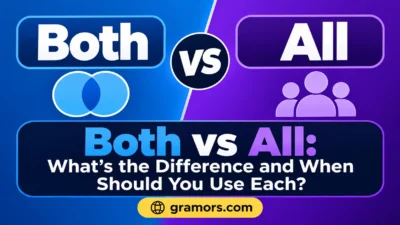
Both and either mainly deal with a set of two, but they describe that pair from different perspectives.
Use both when you explicitly include the full pair:
“Both doors are open.”
Use either when one member or the other can satisfy a condition or be selected:
“Either door will work.”
The distinction is not as simple as saying both means two and either means one. In some constructions, either can mean each of two, as in:
“Houses stood on either side of the street.”
So the correct choice depends on whether you are emphasizing the complete pair, alternatives, or individual members of a pair.
2. Quick Answer
Use both when you mean the two together or explicitly include the full pair:
“I invited both.”
Use either when one of two alternatives can be chosen or when either individual member satisfies the condition:
“Either date works for me.”
Remember the important nuance:
“Trees grow on either side of the road.”
Here, either side means each of the two sides.
3. Why People Confuse Them
The confusion comes from the fact that both words usually refer to a set of two.
Compare:
“Both routes are safe.”
“Either route is safe.”
The first sentence says the two routes are safe.
The second says that whichever route you choose will be safe.
In practice, both statements may lead to the same decision, but they frame the situation differently.
The same overlap appears here:
“Shops are on both sides of the street.”
“Shops are on either side of the street.”
Both can describe shops on the two sides, but both sides explicitly presents the pair together, while either side views the sides distributively—each of the two.
Both words can also stand without an expressed noun:
“I invited both.”
“Either will work.”
This overlap can make them look more interchangeable than they really are.
4. Key Differences At A Glance
| Feature | Both | Either |
|---|---|---|
| Core reference | Full pair | One or the other / either member individually |
| Typical noun pattern | both + plural noun | either + singular noun |
| Example | both options | either option |
| Agreement | Both options are… | Either option is… |
| Correlative structure | both…and | either…or |
| Negative adverb use | No parallel use | “I don’t like it either.” |
| Limited overlap | both sides | either side |
| Choice meaning | Includes both | Allows either alternative |
Examples:
“Both employees passed.”
“Either employee can help you.”
“Both Maya and Olivia applied.”
“Either Maya or Olivia can present.”
The basic grammatical pattern is:
both + plural noun
either + singular noun
5. Meaning and Usage Difference
- Both: The Full Pair
- Both includes one member and the other.
- “Both cars need repairs.”
This means the first car and the second car both need repairs.
Other common structures include:
“Both of them agreed.”
“They both agreed.”
“Both Maya and Olivia applied.”
“The policy affects both departments.”
Both may emphasize the pair collectively or distribute the same statement across both members.
- Either: One or the Other
- Either commonly presents two alternatives individually.
- “Either employee can help you.”
This means employee A can help and employee B can help; whichever one is selected is acceptable.
“You may choose either.”
The expected action may involve choosing one, even though both alternatives qualify.
The correlative pattern is:
“Either Maya or Olivia can present.”
Here, the alternatives are made explicit.
Either Meaning “Each of Two”
Either also has an important distributive meaning: each of the two.
“There were exits on either side of the building.”
This normally means there was an exit on each of the two sides.
Similarly:
“Trees lined either side of the road.”
This does not make either a general synonym of both. The construction simply allows either to view the two sides individually.
Negative-Adverb Use of Either
Either also appears after a negative:
“I don’t like that version either.”
“She didn’t call, and I didn’t either.”
This use means roughly also not or neither, depending on the structure. It is separate from the basic pair-selection meaning.
Common Grammatical Roles
In ordinary usage, both can function as a determiner-like word, pronoun, or part of the correlative construction both…and.
Either can function as a determiner-like word, pronoun, part of either…or, and as an adverb after negatives.
Pronunciation does not determine usage.
Both is normally pronounced /boʊθ/.
Either has two standard pronunciations commonly represented as EE-ther and EYE-ther. The meaning is the same with either pronunciation.
6. Tone, Context, and Formality
Neither both nor either is inherently more formal.
Both are standard in conversation, professional writing, education, and formal prose.
Compare:
“Both proposals are practical.”
“Either proposal is acceptable.”
The first emphasizes inclusion of the two proposals.
The second emphasizes that whichever proposal is selected will work.
The correlative patterns can add explicit structure:
“We can either leave now or wait.”
“The plan is both practical and affordable.”
The negative use of either is also completely normal:
“I don’t want it either.”
In straightforward edited English, singular agreement is the safest standard pattern after either + singular noun:
“Either option is acceptable.”
The difference between both and either is mainly semantic and grammatical, not a matter of regional preference or formality.
7. Which One Should You Use?
Use both when you need the two together:
“Bring both documents.”
Use both when the statement applies explicitly to the full pair:
“Both managers approved the request.”
Use both when you mean A and B:
“Both Maya and Olivia attended.”
Use either when one of two alternatives is enough:
“Bring either document.”
Use either when whichever individual option is chosen will work:
“Either route will get you there.”
Use either when you mean A or B:
“Either Maya or Olivia can represent us.”
Use either after a negative when appropriate:
“I don’t like either.”
Use either in the distributive “each of two” sense:
“There were cafés on either side of the street.”
Compare:
“Bring both keys if you need the two.”
“Bring either key if one of them is enough.”
That is the practical distinction: both includes the pair; either normally treats the members as alternatives or individually qualifying choices.
8. When One Choice Sounds Wrong
Some substitutions create grammatical errors. Others remain grammatical but change the meaning.
Incorrect for “I need the pair”:
“I need either shoes.”
Better:
“I need both shoes.”
Incorrect:
“Either students passed.”
Correct:
“Either student passed.”
Incorrect:
“Choose both option.”
Correct:
“Choose both options.”
But meaning also matters.
“Choose both options.”
This means select the two.
“Choose either option.”
This means select whichever one you prefer.
Negation requires special care.
“I don’t like either.”
This normally means I like neither one.
“I don’t like both.”
This can mean it is not true that I like the two of them. The sentence may leave open the possibility that I like one.
Therefore, both + negative can create scope ambiguity.
Clearer alternatives include:
“Neither one attended.”
or:
“Not both attended.”
The correct wording depends on the intended meaning.
9. Common Mistakes
Mistake: “Both option”
Incorrect:
“Both option are available.”
Correct:
“Both options are available.”
Use a plural noun after both in the basic pattern.
Mistake: “Either options”
Incorrect:
“Either options will work.”
Correct:
“Either option will work.”
Use a singular noun after either in the basic pattern.
Mistake: “Both A or B”
Incorrect:
“Both tea or coffee are available.”
Correct for inclusion:
“Both tea and coffee are available.”
Correct for alternatives:
“Either tea or coffee is available.”
Mistake: Assuming “either” always means exactly one
Consider:
“There are houses on either side of the street.”
Here, either side means each of the two sides.
Mistake: Using “both” when only one choice is intended
“Choose both desserts.”
This means select the two desserts.
“Choose either dessert.”
This means select whichever one you prefer.
Mistake: Confusing negative meanings
“I don’t like either.”
Normally: I like neither one.
“I don’t like both.”
Normally: I do not like the pair as a whole; perhaps I like one.
Mistake: Agreement errors
Correct:
“Both answers are correct.”
Correct:
“Either answer is correct.”
The plural pattern belongs with both; the standard singular pattern belongs with either.
10. Everyday Examples
Food
“I’ll have both.”
This means I want the two items.
“Either dessert is fine.”
This means whichever dessert is chosen will work.
Work
“Both managers approved the request.”
The two managers approved it.
“Either manager can sign it.”
Whichever manager is available can sign.
Travel
“Both routes pass through downtown.”
The two routes share that feature.
“Either route will get you there.”
Whichever route you choose will work.
School
“Both answers are grammatically possible.”
The two answers are possible.
“Either answer will receive full credit.”
Whichever answer is selected is acceptable.
Shopping
“I bought both shirts.”
The two shirts were purchased.
“You can choose either shirt.”
Choose whichever one you prefer.
Home
“Both doors are locked.”
The two doors are locked.
“You can use either entrance.”
Whichever entrance you choose is acceptable.
Spatial Meaning
“Trees line both sides of the road.”
This explicitly includes the two sides.
“Trees line either side of the road.”
This views each of the two sides distributively.
Negative Use
“I don’t want either.”
This means I want neither one.
“She didn’t call, and I didn’t either.”
Here, either means roughly “also not.”
11. Dictionary-Style Word Details
Verb
Both
Both is not commonly a verb in standard modern English.
Applicability: Not relevant as a verb.
Either
Either is also not commonly a verb.
Its normal roles include determiner-like use, pronoun use, conjunction-related use, and adverbial use.
Noun
Both
Both is not normally an ordinary lexical noun.
It can stand independently as a pronoun:
“Both were ready.”
“I bought both.”
Either
Either is also not normally an ordinary lexical noun.
It can stand independently as a pronoun:
“Either will work.”
“Choose either.”
Synonyms
Closest plain alternatives for both include:
- the two
- the two together
- the one and the other
Example:
“Both students passed.”
“The two students passed.”
Do not treat all as an exact synonym because all normally applies more broadly than a pair.
Closest alternatives for either depend on the sense:
- one or the other
- whichever of the two
- each, in limited constructions such as either side
- also or too, in certain negative-adverb contexts
No single synonym replaces either in every structure.
Example Sentences
Both
“Both windows are open.”
“I invited both.”
“They both agreed.”
“Both Maya and Olivia applied.”
“The policy affects both departments.”
Either
“Either answer is acceptable.”
“You may choose either.”
“Either Maya or Olivia can present.”
“There were cafés on either side of the street.”
“I don’t like that version either.”
These examples show that either has several distinct but related functions.
Word History
Both is an old English word that developed through Middle English forms such as bothe. Its pronoun and conjunction-related uses have a very long history, extending back to early English.
Either also has deep Old and Middle English roots connected historically with ideas involving two alternatives or each of two.
These historical roots help explain why both words have long been associated with pairs, but modern grammar should be learned from current usage rather than reconstructed from etymology alone.
Phrases Containing
Common expressions with both include:
- both…and
- both sides
- the best of both worlds
- cut both ways
- on both counts
- burn the candle at both ends
Examples:
“The decision cuts both ways.”
“She wants the best of both worlds.”
Common expressions with either include:
- either…or
- either way
- go either way
- either side
- either one
Examples:
“Either way is fine.”
“The decision could go either way.”
“Either one will work.”
12. FAQs
What is the main difference between “both” and “either”?
Both explicitly includes the full pair. Either usually presents the members as alternatives or considers whichever individual member qualifies.
“Both doors are open” includes the two doors.
“Either door will work” means whichever door you choose is acceptable.
Can “either” mean “both”?
In limited constructions, either can mean each of two:
“Trees grew on either side of the road.”
This can refer to the two sides, but it does not make either generally interchangeable with both.
Is it “both options are” or “either option is”?
Both are correct structures:
“Both options are available.”
“Either option is available.”
Use a plural noun and plural agreement with both. Use a singular noun and standard singular agreement with either.
What is the difference between “both…and” and “either…or”?
Both A and B includes the two:
“Both Maya and Olivia applied.”
Either A or B presents alternatives:
“Either Maya or Olivia can present.”
Are “either side” and “both sides” the same?
They can refer to the same physical two sides, but the viewpoint differs.
“Both sides” explicitly presents the pair.
“Either side” treats each of the two sides distributively.
Can I say “I don’t like both” instead of “I don’t like either”?
Not with the same meaning.
“I don’t like either” normally means neither one is liked.
“I don’t like both” can mean that it is not true that you like both, leaving open the possibility that you like one.
13. Conclusion
Both and either are correct, but they view a pair differently.
Use both when you explicitly include the two:
“Bring both keys.”
Use either when one of the two can be selected or whichever individual member qualifies:
“Bring either key.”
Remember that either can also mean each of two in expressions such as:
“either side”
The most reliable rule is: both includes the full pair; either usually treats the two as alternatives or considers each member individually.