The difference between maybe and may be is small in spelling but big in grammar. One space changes how the words work.
Compare:
Maybe he is right.
He may be right.
Both sentences show uncertainty, but they are built differently. Maybe means perhaps. May be means might be.
Neither form is always wrong. The correct choice depends on how the sentence is structured.
Quick Answer
Use maybe when you mean perhaps.
Example:
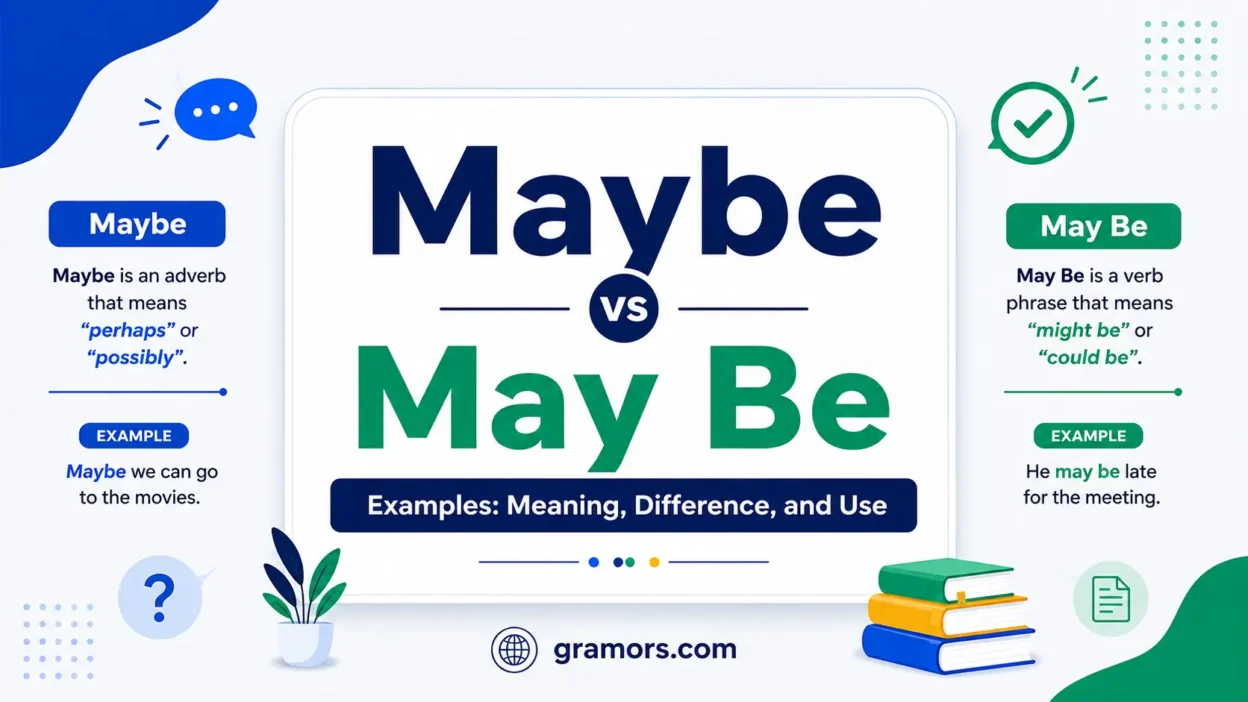
Maybe we’ll go after lunch.
Use may be when you mean might be.
Example:
She may be tired.
In maybe vs may be examples, the word examples is only part of the search phrase. The real comparison is between maybe and may be.
Why People Confuse Them
People confuse these forms because they sound alike.
They also both express uncertainty.
Compare:
Maybe it works.
It may be working.
The first sentence uses maybe to show that the whole idea is uncertain. The second sentence uses may be as part of the verb phrase.
The space matters because it changes the grammar.
Key Differences At A Glance
| Context | Best Choice | Why |
|---|---|---|
| Meaning “perhaps” | maybe | It works as an adverb. |
| Meaning “might be” | may be | It is a verb phrase. |
| Before a full clause | maybe | It can introduce uncertainty. |
| After a subject | may be | It often follows the subject. |
| Casual plans | maybe | Maybe we’ll go. |
| Description or condition | may be | She may be busy. |
Compact comparison:
• Maybe: one-word adverb meaning perhaps or possibly.
• May be: two-word verb phrase meaning might be or could be.
Meaning and Usage Difference
Maybe modifies a full idea. It tells the reader that the statement is uncertain.
Examples:
- Maybe the answer is yes.
- Maybe I left my keys at work.
- Maybe we should wait.
May be combines the modal verb may with the verb be. It works as part of the sentence’s verb.
Examples:
The answer may be yes.
I may be late.
She may be confused.
Do not treat the two forms as if they can go anywhere. Their position depends on their grammar role.
Tone, Context, and Formality
Both forms are standard in American English.
Maybe often sounds more conversational.
Casual:
Maybe I’ll call you later.
Texting:
Maybe we can meet tomorrow.
May be can sound neutral, careful, or more formal, depending on the sentence.
Work:
The report may be ready by Friday.
School:
The answer may be correct, but explain your reasoning.
Formal:
This change may be required under the new policy.
The difference is not about country or accent. It is about sentence structure and tone.
Which One Should You Use?
Use this test: replace maybe with perhaps.
Example:
Maybe she forgot.
Perhaps she forgot.
That works, so maybe is correct.
Now test may be with might be.
Example:
She may be confused.
She might be confused.
That works, so may be is correct.
These tests are helpful, but they are not magic. You still need to check whether the sentence needs an adverb or a verb phrase.
When One Choice Sounds Wrong
Maybe sounds wrong when the sentence needs a verb phrase after the subject.
Wrong:
She maybe late.
Correct:
She may be late.
May be sounds wrong when you need one word meaning perhaps before a full clause.
Wrong:
May be she is late.
Correct:
Maybe she is late.
In informal messages, people may type quickly and make these mistakes. In standard writing, the spacing should be correct.
Common Mistakes
Mistake:
This maybe true.
Fix:
This may be true.
Mistake:
May be this will work.
Fix:
Maybe this will work.
Mistake:
The meeting maybe canceled.
Fix:
The meeting may be canceled.
Mistake:
Maybe the answer may be right.
Better:
Maybe the answer is right.
Also correct:
The answer may be right.
Mistake:
She may be forgot.
Fix:
Maybe she forgot.
Everyday Examples
Maybe I’ll study after dinner.
I may be busy tonight.
Maybe the teacher will explain it again.
The answer may be on page ten.
Maybe we should leave early.
This may be a good time to call.
Maybe your email went to spam.
The file may be too large to send.
Maybe he forgot the meeting.
She may be waiting outside.
Maybe they changed the schedule.
The store may be closed today.
Maybe I need more practice.
That may be the best option.
Dictionary-Style Word Details
Verb
• Maybe: Not commonly used as a verb.
• May be: Applies fully as a modal plus verb phrase.
Noun
• Maybe: Can be used as a noun in casual speech, as in a maybe, meaning an uncertain answer or person.
• May be: Not commonly used as a noun.
Synonyms
• Maybe: perhaps, possibly, conceivably.
• May be: might be, could be.
The match is strongest for maybe. With may be, the best replacement depends on the full sentence.
Example Sentences
• Maybe: Maybe I’ll call later.
• Maybe: Maybe the bus is late.
• May be: I may be late.
• May be: The instructions may be unclear.
Word History
• Maybe: This is a long-established one-word form used to mean perhaps.
• May be: This is the ordinary combination of may and be.
Phrases Containing
• Maybe: maybe later, yes, no, or maybe, maybe next time
• May be: may be able to, may be required to, may be ready, may be true
FAQs
Is maybe one word or two?
Maybe is one word when it means perhaps.
Example:
Maybe it is true.
Is may be correct?
Yes. May be is correct when it means might be.
Example:
It may be true.
Are maybe and may be interchangeable?
No. They show similar uncertainty, but they have different grammar roles.
Which is correct: “She maybe late” or “She may be late”?
Correct:
She may be late.
Which is correct: “Maybe it works” or “May be it works”?
Correct:
Maybe it works.
How can I remember the difference?
Use maybe for perhaps. Use may be for might be.
Conclusion
The space matters in maybe vs may be examples.
Use maybe when you mean perhaps. Use may be when you mean might be.
Final pair:
Maybe he is right.
He may be right.