At the end vs in the end is a common English confusion because both phrases use the end. However, they do not answer the same question.
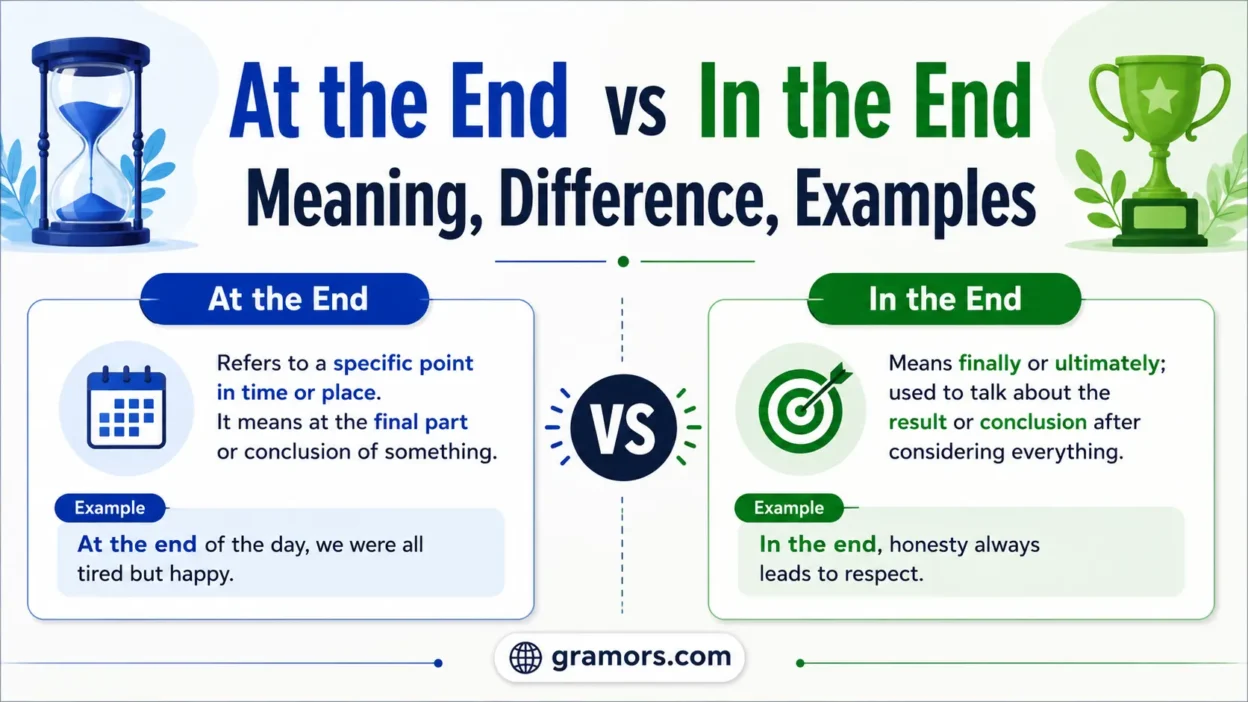
At the end points to the final point of something specific, such as a movie, road, class, book, meeting, or year. In the end points to a final result, decision, or outcome after something happens.
Correct: “The credits appear at the end of the movie.”
Correct: “In the end, we chose another plan.”
Quick Answer
Use at the end for the final point of something specific.
Correct: “At the end of class, we reviewed the answers.”
Use in the end when you mean finally, ultimately, or after everything happened.
Correct: “In the end, we stayed home.”
The phrases are not interchangeable. Some contexts feel close, but the meaning changes.
Why People Confuse Them
People confuse at the end and in the end because both phrases refer to final moments or final results.
They also appear in similar contexts, such as stories, meetings, plans, events, projects, and decisions.
Compare these sentences:
“At the end of the meeting, the manager answered questions.”
“In the end, the meeting helped us understand the problem.”
The first sentence points to the final part of the meeting. The second sentence gives the final result after the meeting.
You do not need a long rule about prepositions. The practical question is simple: are you talking about a final point, or a final outcome?
Key Differences At A Glance
| Context | Best Choice | Why |
|---|---|---|
| Final point in a movie, book, class, or meeting | at the end | It points to a specific final part. |
| Final result after a process or decision | in the end | It means ultimately or finally. |
| Physical location | at the end | It can point to a place, such as a road or hallway. |
| Story outcome | in the end | It explains what finally happened. |
| With “of” + noun | at the end | Common structure: at the end of something. |
| After discussion, delay, or conflict | in the end | It shows the final outcome. |
Meaning and Usage Difference
At the end marks a final point in time, space, text, or sequence.
- Correct: “There is a glossary at the end of the book.”
- Correct: “The restroom is at the end of the hall.”
- Correct: “We took a quiz at the end of class.”
- Correct: “The best scene comes at the end.”
The phrase often uses of, as in at the end of the road or at the end of the year. It can also stand alone when the context is clear.
Correct: “The twist happens at the end.”
In the end describes the final outcome after a process, delay, problem, argument, discussion, or decision.
Correct: “In the end, the cheaper option worked better.”
Correct: “We compared three hotels. In the end, we booked the first one.”
Correct: “They argued for weeks, but in the end, they agreed.”
Compact comparison:
• At the end: final point.
• In the end: final result.
• At the end: often answers “at the end of what?”
• In the end: often means “ultimately.”
• At the end: can refer to time, place, text, or sequence.
• In the end: refers to outcome or conclusion.
Tone, Context, and Formality
Both at the end and in the end are standard in everyday and formal English. The difference is mainly meaning, not formality.
At the end sounds more literal and structural.
Work: “Please add your notes at the end of the document.”
School: “The teacher collected the papers at the end of class.”
Email: “I included a short summary at the end.”
In the end sounds more reflective, narrative, or result-focused.
Story: “In the end, the family moved back home.”
Conversation: “In the end, it was not worth the stress.”
Work: “In the end, the team chose the simpler design.”
Use at the end when the final point matters. Use in the end when the final result matters.
Which One Should You Use?
Ask this question: At the end of what?
If you can answer with a specific thing, use at the end.
- Correct: “There will be questions at the end.”
- Correct: “At the end of the semester, we took a final exam.”
- Correct: “The parking lot is at the end of the street.”
Now ask: Can I replace it with ultimately?
If yes, use in the end.
- Correct: “In the end, we agreed.”
- Correct: “In the end, she accepted the offer.”
- Correct: “In the end, the extra practice helped.”
Be careful with at the end of the day. It can be literal or idiomatic.
Literal: “At the end of the day, we cleaned the office.”
Idiomatic: “At the end of the day, the customer matters most.”
In the idiomatic meaning, at the end of the day is close to ultimately.
When One Choice Sounds Wrong
Use at the end of + noun for the final part of a specific thing.
Wrong: “In the end of the movie, they leave.”
Correct: “At the end of the movie, they leave.”
Wrong: “In the end of the road, turn left.”
Correct: “At the end of the road, turn left.”
Use in the end for final outcomes.
Awkward: “At the end, we decided to cancel.”
Better: “In the end, we decided to cancel.”
The first sentence can work if you mean “at the final stage,” but in the end is usually better when the focus is the final decision.
Another example:
Awkward: “At the end, the plan worked.”
Better: “In the end, the plan worked.”
The result is the focus, so in the end fits better.
Common Mistakes
Mistake: Using in the end of for a final point.
Wrong: “In the end of the class, we had a quiz.”
Correct: “At the end of the class, we had a quiz.”
Mistake: Using at the end for an outcome.
Awkward: “At the end, we chose the blue one.”
Better: “In the end, we chose the blue one.”
Mistake: Confusing by the end with at the end.
Different: “By the end of the week, I finished the report.”
Different: “At the end of the week, we had a meeting.”
By the end means before or no later than the final point.
Mistake: Overusing at the end of the day.
Wordy: “At the end of the day, we need better planning.”
Cleaner: “Ultimately, we need better planning.”
Mistake: Leaving at the end unclear.
Unclear: “I will explain it at the end.”
Clearer: “I will explain it at the end of the lesson.”
Mistake: Using in the end for location.
Wrong: “The store is in the end of the block.”
Correct: “The store is at the end of the block.”
Everyday Examples
At the end
“At the end of the semester, we took a final exam.”
“The twist happens at the end.”
“She added her sources at the end of the paper.”
“We clapped at the end of the presentation.”
“The playground is at the end of the street.”
“Please sign your name at the end of the form.”
“The teacher gave homework at the end of class.”
- In the end
- “In the end, the extra practice helped.”
- “In the end, we ordered pizza instead.”
- “In the end, the hero forgives him.”
- “In the end, the cheaper laptop was the better choice.”
- “In the end, they decided to stay in Chicago.”
- “In the end, I was glad I waited.”
“In the end, the project turned out well.”
Contrast pairs
“At the end of the movie, the hero leaves town.”
“In the end, the hero learns to forgive.”
“At the end of the meeting, we took questions.”
“In the end, the meeting saved us time.”
Dictionary-Style Word Details
Verb
• At the end: At the end is not a verb. It is a prepositional phrase built around the noun end.
• In the end: In the end is not a verb. It is an idiomatic adverbial phrase.
The word end can be a verb, as in “The meeting ended,” but that is not the same as either phrase in this comparison.
Noun
• At the end: The phrase contains the noun end, meaning the final point or final part of something. The full phrase usually functions as a location or time expression.
• In the end: The phrase contains the noun end, but the full phrase functions idiomatically as an adverbial expression meaning ultimately.
Do not treat in the end as a normal noun phrase in everyday sentence use.
Synonyms
• At the end: Closest plain alternatives include at the final point, at the close of, at the finish of, and at the far end of.
• In the end: Closest plain alternatives include ultimately, finally, eventually, after all, and when all was said and done.
These alternatives are not exact in every sentence. Choose based on whether you mean a final point or a final result.
Example Sentences
• At the end: “There is a chart at the end of the report.”
• At the end: “The kids played a game at the end of class.”
• At the end: “The house is at the end of the road.”
• At the end: “The answer key is at the end of the book.”
• In the end: “In the end, we chose the smaller apartment.”
• In the end: “In the end, the delay did not matter.”
• In the end: “In the end, they apologized.”
• In the end: “In the end, the plan worked.”
Contrast:
“At the end of the race, she was exhausted.”
“In the end, she was proud of herself.”
Word History
• At the end: The phrase is built from ordinary uses of at and end. The base word end has long been used for the final point or final part of something.
• In the end: In the end is an established idiom meaning ultimately or after everything is considered.
The history is less important than the modern use: at the end points to a final place or time, while in the end points to a result.
Phrases Containing
• At the end: at the end of the day, at the end of the line, at the end of your rope, at the end of the road.
At the end of the day can be literal or idiomatic.
Literal: “At the end of the day, we locked the doors.”
Idiomatic: “At the end of the day, honesty matters.”
• In the end: in the end, right in the end.
In modern US writing, in the end is the main useful phrase. It usually means ultimately.
FAQs
Is it “at the end” or “in the end”?
Use at the end for a final point.
Correct: “The quiz is at the end of the chapter.”
Use in the end for a final result.
Correct: “In the end, the quiz helped me study.”
Is “in the end of the movie” correct?
Usually, no. Use at the end of the movie when you mean the final part of the movie.
Wrong: “In the end of the movie, they get married.”
Correct: “At the end of the movie, they get married.”
Can I say “at the end” without “of”?
Yes, when the context is clear.
Correct: “The answer is at the end.”
This works if the reader knows what the end refers to.
Is “in the end” the same as “finally”?
Often, yes. In the end can mean finally, ultimately, or after everything happened.
Correct: “In the end, we decided not to move.”
What does “at the end of the day” mean?
It can be literal or idiomatic.
Literal: “At the end of the day, we went home.”
Idiomatic: “At the end of the day, family comes first.”
The idiomatic meaning is close to ultimately.
What is the easiest way to remember the difference?
Use at the end when you can ask “at the end of what?”
Correct: “At the end of the book, there is a glossary.”
Use in the end when you mean ultimately.
Correct: “In the end, we changed our minds.”
Conclusion
Use at the end for a final point in time, space, text, or sequence. Use in the end for a final result or outcome.
Correct: “At the end of the movie, everyone clapped.”
Correct: “In the end, everyone enjoyed the movie.”
For at the end vs in the end, remember: at points to the final place or moment; in points to the final result.