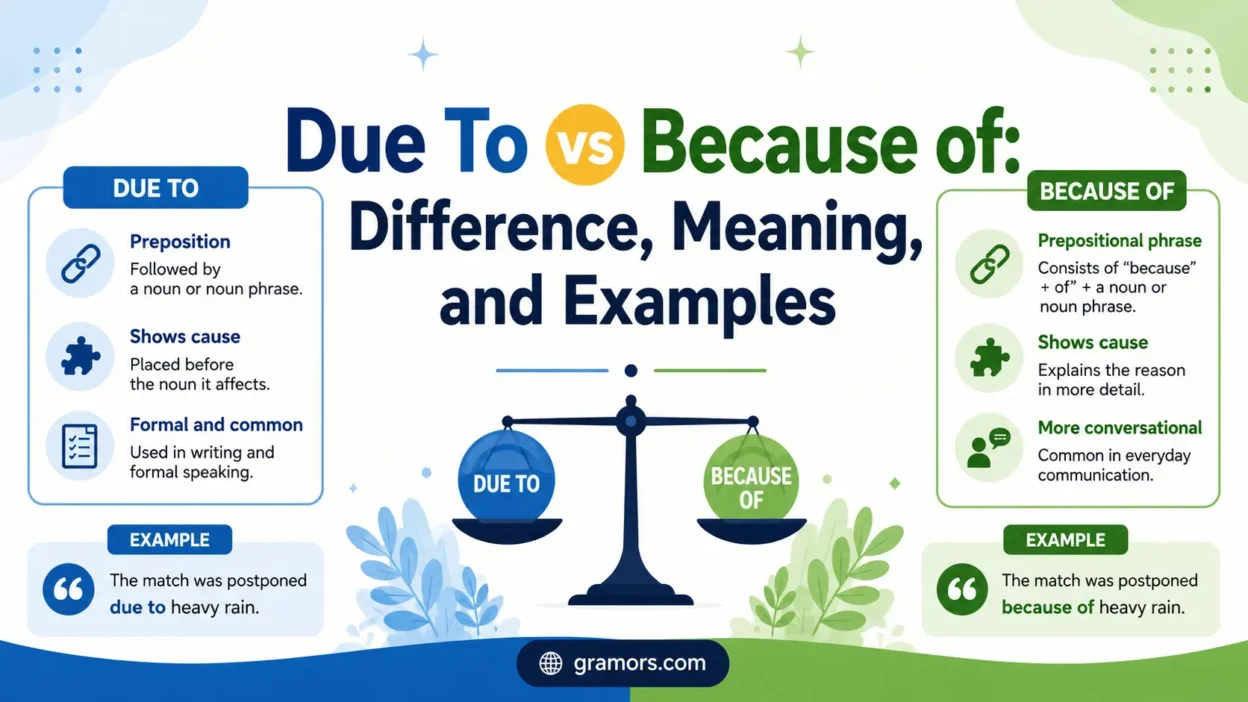
Due to vs because of can confuse writers because both phrases show cause. You might see “The delay was due to traffic” and “We were late because of traffic,” and both sound normal.
The confusion happens because modern usage is flexible, while traditional grammar gives a stricter rule. This guide focuses on clear examples, practical structure, and the safest choice for everyday writing.
Quick Answer
Use due to when the phrase describes a noun or means caused by.
Correct: “The cancellation was due to rain.”
Use because of when explaining why an action happened.
Correct: “The game was canceled because of rain.”
Modern usage overlaps, and many dictionaries accept due to as a preposition. Still, because of is often safer in clear everyday sentences.
Why People Confuse Them
People confuse due to and because of because both introduce reasons. Both are also followed by nouns or noun phrases.
Correct: “due to heavy snow”
Correct: “because of heavy snow”
Correct: “due to illness”
Correct: “because of illness”
You often see both phrases in sentences about weather, delays, accidents, cancellations, illness, and travel.
Be careful not to confuse because of with because. Because of needs a noun-style reason. Because can introduce a full clause.
Correct: “We stayed home because of the rain.”
Correct: “We stayed home because it rained.”
Key Differences At A Glance
| Context | Best Choice | Why |
|---|---|---|
| Describing the cause of a noun | due to | It works well when it means caused by. |
| Explaining why an action happened | because of | It clearly gives the reason for the action. |
| Formal notice or report | due to | It often sounds official or report-like. |
| Plain everyday sentence | because of | It sounds natural and direct. |
| Before a full clause | because | Use because, not because of. |
| Common mistake | depends on structure | Do not overuse due to when because of is clearer. |
Meaning and Usage Difference
Due to means caused by or attributable to. It often points back to a noun.
Correct: “The delay was due to a system error.”
Correct: “Her absence was due to a fever.”
Correct: “The problem was due to poor planning.”
In these examples, due to describes the cause of delay, absence, and problem.
Because of means by reason of or as a result of. It often explains why an action happened.
Correct: “The flight was delayed because of a system error.”
Correct: “She missed class because of a fever.”
Correct: “The team failed because of poor planning.”
Traditional grammar often says due to should point back to a noun, while because of should explain an action. Modern English is more flexible, but that traditional rule is still a useful editing test.
Compact comparison:
• Due to: best when “caused by” fits smoothly.
• Because of: best when explaining why someone did something or why an action happened.
• Due to: often sounds formal or official.
• Because of: often sounds clearer in plain writing.
• Because: use before a full subject-verb clause.
Tone, Context, and Formality
Due to often sounds formal, official, or report-like.
Formal: “The office is closed due to maintenance.”
Notice: “The event was postponed due to safety concerns.”
Report: “The error was due to missing data.”
Because of sounds natural in speech and plain writing.
Plain: “The office is closed because of maintenance.”
Conversational: “I left early because of the storm.”
Direct: “They postponed the event because of safety concerns.”
This is not a strict formality rule. Both phrases can appear in serious writing. The practical difference is that due to can sound official, while because of often sounds more direct.
Which One Should You Use?
Use due to when caused by fits smoothly after a noun.
Correct: “The outage was due to a power failure.”
Test: “The outage was caused by a power failure.”
Correct: “The delay was due to staff shortages.”
Test: “The delay was caused by staff shortages.”
Use because of when the phrase explains why someone did something or why an action happened.
Correct: “We lost internet because of a power failure.”
Correct: “He missed the meeting because of traffic.”
Correct: “She stayed home because of the flu.”
Use because before a full clause.
Correct: “We lost internet because the power failed.”
Correct: “She stayed home because she had the flu.”
The caused by test is helpful, but it is not a complete grammar law. Use it as a quick way to make your sentence cleaner.
When One Choice Sounds Wrong
Some sentences are common but less smooth in careful plain English.
Weak: “He missed the meeting due to traffic.”
Clearer: “He missed the meeting because of traffic.”
Better noun structure: “His absence was due to traffic.”
The first sentence is common, but because of connects more naturally to the action missed.
Here is another example:
Common: “I stayed home due to the flu.”
Smoother: “I stayed home because of the flu.”
Tighter noun structure: “My absence was due to the flu.”
Sometimes because of is understandable but less polished after a noun.
Understandable: “My absence was because of the flu.”
Tighter: “My absence was due to the flu.”
The issue is not always right versus wrong. Often, it is about which phrase sounds clearer, tighter, or more natural.
Common Mistakes
- Mistake: Using because of before a full clause.
- Incorrect: “Because of it rained, we stayed home.”
- Correct: “Because it rained, we stayed home.”
- Correct: “Because of the rain, we stayed home.”
- Mistake: Overusing due to in every cause sentence.
- Less natural: “We left early due to the storm.”
- Clearer: “We left early because of the storm.”
- Mistake: Writing due to the fact that when because is better.
- Wordy: “Due to the fact that it rained, we stayed home.”
- Better: “Because it rained, we stayed home.”
- Mistake: Choosing the formal phrase when plain English is stronger.
- Stiff: “I was late due to traffic.”
- Plain: “I was late because of traffic.”
Due to the fact that is not always ungrammatical, but it is usually wordy. In most sentences, because is cleaner.
Everyday Examples
“The delay was due to staff shortages.”
“The bus arrived late because of staff shortages.”
“Her headache was due to dehydration.”
“She felt weak because of dehydration.”
“The event was postponed due to safety concerns.”
“They postponed the event because of safety concerns.”
“The outage was due to a power failure.”
“We lost internet because of a power failure.”
“The cancellation was due to heavy rain.”
“The game was canceled because of heavy rain.”
“The error was due to missing data.”
“The report changed because of missing data.”
“His absence was due to a family emergency.”
“He missed work because of a family emergency.”
Dictionary-Style Word Details
Verb
• Due to: Due to is not a verb. Due alone is mainly an adjective in common use.
• Because of: Because of is not a verb. Because is not a verb.
In this comparison, both are phrase-level cause expressions.
Noun
• Due to: Due to is not a noun. Due can appear in noun-related forms such as dues, but that is a different use.
• Because of: Because of is not a noun.
Both phrases introduce causes or reasons rather than naming things.
Synonyms
• Due to: Closest plain alternatives include caused by, attributable to, as a result of, because of, and owing to.
• Because of: Closest plain alternatives include due to, on account of, as a result of, and owing to.
These alternatives depend on sentence structure. Some sound more formal than others.
Example Sentences
• Due to: “The delay was due to heavy traffic.”
• Due to: “The error was due to missing data.”
• Due to: “The closure was due to repairs.”
• Because of: “We arrived late because of heavy traffic.”
• Because of: “The report changed because of missing data.”
• Because of: “The store closed because of repairs.”
Word History
• Due to: Due comes from older senses connected with what is owed, proper, or expected. Over time, due to developed into a causal phrase.
• Because of: Because is historically connected to the idea of “by cause.” Because of became a cause phrase meaning “by reason of.”
The history is useful, but modern writers should focus on structure and clarity.
Phrases Containing
• Due to: due to, due to the fact that, due to be, due date.
Due to be means expected or scheduled, not “because of.”
Correct: “The train is due to be here at noon.”
• Because of: because of, because of this, because of that, just because of, not because of.
Compare because of with because:
Correct: “We stayed home because of the rain.”
Correct: “We stayed home because it rained.”
FAQs
Is due to correct?
Yes. Due to is correct, especially when it means caused by.
Correct: “The delay was due to traffic.”
Is because of more natural?
Often, yes. Because of is usually more natural when the phrase explains an action.
Correct: “We were delayed because of traffic.”
Are due to and because of interchangeable?
Sometimes they overlap, but they are not always equally natural.
Natural: “The problem was due to poor planning.”
Natural: “The team failed because of poor planning.”
The first describes the cause of a noun. The second explains an action.
Can a sentence start with due to?
Yes, especially in notices and announcements.
Correct: “Due to bad weather, the event is canceled.”
Some careful writers may prefer because of when the sentence explains an action.
Also correct: “Because of bad weather, the event is canceled.”
Can a sentence start with because of?
Yes. Because of can start a sentence when it introduces a noun-style reason.
Correct: “Because of traffic, we arrived late.”
What should I use before a full clause?
Use because, not because of.
Wrong: “Because of traffic was heavy, we arrived late.”
Correct: “Because traffic was heavy, we arrived late.”
Final takeaway
Use due to for caused-by noun structures.
Correct: “The delay was due to traffic.”
Use because of for action reasons.
Correct: “We were delayed because of traffic.”
Use because before a full clause.
Correct: “We were delayed because traffic was heavy.”
Conclusion
For due to vs because of, do not follow an extreme rule. Choose due to when it describes the cause of a noun, and choose because of when it explains why an action happened.