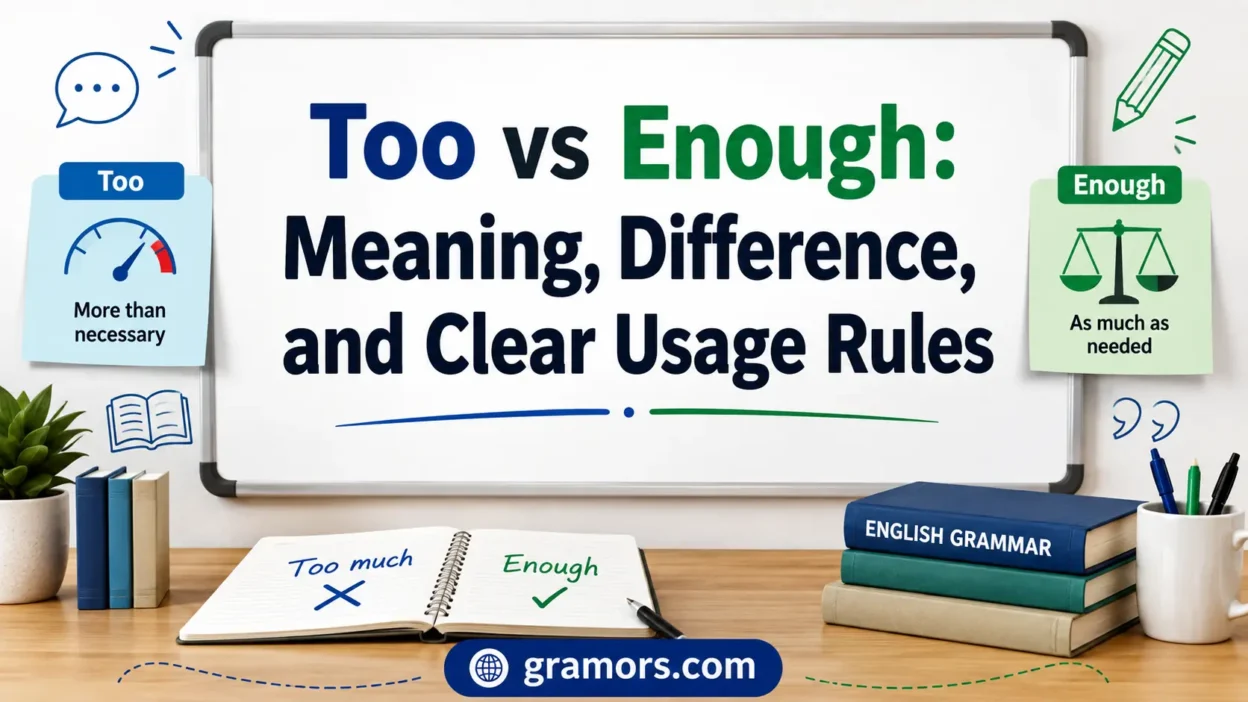
Too and enough both describe limits, degree, quantity, ability, or suitability, but they show different relationships to a requirement.
Too normally means that something has gone beyond an acceptable or useful limit:
- The coffee is too hot.
Enough means that the necessary amount or degree has been reached:
- The coffee is cool enough to drink.
Not enough means the requirement has not been met:
- We don’t have enough time.
The difference is not only about meaning. Word order matters too. We say too hot but cool enough, and we say enough money but too much money.
Quick Answer
Use too + adjective or adverb when something exceeds a useful or acceptable limit:
- This bag is too heavy.
Use adjective or adverb + enough when the necessary degree has been reached:
- This bag is light enough.
Use enough + noun for sufficient quantity:
- We have enough chairs.
Use too much or too many + noun for excessive quantity:
- There are too many chairs.
Use not enough when something is insufficient.
Why People Confuse Them
Too and enough often describe the same general threshold from different sides.
Compare:
- She’s too young to drive.
- She’s not old enough to drive.
Both sentences describe the same practical limitation. However, the words are not interchangeable. The second sentence requires an opposite adjective.
The same pattern appears here:
- He spoke too quietly.
- He didn’t speak loudly enough.
Too shows that the degree went beyond an acceptable limit in one direction. Enough asks whether the required degree was reached.
Their word order also differs:
- too difficult
- easy enough
That combination of similar meaning and different structure creates much of the confusion.
Key Differences At A Glance
| Feature | Too | Enough |
|---|---|---|
| Core meaning | Beyond a relevant limit | Meets a relevant requirement |
| Below requirement | Not normally expressed by bare too | not enough |
| With adjective | too difficult | easy enough |
| With adverb | too slowly | quickly enough |
| With countable noun | too many books | enough books |
| With uncountable noun | too much money | enough money |
| With verb | No direct parallel in the core use | work enough |
| Main idea | Excess | Sufficiency |
| Context | Best Choice | Why |
|---|---|---|
| Excessive degree | too | A limit has been exceeded. |
| Sufficient degree | enough | The requirement has been met. |
| Insufficient degree | not enough | The requirement has not been met. |
| Excessive countable quantity | too many | The number is excessive. |
| Excessive uncountable quantity | too much | The amount is excessive. |
| Sufficient quantity | enough | The amount or number is adequate. |
| Sufficient action or frequency | enough | It can follow a verb. |
Meaning and Usage Difference
Too for excess
Too means more than is suitable, wanted, necessary, possible, or acceptable in the situation.
- The room is too small for 20 people.
- The music is too loud.
- She drove too quickly on the icy road.
- The ticket is too expensive for me.
The relevant limit may involve comfort, safety, money, rules, space, ability, or another practical condition.
Too does not simply mean very. A sentence with too normally evaluates the degree against a threshold.
Too + adjective or adverb
Use too before an adjective or adverb:
- too cold
- too difficult
- too quickly
- too slowly
Examples:
- The water is too cold to swim in.
- He spoke too quietly for us to hear.
Enough for sufficiency
Enough means as much, as many, or to the degree required.
- The room is big enough for ten people.
- We have enough food.
- She practiced enough.
- He spoke loudly enough.
Enough does not mean an exact amount. It means that the relevant requirement has been satisfied.
Adjective or adverb + enough
When enough modifies an adjective or adverb, it normally comes after it:
- tall enough
- warm enough
- quickly enough
- clearly enough
Examples:
- She is old enough to drive.
- He explained the rule clearly enough for everyone to understand.
Enough + noun
When enough modifies a noun, it normally comes before the noun:
- enough time
- enough money
- enough chairs
- enough information
Examples:
- We have enough food for everyone.
- Do you have enough cash?
Verb + enough
Enough can also follow a verb:
- You don’t practice enough.
- I didn’t sleep enough.
- She exercises enough to stay active.
Here, enough refers to the amount, frequency, or degree of the action.
Too much and too many
Use too much with uncountable nouns:
- too much traffic
- too much water
- too much money
Use too many with countable plural nouns:
- too many people
- too many cars
- too many questions
Too also has a separate meaning of also:
- I want to come too.
That use is not part of the excess-versus-sufficiency comparison.
Tone, Context, and Formality
Too and enough are both standard, neutral words. They appear naturally in conversation, workplace writing, school assignments, and formal prose.
Compare:
- The report is detailed enough.
- The report is too detailed for this audience.
The first says the required level of detail has been reached. The second evaluates the detail as excessive for a specific purpose.
Too can therefore sound more critical because it identifies a limit that has been crossed.
Enough can sound merely adequate rather than enthusiastic:
- The design is good enough.
Depending on context, this may mean the design meets the requirement but is not especially impressive.
Several expressions are strongly conversational:
- Fair enough.
- Enough already.
- I’ve had enough.
A more formal sentence may still use enough naturally:
- The evidence was not strong enough to support the claim.
The surrounding sentence determines the tone more than the basic words themselves.
Which One Should You Use?
Ask where the situation stands relative to the requirement.
If it goes above an acceptable limit, use too:
- too expensive to buy
- too fast for this road
- too tired to continue
If it meets the requirement, use enough:
- cheap enough to buy
- warm enough to swim
- strong enough to lift it
If it falls below the requirement, use not enough:
- not cheap enough
- not warm enough
- not strong enough
With adjectives and adverbs:
- too + adjective/adverb
- adjective/adverb + enough
With nouns:
- enough + noun
- too much + uncountable noun
- too many + plural countable noun
With actions:
- study enough
- sleep enough
- practice enough
The choice depends on the threshold, not whether the overall sentence feels positive or negative.
When One Choice Sounds Wrong
Enough cannot normally appear before a simple adjective:
- Incorrect: She is enough old.
- Correct: She is old enough.
Too normally appears before an adjective:
- Incorrect: She is tired too, for the intended excess meaning.
- Correct: She is too tired.
For nouns, bare too is not enough:
- Incorrect: We have too money.
- Correct: We have too much money.
With countable plural nouns:
- Incorrect: There are too people here.
- Correct: There are too many people here.
Word order with enough also matters:
- Incorrect: He spoke enough quickly.
- Correct: He spoke quickly enough.
However, enough before an adjective-plus-noun phrase can sometimes be grammatical when it quantifies the noun phrase:
- We don’t have enough big boxes.
This means we need a greater number of big boxes.
Compare:
- We don’t have big enough boxes.
This means the boxes we have are not sufficiently large.
Position changes what enough modifies.
Common Mistakes
Putting enough before a simple adjective
- Incorrect: enough strong
- Correct: strong enough
Enough follows the adjective when it refers to degree.
Putting too after an adjective
- Incorrect for excess: fast too
- Correct: too fast
Too comes before the adjective or adverb in this use.
Using too much with plural countable nouns
- Incorrect: too much cars
- Correct: too many cars
Cars can be counted individually, so use too many.
Using too many with uncountable nouns
- Incorrect: too many water
- Correct: too much water
Water is treated as an uncountable quantity here.
Confusing too with very
- very expensive = expensive to a high degree
- too expensive = beyond an acceptable price
Too introduces a limit.
Forgetting not enough
When the problem is insufficiency, use not enough:
- The room is not warm enough.
- We don’t have enough time.
Treating too and enough as direct substitutes
Changing between them often requires changing the adjective:
- too young
- not old enough
They describe opposite sides of a threshold, not identical structures.
Forgetting verb + enough
- I don’t exercise enough.
- She didn’t study enough.
Enough can directly follow a verb.
Everyday Examples
Age and eligibility
- He is too young to rent the car.
- She is old enough to apply.
- He is not experienced enough for the position.
Money and shopping
- The ticket is too expensive.
- I don’t have enough cash.
- We have enough money for the cheaper option.
Time and deadlines
- It is too late to submit the form.
- We arrived early enough to get seats.
- There isn’t enough time to revise everything.
Size and fit
- This jacket is too small.
- This jacket is big enough.
- The box is not large enough for the monitor.
Temperature
- The soup is too hot to eat.
- The soup is cool enough now.
- The water isn’t warm enough for me.
Speed
- You’re driving too fast.
- We arrived quickly enough to catch the train.
- The computer isn’t running fast enough.
Food and quantity
- There are too many cookies on the tray.
- We have enough food for everyone.
- There is too much sugar in this drink.
Work and study
- I didn’t sleep enough last night.
- She studies enough to keep up with the class.
- The workload is too heavy this week.
Ability and accessibility
- The shelf is too high for me to reach.
- The text is large enough to read.
- The instructions aren’t clear enough for beginners.
Dictionary-Style Word Details
Too is primarily an adverb. Enough has several grammatical uses, including determiner-like, pronoun, and adverbial functions depending on the construction.
Verb
- Too: Too does not normally function as a verb in standard modern English.
- Enough: Enough is not a verb. It can follow a verb as an adverb:
- She practiced enough.
- I slept enough.
Its position after a verb does not make enough a verb.
Noun
- Too: Too is not a standard modern noun in this comparison.
- Enough: Enough is not normally taught as an ordinary noun. In standalone uses, it is commonly analyzed as a pronoun or similar quantity expression.
Example:
- We already have enough.
The exact grammatical label may vary by framework, but learners do not need to treat enough as a regular noun.
Synonyms
Too, for excess:
- excessively
- overly
Too, meaning also:
- also
- as well
Enough, depending on structure:
- sufficient
- sufficiently
- adequately
These alternatives are context-dependent. Too and enough are not synonyms.
Example Sentences
Too
- The suitcase is too heavy.
- She arrived too late.
- There are too many files.
- I want to come too.
The last example uses the separate meaning also.
Enough
- The suitcase is light enough to carry.
- We arrived early enough.
- We have enough food.
- I didn’t practice enough.
Word History
Too developed historically from a stressed form related to to. Its meaning involving an excessive degree became established over time.
Enough comes from Old English genog, connected with the meaning sufficient in quantity or number.
Their histories do not determine modern sentence structure, so current usage remains the best guide.
Phrases Containing
Too
- too much: an excessive amount
- too many: an excessive number
- too good to be true: so good that it seems unbelievable
- too little, too late: insufficient action taken after the useful time
- all too: unfortunately or excessively
- only too: very or extremely, often in willing or emphatic expressions
Enough
- fair enough: reasonable or acceptable
- enough is enough: no more will be tolerated
- enough said: no further explanation is needed
- have had enough: be unwilling to tolerate more
- enough to go around: sufficient for everyone
- sure enough: as expected
These expressions may carry meanings that extend beyond the basic threshold pattern.
FAQs
What is the main difference between too and enough?
Too means that a relevant limit has been exceeded. Enough means the requirement has been met.
- too cold to swim
- warm enough to swim
Is it “enough good” or “good enough”?
Use good enough.
Enough normally follows an adjective:
- The result is good enough.
What is the difference between too much and enough?
Too much means an excessive amount. Enough means a sufficient amount.
- There is too much food.
- There is enough food.
Can enough come before a noun?
Yes.
- enough money
- enough chairs
- enough information
Enough normally comes before the noun it quantifies.
Can enough come after a verb?
Yes.
- I didn’t sleep enough.
- She practices enough.
Here, enough describes the amount or degree of the action.
What is the difference between too and very?
Very describes a high degree. Too indicates that a useful or acceptable limit has been exceeded.
- very expensive
- too expensive for me
Are too and not enough opposites?
They can describe opposite sides of a threshold, but the wording often requires an opposite adjective.
- too young
- not old enough
They are not direct substitutes in every sentence.
Can too and enough both be followed by “to + verb”?
Yes.
- The box is too heavy to carry.
- The box is light enough to carry.
The first means the limit is exceeded. The second means the requirement is met.
Conclusion
Use too when something goes beyond a relevant limit. Use enough when the necessary degree or quantity has been reached. Use not enough when the requirement has not been met.
Remember the main structures:
- too + adjective/adverb
- adjective/adverb + enough
- enough + noun
- too much/many + noun
Compare:
- It’s too cold to swim.
- It’s warm enough to swim.
- There isn’t enough time.
Think about the threshold first, then choose the structure that matches the meaning.