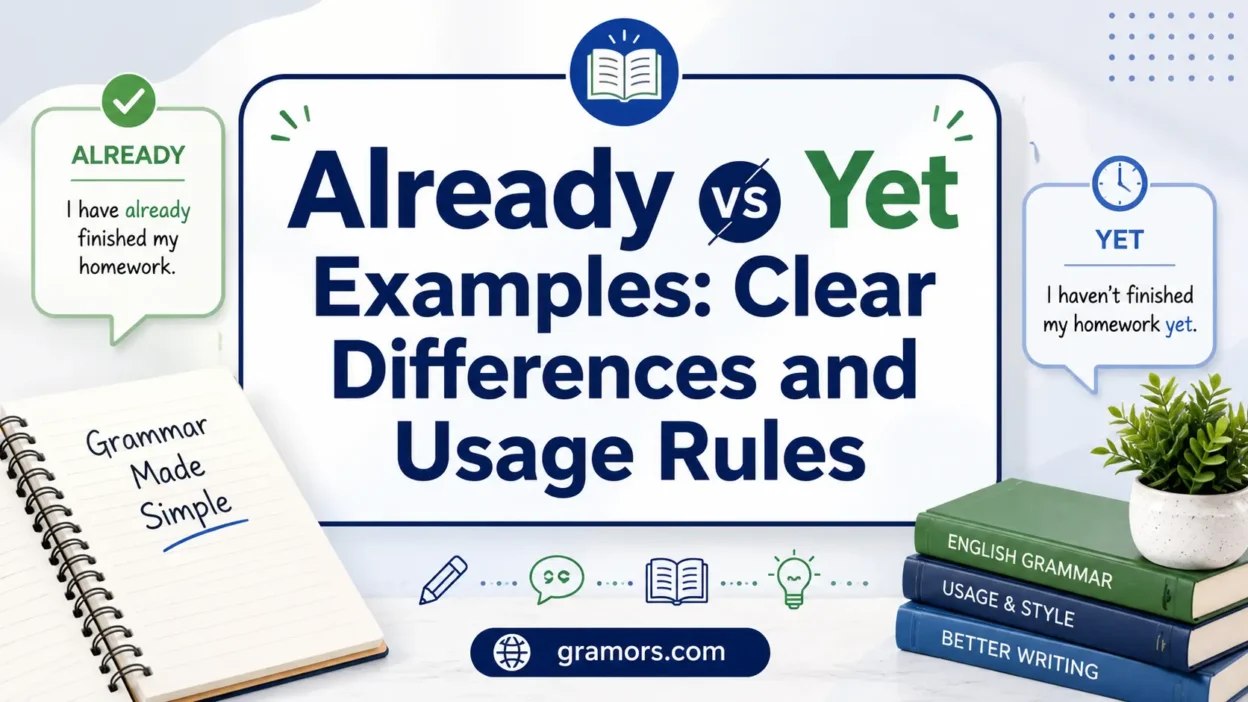
Already and yet both deal with time, completion, and expectation, which makes them easy to confuse. The main difference is not simply whether a sentence is positive or negative. It also depends on how the speaker views the event.
Already usually looks back at something that happened before now or before another reference time:
- I’ve already finished.
- I already ate.
Yet commonly asks whether something has happened up to now or says that it has not happened:
- I haven’t finished yet.
- Did you eat yet?
Both perfect and simple-past patterns are natural in American English. The most useful distinction is therefore based on completion and expectation rather than tense alone.
2. Quick Answer
Use already when something happened before now or before another reference point, sometimes earlier than expected:
- She has already called.
Use yet when asking whether an expected event has happened or saying that it has not happened up to now:
- Has she called yet?
- She hasn’t called yet.
Both words can appear in questions:
- Has she already called?
This question may suggest that the speaker thinks the call happened surprisingly early.
3. Why People Confuse Them
Already and yet often appear in sentences about recent events and completion.
Learners frequently see patterns such as:
- Have you finished yet?
- Have you already finished?
The real-world event is the same: finishing something. What changes is the speaker’s viewpoint.
“Have you finished yet?” usually checks completion neutrally.
“Have you already finished?” often suggests that the speaker thinks completion may have happened sooner than expected.
The words also appear with similar tenses, especially in instructional examples using the present perfect. However, sentence type and tense do not automatically determine the correct choice.
American conversation commonly uses:
- Did you finish yet?
- Did you already finish?
Both are natural, but the expectation differs.
4. Key Differences At A Glance
| Feature | Already | Yet |
|---|---|---|
| Basic meaning | Before now or before a reference time | Up to now or up to a reference time |
| Typical sentence type | Often affirmative; also questions and some negatives | Common in questions and negatives |
| Main viewpoint | Prior completion or established situation | Completion checked or still unrealized |
| Common position | Before main verb; after be in many structures | Often near the end of the clause |
| Question nuance | May suggest expectation, confirmation, or surprise | Often neutral completion check |
| Present perfect | Common | Common |
| U.S. simple past | Natural | Natural |
| Main role | Adverb | Adverb in this comparison |
| Context | Best Choice | Why |
|---|---|---|
| Event has happened | already | Prior completion is the focus. |
| Event has not happened | yet | Non-completion up to now is the focus. |
| Neutral completion question | yet | It checks whether the event has occurred. |
| Early-completion surprise | already | It can signal “so soon?” |
| U.S. completed action | already | “I already sent it” is natural. |
| U.S. completion question | yet | “Did you send it yet?” is natural. |
5. Meaning and Usage Difference
Already and prior completion
Already looks backward from a reference point.
- The train has already left.
- By noon, she had already finished.
- I already sent the email.
In each sentence, the event occurred before the relevant time.
Already can also imply earlier-than-expected timing:
- You’re home already?
The speaker may have expected the person to arrive later.
That implication is common, but it is not required:
- I’ve already completed the form.
This may simply report completion.
Yet and non-completion
Temporal yet looks at the period up to the relevant time.
In negative sentences:
- The train hasn’t left yet.
- She hadn’t finished yet.
- I haven’t received a reply yet.
The event has not occurred up to that point.
Yet in questions
Yet commonly appears in neutral questions about expected completion:
- Has the train left yet?
- Did Maya call yet?
- Are they here yet?
The speaker is checking whether something expected has happened.
Already in questions
Already can also appear naturally in questions:
- Has the train already left?
- Did you already submit the form?
- Are they here already?
These questions may express surprise, confirmation, or an expectation that the event may have occurred earlier than anticipated.
Compare:
- Has the train left yet?
Neutral completion check. - Has the train already left?
Possible reaction to an unexpectedly early departure.
Parts of speech
Already is an adverb.
Yet is also an adverb in the main time comparison:
- I haven’t finished yet.
Yet has other grammatical uses, including a conjunction:
- The task was difficult, yet worthwhile.
That separate meaning should not be mixed with temporal yet.
6. Tone, Context, and Formality
Already and yet are both standard, neutral words in ordinary American English.
Yet often sounds neutral in information-seeking questions:
- Have you finished yet?
Already can add a stronger speaker attitude:
- You’ve finished already?
Depending on context and intonation, already may express:
- surprise
- impatience
- confirmation
- earlier-than-expected timing
However, not every sentence with already contains surprise.
For example:
- I’ve already sent the file.
This can be a simple factual statement.
Yet in negatives often carries an idea of waiting or expectation:
- They haven’t answered yet.
The statement commonly leaves open the possibility of a later answer.
American conversation frequently uses the simple past:
- Did she call yet?
- Did you already submit it?
- I already ate.
Present-perfect versions remain completely natural:
- Has she called yet?
- Have you already submitted it?
- I’ve already eaten.
The tense choice and the already-versus-yet choice should be treated separately.
7. Which One Should You Use?
Start by asking whether the event has happened.
If yes, and prior completion is the focus, usually choose already:
- I’ve already booked the hotel.
- I already paid.
If the event has not happened and remains expected, usually choose yet:
- I haven’t booked the hotel yet.
- I haven’t paid yet.
If you are neutrally asking whether something has happened, yet is usually natural:
- Have you booked the hotel yet?
- Did you pay yet?
If you are asking because you think the event may have happened surprisingly early, choose already:
- Have you already booked the hotel? That was fast.
- You already finished?
American English can express the same contrast with different tense choices:
- I’ve already booked it.
- I already booked it.
- Have you booked it yet?
- Did you book it yet?
The adverb choice depends primarily on meaning and expectation.
8. When One Choice Sounds Wrong
For an ordinary completed-event statement, already is natural:
- Natural: I’ve already paid.
- Wrong for that intended temporal meaning: I’ve paid yet.
Temporal yet does not normally mark straightforward completed action in this structure.
For ordinary non-completion, use yet:
- Natural: I haven’t paid yet.
Compare:
- I haven’t already paid.
This can be grammatical, but it usually carries a different implication. Perhaps someone is checking whether payment happened earlier than expected.
Yet also has valid uses outside the basic negative/question pattern:
- That was the best result yet.
- Things may yet improve.
- It was difficult, yet worthwhile.
These sentences do not make ordinary “I’ve paid yet” correct for completed-action meaning. They simply show that yet has additional uses.
9. Common Mistakes
Using yet for an ordinary completed action
- Incorrect for the intended meaning: I finished yet.
- Natural: I already finished.
Already shows that completion occurred before now.
Assuming already cannot appear in questions
Already is completely natural in questions:
- Did you already call?
- Have you already finished?
It often changes the speaker’s expectation.
Automatically using already in every positive sentence
A positive-looking sentence can contain yet in another valid sense:
- This is our best result yet.
- Things may yet improve.
Choose according to meaning, not just sentence polarity.
Automatically using yet in every question
Compare:
- Did you call yet?
Neutral check. - Did you already call?
Often confirmation or surprise.
Both are correct.
Placing yet unnaturally
In ordinary temporal questions and negatives, yet commonly appears near the end:
- Natural: I haven’t heard from her yet.
- Natural: Did she answer yet?
Assuming both require the present perfect
American English naturally uses the simple past:
- Did you eat yet?
- I already ate.
Present-perfect alternatives are also standard:
- Have you eaten yet?
- I’ve already eaten.
Confusing temporal yet with conjunction yet
- I haven’t finished yet.
Time adverb. - It was difficult, yet useful.
Conjunction expressing contrast.
These uses should be kept separate.
10. Everyday Examples
Work
- I already sent the email.
- I haven’t sent the email yet.
- Did you send the report yet?
- Did you already send it? I thought the deadline was tomorrow.
School
- Maya has already submitted the assignment.
- Maya hasn’t submitted it yet.
- Have you started studying yet?
- You’ve already finished the chapter?
Food
- She already ate.
- She hasn’t eaten yet.
- Did you eat yet?
- You already ate? Dinner is in twenty minutes.
Travel
- We’ve already booked our tickets.
- We haven’t booked our tickets yet.
- Has the flight boarded yet?
- Has the flight already boarded?
Messages and email
- I already replied.
- I haven’t replied yet.
- Did Maya text you yet?
- Did Maya already text you?
Shopping
- I’ve already ordered the shoes.
- I haven’t ordered them yet.
- Did the package arrive yet?
- Did the package already arrive? That was quick.
Appointments
- I’ve already scheduled the appointment.
- I haven’t scheduled it yet.
- Is the doctor here yet?
- Is the doctor here already?
Household situations
- They had already left when we arrived.
- They hadn’t left yet when I called.
- Is dinner ready yet?
- Dinner is ready already?
American conversational forms
- I already did it.
- Did you do it yet?
- I already told him.
- Did he answer yet?
11. Dictionary-Style Word Details
Already is primarily an adverb. Yet is also an adverb in the central comparison, with additional uses outside the main time meaning.
Verb
Already
Already is not commonly used as a verb in standard modern English.
Yet
Yet is not commonly used as a verb.
Neither word should be given invented verb forms.
Noun
Already
Already is not ordinarily used as a noun in standard modern English.
Yet
Yet is also not ordinarily a noun in the target usage.
Quoting either word as a word does not make it a regular lexical noun.
Synonyms
Already, depending on context:
- previously
- before now
- by now
- by then
- earlier
These are closest plain alternatives rather than universal replacements.
Yet, in the temporal sense:
- so far
- up to now
- as yet
In its separate contrastive use, alternatives may include:
- but
- however
- nevertheless
The correct substitute depends on the particular sense.
Example Sentences
Already
- I’ve already seen it.
- Did you already pay?
- They had already left.
- By then, she will already know.
- I already told him.
Yet
- I haven’t seen it yet.
- Did you pay yet?
- Things may yet improve.
- It was simple, yet effective.
The first two examples use temporal yet. The final two illustrate other established senses.
Word History
Already developed from Middle English al redy, historically connected with words meaning all and ready. Its use as an adverb has a long history.
Yet comes through Middle English from Old English gīet. Its adverbial history is older than its later conjunction use.
These origins do not directly determine the modern distinction.
Phrases Containing
Already
- enough already: a request for something to stop
- already there: present before the reference time
- already done: completed beforehand
- already know: possess the information beforehand
Some of these are common combinations rather than fixed idioms.
Yet
- not yet: not up to now
- as yet: until now
- yet again: once again
- have yet to: have not done something up to this point
- the best is yet to come: the best part remains in the future
- best yet: the best up to the current point
These expressions demonstrate several established uses of yet.
12. FAQ
What is the main difference between already and yet?
Already usually points to something that happened before now or before another reference time. Yet usually checks whether something has happened or says it has not happened up to that point.
- I’ve already finished.
- I haven’t finished yet.
Can already be used in questions?
Yes.
- Have you already finished?
It may express confirmation, expectation, or surprise at early completion.
Can yet be used in positive sentences?
Yes, in additional established senses.
- That was the best result yet.
- Things may yet improve.
These differ from the ordinary temporal question/negative use.
Is “Did you eat yet?” correct in American English?
Yes. It is natural conversational American English.
- Did you eat yet?
“Have you eaten yet?” is also standard.
Is “I already ate” correct?
Yes.
- I already ate.
“I’ve already eaten” is also completely natural.
Do already and yet always require the present perfect?
No. Both can appear with other tense structures.
- I already ate.
- Did you eat yet?
- They had already left.
- She hadn’t arrived yet.
What is the difference between “Have you already finished?” and “Have you finished yet?”
“Have you finished yet?” usually checks completion neutrally.
“Have you already finished?” often suggests the speaker thinks finishing may have happened surprisingly early.
13. Conclusion
Already normally points to prior completion or to something established before the reference time. Temporal yet normally focuses on whether something has happened up to that point.
Questions show the contrast especially clearly, and natural American English allows both perfect and simple-past patterns.
Remember:
- I already finished.
- I haven’t finished yet.
And in questions:
- Did you already finish?
- Did you finish yet?
The best choice depends on completion and speaker expectation, not simply whether the sentence looks positive or negative.