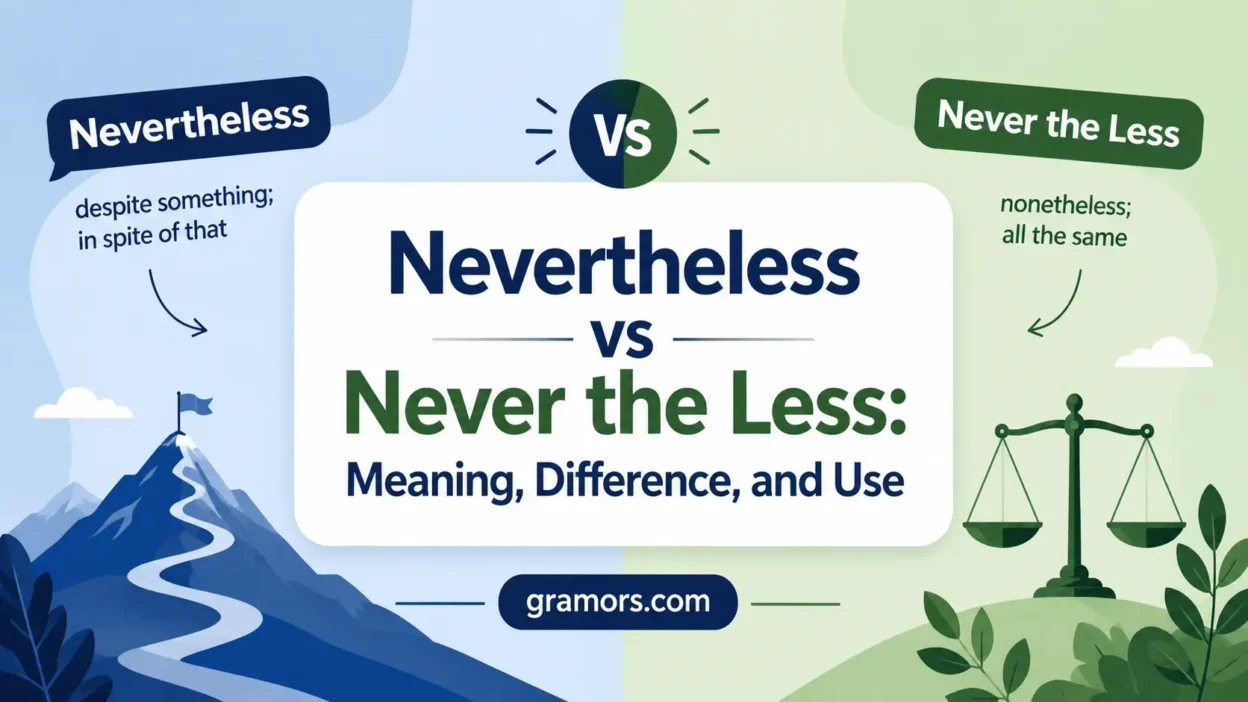
Many writers wonder whether they should use nevertheless or never the less. The confusion is understandable because the standard form looks like three separate words joined together.
For example:
The plan was risky; nevertheless, it worked.
At first glance, it may seem that never the less means the same thing. However, modern English strongly favors the one-word form.
Understanding the difference will help you avoid a spelling choice that may distract readers.
Quick Answer
Use nevertheless in almost all modern writing.
Example:
She was tired; nevertheless, she finished the project.
The form never the less is rare and usually looks incorrect to modern readers.
If you are writing an essay, article, email, report, or business message, nevertheless is the recommended choice.
Why People Confuse Them
People often confuse these forms because nevertheless appears to be built from three separate words:
never + the + less
As a result, some writers assume they can simply separate the words and write never the less.
Historically, the compound developed from those individual elements. Today, however, standard English treats nevertheless as a single word.
That is why most dictionaries and style references list the one-word spelling as the normal form.
Key Differences At A Glance
| Context | Best Choice | Why |
|---|---|---|
| Modern writing | Nevertheless | Standard spelling |
| Academic papers | Nevertheless | Expected by readers |
| Business emails | Nevertheless | Professional and clear |
| Everyday writing | Nevertheless | Most common form |
| Historical quotations | Never the less | May appear in original wording |
| General recommendation | Nevertheless | Safe default choice |
Meaning and Usage Difference
Nevertheless means in spite of that, even so, or however.
It introduces a contrast between two ideas.
Beginning of a sentence:
Nevertheless, the team continued working.
Middle of a sentence:
The team, nevertheless, continued working.
End of a sentence:
The team continued working nevertheless.
The separated form never the less is generally understood to express the same contrast idea. However, modern readers usually view it as a spelling issue rather than a meaningful alternative.
There is no important meaning difference between the two forms in modern usage.
Tone, Context, and Formality
Nevertheless often sounds polished, thoughtful, and slightly formal.
Because of that, it appears frequently in:
- academic writing
- business communication
- reports
- articles
- professional emails
Example:
The proposal faced criticism; nevertheless, it was approved.
By contrast, never the less looks unusual in modern writing. Many readers may assume it is a mistake rather than a deliberate choice.
For that reason, it is rarely the best option in professional communication.
Which One Should You Use?
Choose nevertheless for nearly every situation.
It works well in:
- essays
- articles
- workplace writing
- school assignments
- emails
- formal discussions
Examples:
The forecast predicted rain. Nevertheless, the event continued.
The budget was limited. Nevertheless, the project succeeded.
You can often replace however with nevertheless when you want a stronger sense of contrast.
Use never the less only when preserving historical wording or quoting a source exactly.
When One Choice Sounds Wrong
In modern writing, never the less often looks like a spelling error.
Example:
Never the less, we continued.
Most readers expect:
Nevertheless, we continued.
That does not mean the separated form is impossible in every context. A quotation or historical text may contain it.
Still, outside those situations, the one-word form is almost always the better choice.
Common Mistakes
Mistake:
Never the less, the plan succeeded.
Fix:
Nevertheless, the plan succeeded.
Mistake:
The results improved nevertheless, we remained cautious.
Fix:
The results improved; nevertheless, we remained cautious.
Mistake:
Using nevertheless in every paragraph.
Fix:
Alternate with words such as however, still, or even so when appropriate.
Mistake:
Confusing nevertheless with nonetheless.
Fix:
Both are correct and similar, but use one consistently within a passage.
Everyday Examples
The weather was cold; nevertheless, the game continued.
She missed the bus; nevertheless, she arrived on time.
The assignment was difficult; nevertheless, the students completed it.
The company faced challenges; nevertheless, sales increased.
The restaurant was crowded; nevertheless, service remained fast.
The trip was expensive; nevertheless, it was worth it.
The team lost several players; nevertheless, it won the championship.
The report was lengthy; nevertheless, everyone read it.
The road was closed; nevertheless, traffic moved smoothly nearby.
He was nervous; nevertheless, he gave an excellent presentation.
Dictionary-Style Word Details
Verb
Nevertheless: Not a verb.
Never the Less: Not a verb.
Noun
Nevertheless: Not a noun.
Never the Less: Not a noun.
Synonyms
Nevertheless:
- however
- nonetheless
- still
- yet
- even so
Never the Less:
When intended as the separated version of the compound, it carries the same basic meaning. However, it is not recommended as the normal modern spelling.
Example Sentences
Nevertheless:
The evidence was limited; nevertheless, the researchers continued.
The task was difficult; nevertheless, she succeeded.
Never the Less:
Never the less, the meeting continued.
This sentence is understandable, but most readers would expect the one-word spelling.
Word History
Nevertheless:
The word developed from older English forms combining the ideas of never, the, and less. Over time, it became established as a single compound word.
Never the Less:
This spelling reflects the separate words that originally contributed to the compound form. Today, it is uncommon in standard writing.
Phrases Containing
Nevertheless:
- but nevertheless
- nevertheless true
- nevertheless important
Never the Less:
There is no common modern phrase set built around the separated form.
FAQs
Is never the less correct?
It may appear in historical or quoted material, but it is not the preferred modern spelling.
Is nevertheless one word?
Yes. Modern English treats nevertheless as a single word.
Is nevertheless formal?
It can sound slightly formal, but it is widely accepted in both professional and everyday writing.
Can I use nevertheless in an email?
Yes. It works well in business and personal emails.
Is nevertheless the same as however?
They are similar. Nevertheless often creates a slightly stronger contrast.
Should I ever use never the less?
Only when preserving original wording or discussing historical usage.
Conclusion
The practical rule is simple: use nevertheless in modern writing.
While never the less may occasionally appear in quotations or older material, it is not the standard choice today.
A safe final example is:
The project faced several obstacles; nevertheless, it succeeded.
When in doubt, choose the one-word form and write with confidence.