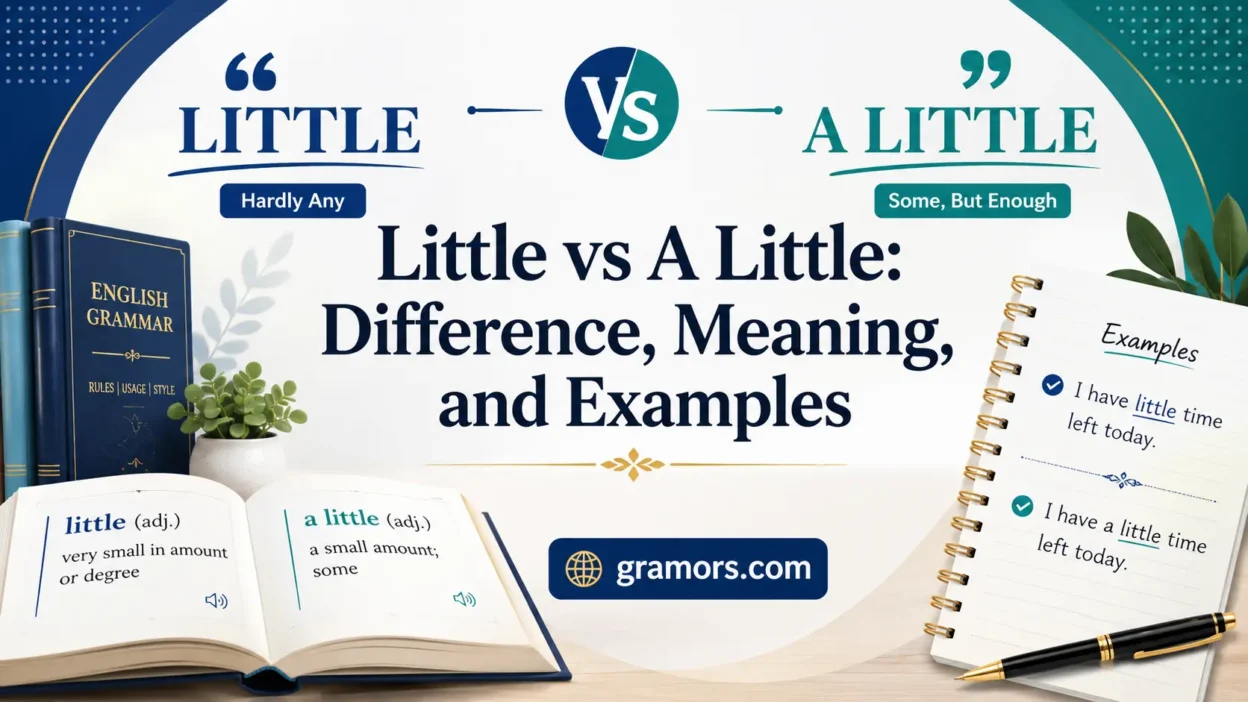
Little and a little are both correct English expressions, but adding a can significantly change the speaker’s perspective.
Compare:
“We have little time.”
“We have a little time.”
Both sentences describe a small amount of time. However, little emphasizes that the amount is limited or that there is not much. A little emphasizes that some amount exists.
The same contrast appears here:
“There is little hope.”
“There is a little hope.”
The first sounds more scarcity-focused. The second highlights that some hope remains.
In this comparison, both forms mainly relate to small quantities of uncountable nouns. However, little also has other meanings, such as describing something as small, so context matters.
Quick Answer
Use little when you want to emphasize not much or a very limited amount:
“I have little money left.”
Use a little when you mean some or a small amount:
“I have a little money left.”
Both normally work with uncountable nouns in this quantity sense, but they are not freely interchangeable.
Why People Confuse Them
The two expressions look almost identical and both involve small quantities.
Compare:
“little water”
“a little water”
“little patience”
“a little patience”
Adding a changes how the quantity is presented.
“Little patience” emphasizes that patience is scarce.
“A little patience” means some patience exists.
Another source of confusion is that little has meanings outside this quantity comparison.
Consider:
“a little house”
Here, little describes the house as small. The structure is different from:
“a little water”
Here, a little functions as a quantity expression meaning a small amount of water.
There is also an adverbial use:
“I’m a little tired.”
Here, a little means roughly “slightly.”
So the rule is not simply that adding a turns a negative word into a positive one. The grammatical structure and intended meaning must also be considered.
Key Differences At A Glance
| Feature | Little | A Little |
|---|---|---|
| Core quantity meaning | Not much / very small amount | Some / a small amount |
| Typical perspective | Scarcity or limitation | Existence of some amount |
| Main noun type | Uncountable nouns in quantifier use | Uncountable nouns in quantifier use |
| Standalone use | Possible, sometimes more formal or marked | Common when the noun is understood |
| Degree use | Limited or structurally different | Common: “a little tired” |
| Other roles | Can describe something as small | Multiword quantity or degree expression |
| Fixed amount | No | No |
| Example | “We have little time.” | “We have a little time.” |
The safest distinction is:
Little focuses on how limited the amount is.
A little focuses on the fact that some amount exists.
Neither expression has a fixed numerical value.
Meaning and Usage Difference
Little: “Not Much”
In its quantity sense, little means not much or a very small amount.
It often foregrounds scarcity, limitation, or a lower amount than expected or desired.
“She has little confidence.”
“We made little progress.”
“There is little chance of rain.”
“Little information is available.”
These sentences do not mean there is absolutely none. Instead, they emphasize that the amount is small.
A Little: “Some”
A little means some or a small amount.
It presents the quantity as existing rather than focusing mainly on its scarcity.
“She has a little confidence.”
“We made a little progress.”
“There is a little chance of rain.”
“We have a little information.”
Compare:
“She has little confidence.”
The speaker emphasizes that her confidence is very limited.
“She has a little confidence.”
The speaker emphasizes that some confidence exists.
Another Important Contrast
“We have little time.”
This suggests urgency because time is very limited.
“We have a little time.”
This tells us that some time is available.
The second sentence does not automatically mean there is enough time. Context determines whether the amount is sufficient.
Standalone Use
Both forms can appear without an expressed noun when the meaning is understood.
“Do you know French?”
“A little.”
Here, a little means a small amount of French.
Bare little can also stand independently:
“Much was promised, but little was delivered.”
This use may sound more formal or literary depending on context.
Little as an Adjective
Not every use of little refers to quantity.
“They live in a little house.”
Here, little describes the house as small.
That is different from:
“They have a little money.”
Here, a little expresses quantity.
Grammar references may classify little differently depending on the construction—as a determiner, quantifier, adjective, pronoun-like form, or other category. For practical use, the important point is to identify which meaning is intended.
Tone, Context, and Formality
The choice can affect tone because little and a little frame the quantity differently.
Little
Bare little often sounds restrictive or scarcity-focused:
“Little is known about the cause.”
“She showed little interest.”
“We have little time.”
In some affirmative constructions, bare little can sound somewhat formal or emphatic.
For example:
“Little is known about the long-term effects.”
This fits naturally in formal or analytical writing.
However, little is not limited to formal English.
A Little
A little is extremely common in everyday conversation:
“I know a little about the subject.”
“I need a little help.”
“We have a little time.”
It also works naturally as a degree modifier:
“I’m a little worried.”
“Could you speak a little slower?”
“Let’s leave a little later.”
In casual English, a little bit may also appear:
“I’m a little bit tired.”
This is often close in meaning to:
“I’m a little tired.”
The distinction between little and a little is not a US-versus-UK rule. Context, grammatical structure, and speaker attitude matter more.
Which One Should You Use?
Start with the meaning you want.
Do You Mean “Not Much” or “Less Than Desired”?
Use little:
“We have little time before the deadline.”
“She showed little interest in the proposal.”
“There is little hope of finishing today.”
The focus is on limitation.
Do You Mean “Some Amount Exists”?
Use a little:
“We have a little time before the meeting.”
“She showed a little interest in the proposal.”
“There is a little hope.”
The focus is on the existence of some amount.
Is the Following Noun Uncountable?
Both forms commonly work with uncountable nouns in this comparison:
“little money”
“a little money”
“little information”
“a little information”
“little patience”
“a little patience”
Are You Modifying an Adjective or Adverb?
Use a little:
“I’m a little uncomfortable.”
“She seems a little nervous.”
“Drive a little slower.”
Does “Little” Mean Physically Small?
Then the quantity comparison does not apply:
“They adopted a little dog.”
Here, little describes the dog as small.
A useful decision rule is:
Not much / scarcity → little
Some amount exists → a little
When One Choice Sounds Wrong
Some substitutions change the intended meaning, while others create an incorrect quantity structure.
Degree Modification
Natural:
“I’m a little tired.”
Bare little does not normally work the same way:
“I’m little tired.”
That is not standard for the intended meaning.
Plural Count Nouns
In the target quantity sense, use few/a few, not little/a little, with plural count nouns.
Incorrect:
“little books” when you mean “not many books”
Correct:
“few books”
Incorrect:
“a little books”
Correct:
“a few books”
However, little books can be grammatical if little means physically small:
“She collects little books.”
Here, the books themselves are small.
Meaning Changes When Both Are Grammatical
“We have little food.”
Food is very limited.
“We have a little food.”
Some food is available.
Both sentences are grammatical, but the speaker’s perspective changes.
“A Little” Before an Adjective Noun
Consider:
“a little girl”
This does not mean “a small amount of girl.”
Here, a is the article before the singular noun phrase little girl, and little describes the girl.
That structure is different from:
“a little water”
where a little expresses quantity.
Common Mistakes
Mistake: Treating “little” and “a little” as exact synonyms
They both involve small quantities, but the emphasis differs.
Compare:
“I have little time, so hurry.”
“I have a little time, so we can talk.”
Mistake: Assuming “a little” always means enough
Incorrect rule:
“A little means there is enough.”
Better:
A little means some amount exists. Whether it is enough depends on context.
“We have a little money, but not enough to buy the car.”
Mistake: Using Them With Plural Count Nouns
Incorrect:
“I have a little questions.”
Correct:
“I have a few questions.”
Incorrect for “not many”:
“Little people attended.”
Correct:
“Few people attended.”
Mistake: Confusing Quantity With Physical Size
“They live in a little apartment.”
Here, little describes the apartment as small.
“We have a little space.”
Here, a little expresses a small amount of space.
Mistake: Overlooking Adverbial “A Little”
Correct:
“She is a little tired.”
“Move a little closer.”
Here, a little expresses degree rather than directly quantifying a noun.
Mistake: Assuming “Little” Always Means Small Size
In:
“We have little information,”
little means not much, not physically small.
Everyday Examples
Work
“We have little time before the deadline.”
Time is severely limited.
“We have a little time before the meeting.”
Some time is available.
“The project made little progress this week.”
Progress was very limited.
“The project made a little progress this week.”
Some progress occurred.
School
“She showed little interest in the assignment.”
Her interest was minimal.
“She showed a little interest in the assignment.”
Some interest was visible.
“Students received little guidance.”
The guidance was limited.
“Students received a little guidance.”
They received some guidance.
Money
“I have little money left.”
Not much money remains.
“I have a little money left.”
Some money remains.
“They had little financial support.”
Support was scarce.
“They received a little financial support.”
Some support was provided.
Food
“There’s little milk left.”
The supply is nearly exhausted.
“There’s a little milk left.”
Some milk remains.
“Add a little sugar.”
Add a small amount.
Time
“We have little time to decide.”
The decision is urgent.
“We have a little time to decide.”
Some time remains.
Emotions
“She showed little enthusiasm.”
Her enthusiasm was limited.
“She showed a little enthusiasm.”
Some enthusiasm was present.
“I’m a little nervous.”
Here, a little means slightly.
Health and Daily Conversation
“I’m feeling a little better today.”
“Drink a little water.”
“He showed little improvement overnight.”
“There was a little improvement this morning.”
Knowledge and Skill
“I know little about the subject.”
My knowledge is limited.
- “I know a little about the subject.”
- I have some knowledge.
- “I speak a little Spanish.”
This means the speaker knows a small amount of Spanish.
Dictionary-Style Word Details
Verb
Little
This category does not normally apply in standard modern English for the target comparison.
Little is not functioning as a verb in:
“We have little time.”
A Little
This is also not a verb phrase in the target use.
In:
“We have a little time,”
the expression indicates quantity rather than an action.
Noun
Little
Dictionary and grammar classifications vary.
Certain independent uses may be described as noun-like or pronominal:
“Little is known.”
“Much was promised, but little was delivered.”
In the central comparison, however, little is most useful to learners as a quantity expression when it modifies an uncountable noun.
A Little
It can stand independently when the omitted noun or idea is understood:
“Do you speak Italian?”
“A little.”
This is best explained as an independent or pronoun-like quantity use rather than treating a little as an ordinary lexical noun.
Synonyms
For quantity little, closest alternatives include:
- not much
- hardly any, where the stronger meaning fits
- very little, depending on context
Example:
“There is little hope.”
“There is not much hope.”
For adjective little, the alternatives change:
- small
- tiny
Example:
“a little house” → “a small house”
Closest alternatives for a little include:
- some
- a small amount
- a bit, especially in degree uses
- slightly, in some adverbial contexts
Examples:
“I need a little help.”
“I need some help.”
“I’m a little tired.”
“I’m slightly tired.”
These alternatives are context-dependent rather than exact synonyms in every sentence.
Example Sentences
Little
“We have little time left.”
Quantity: not much time.
“She showed little interest.”
Quantity/degree of interest is limited.
“Little is known about the problem.”
Independent quantity-like use.
“They found a little café.”
Here, little is an adjective describing the café as small.
A Little
“We have a little time.”
Some time exists.
“Add a little sugar.”
A small amount of sugar.
“I know a little about gardening.”
Some knowledge.
“I’m a little tired.”
Degree meaning: slightly tired.
Word History
Little is an old English word with roots going back to Old English and related Germanic forms.
Its long history includes meanings connected with small size, small amount, and limited degree.
A little does not need a separate independent origin story. It is a grammatical combination built around the old word little.
The modern contrast between little and a little is best understood through current grammar and usage rather than through a speculative historical explanation.
Phrases Containing
Common constructions with little include:
- little by little
- very little
- too little
- so little
- as little as
- little or no
- little is known
Examples:
“We improved little by little.”
“Very little time remains.”
“They received too little support.”
“There is little or no evidence.”
Common constructions with a little include:
- a little bit
- a little more
- a little less
- a little of
- just a little
- only a little
- a little while
Examples:
“Add a little more water.”
“Wait a little while.”
“I need just a little help.”
These constructions can change emphasis, but the basic contrast remains useful.
FAQs
What is the main difference between “little” and “a little”?
Little emphasizes that there is not much of something. A little emphasizes that some amount exists.
“Little hope remains” sounds scarcity-focused.
“A little hope remains” emphasizes that some hope still exists.
Does “a little” always mean enough?
No. It means some or a small amount. Whether that amount is sufficient depends on context:
“We have a little money, but not enough for the trip.”
Are “little” and “a little” used with countable nouns?
In the target quantity sense, they normally go with uncountable nouns:
“little time”
“a little water”
For plural count nouns, use few/a few:
“few books”
“a few books”
Can “little” and “a little” be used without a noun?
Yes, when the meaning is understood.
“Do you know French?”
“A little.”
Bare little can also stand independently, although some uses sound more formal:
“Little is known about the cause.”
Why does adding “a” change the meaning?
The established English constructions frame the quantity differently. Little highlights how limited the amount is, while a little presents a small amount as existing. This is a grammatical and semantic distinction, not simply a spelling change.
Is “a little tired” correct?
Yes. Here, a little modifies the degree of tired and means approximately “slightly”:
“I’m a little tired.”
This is different from the noun-quantity pattern in “a little water.”
Conclusion
Both little and a little are correct, but they normally frame a small quantity differently.
Use little when emphasizing that not much exists:
“We have little time.”
Time is very limited.
Use a little when emphasizing that some amount exists:
“We have a little time.”
Some time is available.
Remember that a little does not automatically mean “enough,” and little also has adjective uses outside this quantity comparison.
The most reliable memory rule is: little focuses on how limited the amount is; a little focuses on the fact that some amount exists.