People often mix up watch and look because both involve using your eyes. The confusion comes from the fact that they describe similar actions, but they don’t mean the same thing.
In the phrase watch vs look, the real difference is about time and attention. One focuses on short, directed attention. The other focuses on longer, ongoing attention.
For example:
- “I looked at him.”
- “I watched him.”
Both are correct, but they describe different situations.
2. Quick Answer
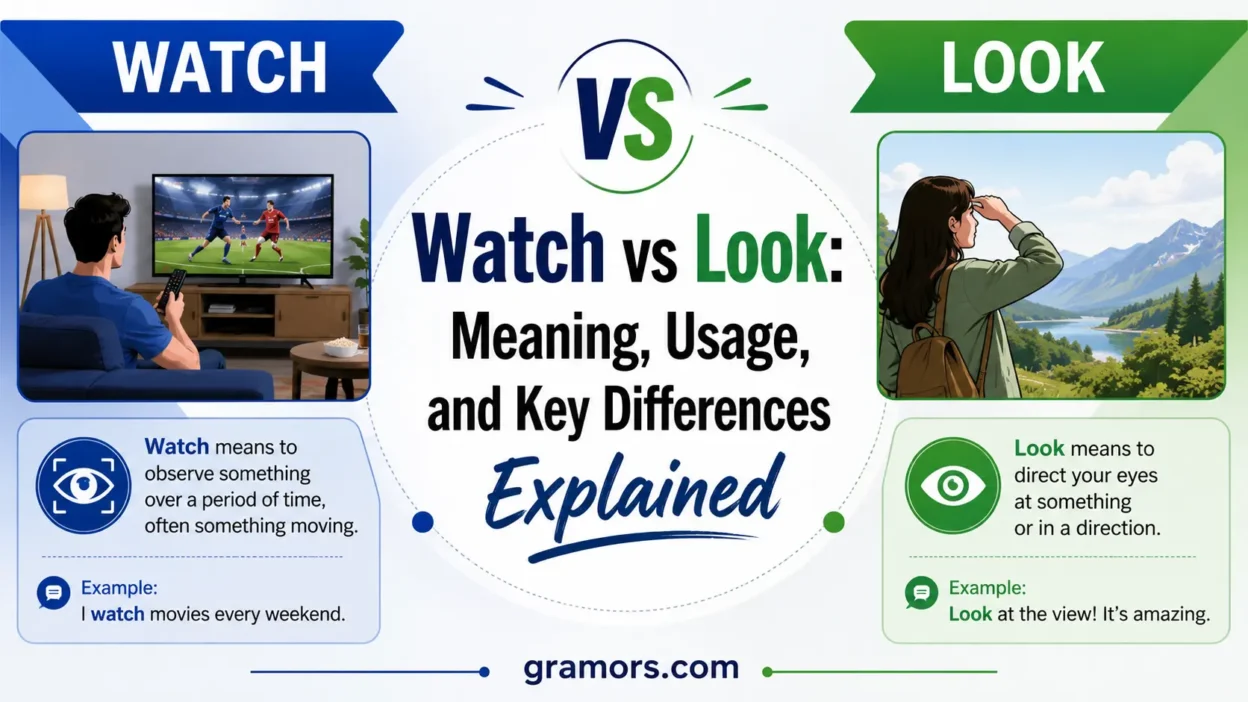
Look means you direct your eyes toward something. It is usually short and intentional.
Watch means you keep your eyes on something for a period of time, especially when it is moving or changing.
- “Look at the sky.”
- “Watch a movie.”
They are not fully interchangeable because the meaning changes with time and attention.
3. Why People Confuse Them
The confusion happens because both verbs involve vision. In many languages, there is only one general verb for seeing something, so learners transfer that idea into English.
Another reason is that both words can appear in similar sentences:
- “Look at the TV.”
- “Watch TV.”
The difference is subtle but important.
4. Key Differences At A Glance
| Context | Best Choice | Why |
|---|---|---|
| Seeing something briefly | Look | Focused, short attention |
| Following action over time | Watch | Continuous attention |
| TV, movies, sports | Watch | Ongoing activity |
| Directing someone’s gaze | Look | Immediate direction |
5. Meaning and Usage Difference
Look is about directing your eyes toward something. It does not require something to happen over time.
Examples:
- “Look at that car.”
- “She looked at the board.”
Watch is about observing something as it happens. It usually involves movement or change.
Examples:
- “We watched the game.”
- “He watched the children play.”
A simple way to think about it:
look = point your eyes
watch = keep your eyes there
6. Tone, Context, and Formality
Look is often used in direct instructions:
- “Look here.”
- “Look at me.”
Watch is often used for activities or responsibility:
- “Watch the video.”
- “Watch the baby.”
In casual American English, both are common, but watch feels more “ongoing,” while look feels more immediate.
7. Which One Should You Use?
Use look when you want someone to direct attention quickly.
Use watch when something continues over time.
Quick guide:
- Need attention now → look
- Need attention over time → watch
Examples:
- “Look at this message.”
- “Watch this tutorial.”
8. When One Choice Sounds Wrong
Some combinations sound unnatural because the attention type doesn’t match the verb.
Incorrect:
- “Look TV.”
- “Watch at me.”
Correct:
- “Watch TV.”
- “Look at me.”
The mistake usually happens when learners mix direction and duration.
9. Common Mistakes (and Quick Fixes)
Mistake → Fix
- “Look movie” → “Watch a movie”
- “Watch at me” → “Look at me”
- “I am looking TV” → “I am watching TV”
A simple fix is to remember:
- look usually needs “at”
- watch does not
10. Everyday Examples
- “Look at the board.”
- “Watch the game tonight.”
- “I looked outside.”
- “She is watching a show.”
- “Look here for a second.”
- “We watched the fireworks.”
- “Look at your phone.”
- “He watched the traffic.”
- “Look at this picture.”
- “They watched the movie together.”
- “Look at that bird!”
- “I’m watching a tutorial.”
- “Look where you’re going.”
- “She watched him leave.”
11. Dictionary-Style Word Details
Verb
- watch: observing something over time or with ongoing attention
- look: directing your eyes toward something
Noun
- watch: also used as a noun (a wristwatch; or an act of watching)
- look: refers to appearance or expression (“a strange look”)
Synonyms
- watch: observe, monitor (closest alternatives)
- look: glance, gaze (context-dependent alternatives)
Example Sentences
- watch: “I watched the sunset.”
- look: “She looked at the sky.”
Word History
- watch: comes from Old English words linked to guarding and observing
- look: comes from Old English roots related to sight and appearance
Phrases Containing
- watch: watch out, watch over, watch TV
- look: look at, look for, look up, look after
12. FAQ
Can I use watch and look the same way?
No. They often change meaning depending on time and attention.
Can I say “look TV”?
No. You must say “watch TV.”
Can I say “watch at me”?
No. The correct form is “look at me.”
Is look always short and watch always long?
Usually yes, but context can slightly change meaning.
13. Conclusion
The difference between watch and look is mainly about attention.
- Look = directing your eyes
- Watch = following something over time
In watch vs look, choosing the right word depends on how long and how deeply you pay attention to what you see.